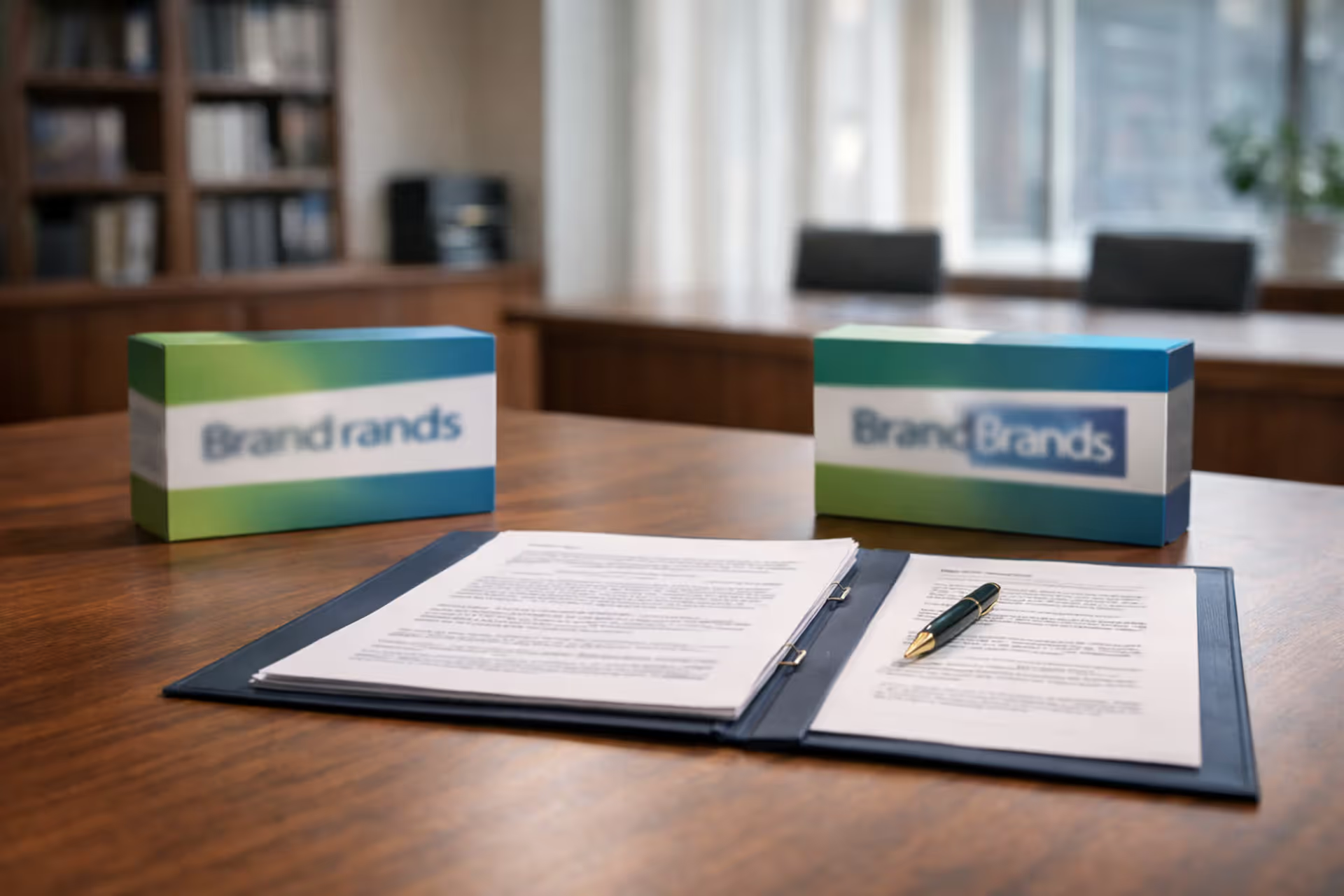
Corporate America bleeds millions annually fighting over logos, names, and brand identities. When one company's branding veers too close to another's protected marks, the resulting legal battles can bankrupt businesses overnight and erase years of marketing investment. These 12 real-world disputes show exactly where the legal lines get drawn—and why crossing them proves so expensive.
What Legally Counts as Trademark Infringement
Here's the central question courts ask: Would a reasonable shopper think two products come from the same company? That's the "likelihood of confusion" standard, and it doesn't require anyone to actually get confused. The mere possibility tips the scales.
Judges weigh several concrete factors when evaluating these claims. How recognizable is the original trademark? Coca-Cola enjoys far stronger protection than "Joe's Pizza" because everyone knows the Coke brand instantly. Visual and phonetic similarities matter tremendously—marks that look alike or sound similar face scrutiny even if they're spelled differently. The marketplace overlap counts too. Selling competing products in identical retail channels creates obvious problems, while operating in separate industries provides breathing room.
Who's buying also matters. Sophisticated B2B purchasers making careful decisions get confused less easily than impulse shoppers grabbing items off drugstore shelves. Courts consider whether the junior user deliberately copied the senior mark—intentional knockoffs face harsher consequences than coincidental similarities.
Geography used to provide natural separation. That Maine bakery called "Sweet Treats" never competed with California's "Sweet Treats" when both stayed regional. The internet obliterated those boundaries. Now both businesses occupy the same digital space, creating inevitable conflicts once either seeks federal registration.
High-Profile Brand Confusion Lawsuits Between Major Companies
Author: David Kessler;
Source: skeletonkeyorganizing.com
Apple vs. Apple Corps: When Two Apples Collide
The Beatles' record label Apple Corps and Apple Computer spent 26 years battling over their shared fruit logo. Their 1981 truce seemed simple enough: computers stayed with Apple Computer, music belonged to Apple Corps. Everyone signed, everyone went home happy.
Then Steve Jobs invented iTunes. Apple Corps immediately lawyered up in 2003. The record company insisted that selling digital music files violated the decades-old settlement's core terms. Apple Computer's defense? They merely provided the technology platform—the metal and silicon—while artists provided the actual music. A distinction without much difference, courts eventually found.
After burning through legal fees across three countries, Apple Inc. (as it had become) purchased complete ownership of all Apple trademarks in 2007. The price tag remains sealed, though estimates exceed $500 million. Apple then licensed the marks back to Apple Corps for managing the Beatles' catalog. The lesson? Technological convergence destroys even the most carefully negotiated coexistence deals.
Starbucks vs. Charbucks: Parody or Infringement?
Black Bear Micro Roastery thought they'd found a clever marketing angle: "Charbucks Blend" and "Mr. Charbucks" coffee, mocking Starbucks' tendency to over-roast beans into charcoal. Starbucks didn't find it funny and sued in 2001.
Black Bear claimed satirical commentary protection. They argued "Charbucks" legitimately criticized Starbucks' roasting methods through protected parody speech. The Second Circuit Appeals Court demolished this defense in 2007. Sure, parody gets First Amendment protection—for art, commentary, criticism. But commercial competitors hawking similar products can't hide behind humor while siphoning customers. The court determined Black Bear primarily wanted to exploit Starbucks' recognition, not make genuine social commentary.
Both sides settled confidentially afterward, but the ruling established firm boundaries: rival businesses selling comparable goods rarely win parody defenses, regardless of their satirical intentions.
A trademark is not a right in gross or at large.
— Justice Oliver Wendell Holmes, Jr.
Adidas vs. Payless: The Three-Stripe Battle
Payless ShoeSource made a catastrophic miscalculation. Starting in the late 1990s, they released over 300 shoe styles featuring two-stripe and four-stripe designs resembling Adidas' famous three stripes. Adidas filed suit in 2001, and the case dragged through discovery for seven years.
The 2008 jury verdict shocked everyone: $304 million for Adidas. Evidence showed Payless designers deliberately referenced Adidas styles when creating their budget alternatives. Internal documents proved they'd specifically aimed to capture Adidas' visual appeal without paying licensing fees. The court found this constituted willful infringement—knowing, intentional copying designed to confuse bargain-hunting consumers.
Payless filed bankruptcy partially because of this judgment. Eventually, the parties settled for approximately $65 million, still among the largest trademark awards ever. The precedent? Even modified versions of famous designs (switching from three to four stripes) infringe when the overall visual impression causes confusion.
Case Name
Year
Type of Infringement
Outcome/Settlement
Damages Awarded
Key Takeaway
Apple vs. Apple Corps
1981-2007
Brand overlap from industry convergence
Apple Inc. bought all trademark rights
Estimated $500M+ (undisclosed)
Technology evolution invalidates old coexistence deals
Starbucks vs. Charbucks
2001-2007
Failed parody defense by competitor
Confidential settlement favoring Starbucks
Undisclosed settlement
Direct competitors can't use humor to confuse buyers
Adidas vs. Payless
2001-2008
Intentional design copying
Jury verdict, later reduced in settlement
$65M final (from $304M verdict)
Even modified famous designs create infringement
Louis Vuitton vs. Haute Diggity Dog
2006-2007
Successful parody (dog toys)
Defendant victory on appeal
Zero—defendant won
True parody works when confusion is impossible
Tiffany vs. Costco
2013-2015
Using brand name as generic descriptor
Tiffany won on counterfeit theory
$19.4M total with punitive damages
Retailers cannot treat trademarks as product categories
Monster Energy vs. Rock Art Brewery
2014-2015
Overaggressive enforcement attempt
Monster withdrew after PR disaster
Neither side—Monster backed down
Trademark bullying triggers public backlash
Logo Dispute Litigation: Visual Similarity Cases
Author: David Kessler;
Source: skeletonkeyorganizing.com
Christian Louboutin's Red Sole Defense
Christian Louboutin transformed red lacquer into a luxury trademark. Those crimson shoe soles, officially registered in 2008, became instant status symbols worth thousands per pair. Then Yves Saint Laurent released their 2011 monochrome collection—entirely red shoes, including red soles on red uppers.
Louboutin sued immediately. The Second Circuit delivered a nuanced 2012 ruling that split the baby. Louboutin's trademark stood valid, but only when the red sole contrasted against different-colored uppers. YSL's all-red shoes didn't infringe because no distinctive sole appeared—everything was red, making the sole non-distinctive in context.
This decision confirmed single colors can function as valid trademarks in fashion, assuming they've acquired "secondary meaning"—that magical point where consumers associate the color specifically with one brand. Louboutin had spent millions marketing those red soles as their signature, and courts rewarded that investment with legal protection. But the protection has limits defined by contrast and context.
North Face vs. South Butt: Geographic Parody Gone Wrong
Missouri teenager Jimmy Winkelmann launched "The South Butt" in 2006, age 18, directly mocking The North Face. His designs flipped everything: "Never Stop Relaxing" replaced "Never Stop Exploring," and his logo mimicked North Face's half-dome mountain shape. Clever? Sure. Legal? Not remotely.
The North Face filed suit in 2009 for infringement and dilution. Despite Winkelmann's youth and clear parody intentions, he faced serious liability. The 2010 settlement let him continue his business only after removing all North Face references and redesigning his branding completely.
Why did parody fail here? The products were too similar—outdoor clothing sold to the same demographic in identical retail environments. Consumers seeing "South Butt" jackets might genuinely think North Face launched a subsidiary line or licensed their brand. The parody wasn't obvious enough to eliminate confusion, which doomed Winkelmann's defense.
Trademark Dilution Cases: When Famous Brands Lose Distinctiveness
Dilution represents trademark law's upper tier, available exclusively to household-name brands. Unlike standard infringement, dilution claims don't require consumer confusion at all. The Trademark Dilution Revision Act recognizes two types: blurring (weakening the mark's uniqueness) and tarnishment (creating negative associations that harm reputation).
The basic objectives of trademark law are to reduce the customer's costs of shopping and making purchasing decisions.
— Justice Stephen Breyer
Tiffany Blue: Protecting Color as Brand Identity
Tiffany & Co. guards their robin's-egg blue (officially Pantone 1837, named for the company's founding year) as fiercely as their diamonds. When Costco advertised "Tiffany" engagement rings in 2013, Tiffany's lawyers mobilized immediately. These weren't Tiffany products—they were rings Costco claimed used "Tiffany settings," a six-prong design style.
Costco argued "Tiffany" had become generic for that setting style, like "zipper" or "escalator" lost their trademark status. The court rejected this argument forcefully. A 2015 jury awarded Tiffany $11.1 million for counterfeiting plus $8.25 million in punitive damages. The judge determined Costco's infringement was willful—internal emails proved employees understood they were misappropriating Tiffany's trademark but sold the rings anyway.
The verdict established that retailers cannot unilaterally decide famous trademarks have become generic product descriptors. That determination belongs to courts, not competitors trying to leverage someone else's brand equity.
Victoria's Secret vs. Victor's Little Secret
Victor's Little Secret, a small Kentucky adult novelty shop, picked an unfortunate name that attracted Victoria's Secret's attention. The lingerie giant filed suit claiming the adult store tarnished their family-friendly brand image through unsavory associations.
The 2003 Supreme Court decision reshaped dilution law nationwide. The Court ruled that dilution requires actual, measurable harm—not just theoretical likelihood of future dilution. Victoria's Secret couldn't prove their brand distinctiveness had actually diminished due to Victor's Little Secret's existence. Without concrete evidence of damage, the claim failed.
Congress responded by amending the dilution statute in 2006, lowering the proof standard to "likelihood of dilution" rather than requiring actual harm. The case remains significant for establishing that dilution claims need substantive evidence, not just assertions that harm might occur theoretically.
Small Business Trademark Disputes That Set Precedents
Author: David Kessler;
Source: skeletonkeyorganizing.com
Big corporations dominate trademark headlines, but small business battles create crucial precedents that affect everyone. Monster Energy Company earned notoriety filing hundreds of opposition proceedings against tiny businesses using "monster" anywhere in their names—Monster Plowing, Monster Transmission, and dozens more never related to beverages.
Rock Art Brewery's "Vermonster" dispute became the breaking point in 2014. Monster Energy demanded this tiny Vermont craft brewery abandon "Vermonster," their barley wine's name since 2006. The Vermont brewery employed maybe 15 people. Monster Energy's market cap exceeded $35 billion.
The public reaction was nuclear. Social media exploded with boycott threats and mockery. Within weeks, Monster Energy withdrew their opposition, but the reputational damage stuck. The incident proved that trademark bullying—even legally justified enforcement—carries serious PR risks when public perception views the enforcement as predatory.
Domain name conflicts trap small businesses constantly. Fashion house Chloé demanded a California bakery called "Chloe's" surrender their domain, despite operating in completely unrelated industries. These disputes frequently settle unfavorably for small businesses who can't afford $300/hour attorneys, even when they have solid legal defenses.
The internet eliminated geographic safety zones. A regional business operating peacefully for a decade suddenly faces demands from a national company that just discovered their online presence. The first-to-use principle legally protects senior users, but enforcement requires litigation budgets most small operations lack entirely.
Common Trademark Infringement Mistakes to Avoid
Launching a brand without comprehensive clearance searches is gambling with your company's future. The USPTO database shows federally registered marks, but state registrations, common-law rights, and unregistered marks create hidden landmines. Professional trademark searches cost $500-$2,000 but examine business directories, domain registrations, social media handles, and international databases.
Industry proximity outweighs exact product matches. "Delta" thrives simultaneously for airlines, faucets, and dental insurance because these markets never overlap in consumers' minds. But two software companies both named "Delta" would clash immediately regardless of whether one makes accounting programs and the other makes video games—they're both technology companies competing for similar customers.
International expansion multiplies risks exponentially. A perfectly clear name domestically might infringe dozens of existing marks internationally. McDonald's lost European trademark rights to "Big Mac" for chicken products because they couldn't demonstrate genuine continuous use—a competitor successfully canceled their registration. Global businesses need country-specific trademark strategies, not one-size-fits-all approaches.
Monitoring competitors and new entrants prevents problems from metastasizing. Trademark rights get abandoned if owners don't enforce them consistently. Companies should watch for new applications, domain purchases, and social media accounts that might infringe their marks. Waiting years to challenge an infringer creates "laches" defenses—courts penalize trademark owners who sleep on their rights.
Generic terms receive zero protection ever. Nobody can trademark "Computer Repair Shop" because it merely describes the service offered. Suggestive marks like "Coppertone" (suggesting suntanning) need proof of secondary meaning before protection kicks in. Arbitrary marks like "Apple" for computers get maximum protection immediately because the word has no logical connection to computers.
Author: David Kessler;
Source: skeletonkeyorganizing.com
FAQ: Trademark Infringement Legal Questions
Can I use a trademark if I'm in a different industry?
Maybe, but you're rolling dice with loaded odds. Regular trademarks get protection only within their relevant commercial sectors. "Cascade" works fine for both bicycle shops and dish detergent since nobody would ever confuse bicycles with dishwashing products—completely separate markets, different distribution channels, zero customer overlap.
Famous marks blow this rule apart. Nike, McDonald's, Disney—these household names receive protection across every conceivable industry under dilution law. Using "Nike" for anything risks infringement even if you're selling products that have nothing to do with athletic apparel. The safer choice? Pick a completely different name instead of testing how far another company's rights extend. Trademark litigation costs more than rebranding.
What's the difference between trademark infringement and dilution?
Infringement needs consumer confusion—buyers might mistakenly think two products share a common source or sponsorship. Dilution only applies to genuinely famous marks and operates without any confusion requirement whatsoever.
Two dilution types exist. Blurring weakens a mark's distinctiveness (imagine "Kodak" pianos reducing Kodak's exclusive association with photography). Tarnishment harms reputation through sleazy associations (picture an adult bookstore called "Toys 'Я' Us"). Infringement cases vastly outnumber dilution cases because the fame threshold excludes 99% of trademarks. Your neighborhood pizza place can sue for infringement if a competitor uses a confusingly similar name, but only brands like Coca-Cola or Google can pursue dilution claims—you need household-name recognition.
How much can trademark infringement lawsuits cost?
Expect anywhere from $50,000 to well over $1 million per party, depending on case complexity and how aggressively both sides litigate. Simple disputes that settle early might cost $50,000-$100,000 in legal fees. Complex cases requiring extensive document discovery, expert witnesses, depositions, and trial easily exceed $1 million per side. The Adidas vs. Payless battle reportedly cost both parties tens of millions in legal fees before reaching that $65 million settlement.
Damages vary wildly too. Some plaintiffs only seek injunctions stopping the infringing use. Others recover the defendant's profits, the plaintiff's own losses, or statutory damages reaching $2 million for willful counterfeiting. Many disputes settle specifically because litigation expenses would exceed any realistic recovery. Cease-and-desist letters often resolve conflicts for $10,000-$25,000 in attorney fees if the accused party agrees to rebrand voluntarily.
Is parody protected under trademark law?
Sometimes, but with significant limitations favoring expressive works over commercial products. Courts balance First Amendment free speech rights against trademark protection using contextual tests. Successful parodies must be immediately obvious—consumers need to instantly recognize the joke rather than experiencing any confusion about product source.
A comedian selling "The Cat NOT in the Hat" (a Dr. Seuss parody about the O.J. Simpson trial) won because buyers clearly understood this wasn't an actual Dr. Seuss product—it was commentary using his style. But "Charbucks" coffee lost because consumers might genuinely confuse it with Starbucks products. Direct competitors using parody to sell similar goods almost never prevail. Non-competing expressive works (books, art, commentary) have better odds, but parody remains a risky defense demanding careful legal analysis before relying on it.
What should I do if I receive a cease-and-desist letter?
Don't ignore it—that's conceding the fight before it starts. But don't panic either. These letters represent opening negotiation positions, not court judgments.
First step: hire a trademark attorney immediately. Response letters require careful drafting because everything you write can be used as evidence if litigation follows. Evaluate the claim objectively: Does your mark actually create confusion? Do you have prior use rights giving you seniority? Are you operating in genuinely different industries? Document your trademark's complete history—first use dates, geographic scope, marketing materials, sales figures.
Sometimes legitimate defenses exist making aggressive demands completely unwarranted. Your response options include: agreeing to stop using the mark, negotiating a coexistence agreement allowing both marks, modifying your mark to reduce similarity, or defending your position and refusing demands. Most disputes settle without ever filing lawsuits. Never rebrand without legal advice first—you might be surrendering valid rights unnecessarily and wasting years of brand investment.
How long do I have to file a trademark infringement lawsuit?
Federal trademark claims follow the statute of limitations from the state where you file suit—typically three to four years from when infringement began or when you reasonably discovered it. But waiting creates problems beyond missing statutory deadlines.
The "laches" doctrine bars claims when unreasonable delay prejudices defendants. If you knew about infringement for years but only sued after the defendant invested millions building their brand, courts might dismiss your case entirely. Trademark owners must police their marks diligently and consistently. Allowing infringement to continue unchallenged can constitute legal abandonment or implied consent to the junior user.
File suit within months of discovering clear infringement, not years later. Quick action prevents defendants from building equitable defenses based on your apparent acceptance of their use. Delayed enforcement also weakens your case practically—proving damages becomes harder when you allowed the situation to continue for extended periods.
These trademark battles reveal consistent patterns helping businesses protect their brands while avoiding legal catastrophes. Consumer confusion drives most disputes, though ultra-famous marks enjoy additional dilution protection. Stronger, more distinctive trademarks earn broader legal protection than weak, descriptive ones. Enforcement demands vigilance rather than sporadic attention when convenient.
The cases examined here share common threads. Businesses must conduct thorough clearance searches before launching brands, monitor marketplaces continuously for potential infringement, and respond quickly when conflicts emerge. Parody defenses rarely succeed for commercial competitors, while geographic and industry separation provides limited breathing room for similar marks.
Small businesses face particular vulnerability when larger corporations assert trademark rights aggressively. Understanding legal standards helps determine whether fighting or negotiating makes strategic sense. Professional legal counsel proves essential when trademark disputes arise—the financial and operational stakes are simply too high for guesswork or DIY legal strategies.
Successful brand protection balances asserting legitimate rights against overreach. Monster Energy's "Vermonster" debacle demonstrated how excessive enforcement damages the enforcer's own reputation. Meanwhile, Tiffany's defense of their distinctive blue showed appropriate vigilance protecting genuine brand equity built through decades of investment.
Companies building new brands should choose distinctive marks, register them federally, and establish clear brand guidelines. Those facing infringement claims need immediate legal counsel to evaluate options and respond strategically. Trademark law rewards preparation and punishes negligence—the difference between the two approaches can determine whether your business survives or collapses.
Patent disputes reshape entire markets — shutting down billion-dollar product lines and forcing nine-figure payouts. This guide covers infringement types, landmark cases from Apple v. Samsung to Polaroid v. Kodak, claim construction mechanics, damages calculations, common defenses, FRAND licensing battles, and why 85-95% of cases settle before trial with real cost breakdowns.
Every negligence claim demands proof of four elements — and falling short on just one collapses the case entirely. This guide traces real verdicts from Palsgraf's foreseeability limits to Ford Pinto's punitive damages, covering medical malpractice, premises liability, motor vehicle accidents, product defects, comparative fault systems across states, and how courts calculate compensatory vs. puniti
Bad outcomes don't automatically mean malpractice — courts draw strict lines between unfortunate results and compensable negligence. This guide covers all four required legal elements, common claim types from surgical errors to birth injuries, real verdict examples ranging from defense wins to $41.5M awards, damage caps by state, filing deadlines, and how 90% of cases actually resolve.
Fifteen Supreme Court cases that rewrote American law — from Marbury v. Madison establishing judicial review to Dobbs overturning Roe. Each ruling is examined through its real-world impact on policing, schools, marriage, privacy, and free speech, with tables comparing before-and-after effects on daily life and guidance on researching case law yourself.
The content on Legal Insights is provided for general informational purposes only. It is intended to offer insights, commentary, and analysis on legal topics and developments, and should not be considered legal advice or a substitute for professional consultation with a qualified attorney.
All information, articles, and materials presented on this website are for general informational purposes only. Laws and regulations may vary by jurisdiction and may change over time. The application of legal principles depends on specific facts and circumstances.
Legal Insights is not responsible for any errors or omissions in the content, or for any actions taken based on the information provided on this website. Users are encouraged to seek independent legal advice tailored to their individual situation before making any legal decisions.