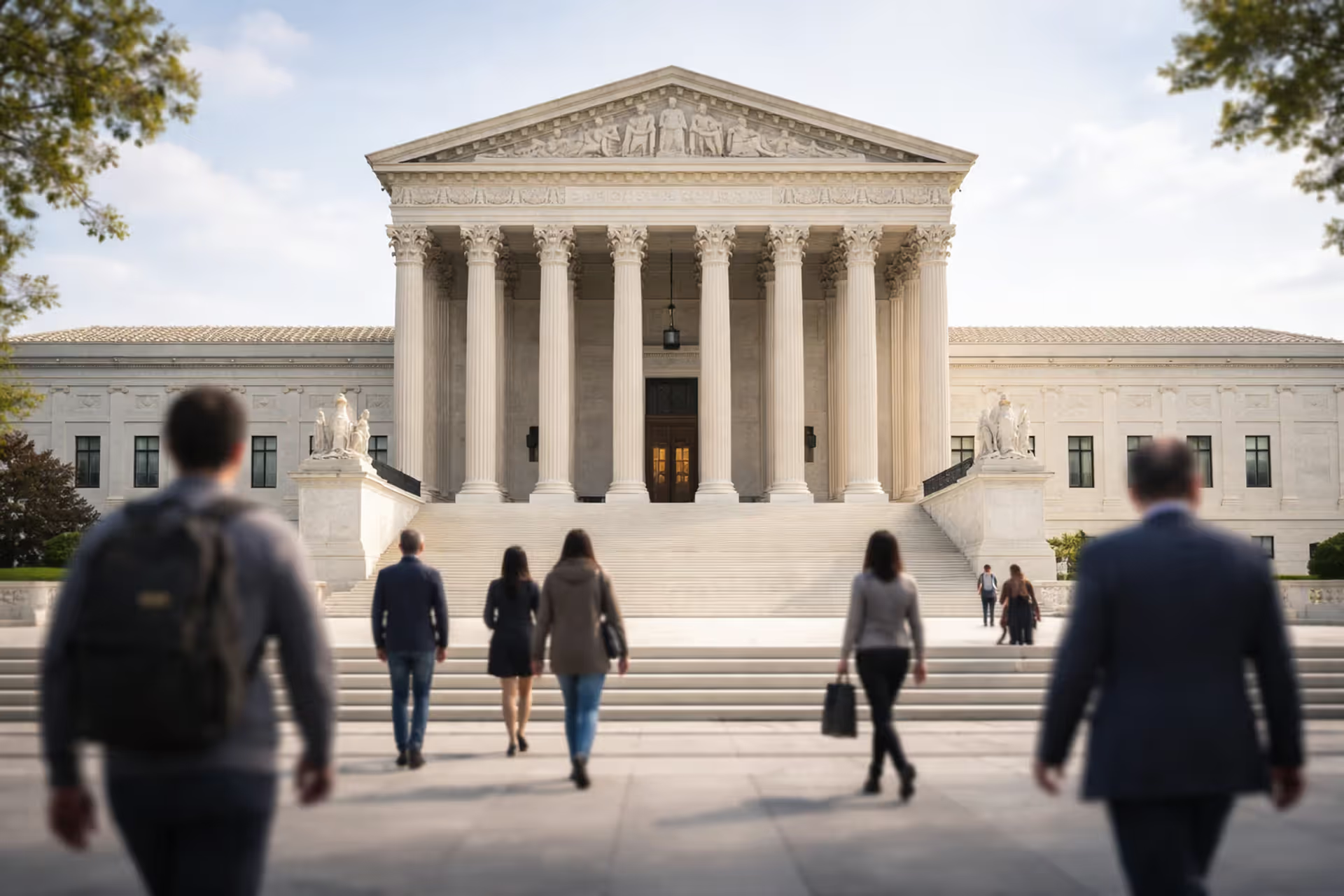
When nine justices gather in their marble palace to decide a case, they're doing more than settling a legal dispute. They're potentially rewriting the rules that govern 330 million Americans. Some decisions fade into obscurity within years. Others—like the 1954 ruling that outlawed school segregation—send shockwaves through society that we still feel today.
These transformative rulings didn't emerge from careful planning or deliberate social engineering. Most arose from ordinary people who'd exhausted every other option: a pool hall burglar denied a lawyer, students suspended for wearing armbands, couples arrested for interracial marriage. Their individual grievances became vehicles for constitutional principles that reshaped American life.
What separates these landmark decisions from the 100+ cases the Court decides annually? It's the difference between applying settled rules and inventing new ones. Between adjusting doctrine at the margins and blowing up decades of precedent. Between technical legal questions and fundamental debates about who we are as a nation.
How the Supreme Court Establishes Legal Precedent Through Case Law
Here's the basic mechanism: Once the Supreme Court interprets the Constitution in a particular way, every judge in America—from small-claims courts to federal circuit panels—must follow that interpretation. This doctrine of stare decisis (lawyers love their Latin) prevents the legal system from devolving into chaos where each judge invents their own constitutional rules.
The life of the law has not been logic; it has been experience.
— Oliver Wendell Holmes Jr.
But where did the Court get this authority? You won't find "judicial review" anywhere in the Constitution's text. The justices essentially granted themselves this power in 1803, and every subsequent generation has accepted it. Chief Justice John Marshall pulled off a political masterstroke, simultaneously refusing to grant a remedy while claiming the authority to strike down laws. Congress could have impeached him for this power grab. They didn't.
Most Supreme Court terms pass without major precedent shifts. The justices hear 70-80 cases per year (down from 150+ in the 1980s), and many involve narrow technical questions—does this particular environmental regulation exceed statutory authority, or which jurisdiction should hear this patent dispute? These cases matter to the parties involved but don't alter constitutional doctrine.
A decision achieves landmark status through one of several paths: establishing an entirely new constitutional right, explicitly overturning prior precedent, or resolving a circuit split on a question that affects millions of people. The 1965 contraception case fits the first category. The 2022 abortion reversal exemplifies the second. The 2015 same-sex marriage ruling resolved conflicting decisions from different appeals courts.
Author: Michelle Granton;
Source: skeletonkeyorganizing.com
Don't dismiss dissenting opinions as irrelevant. Justice Harlan's 1896 dissent arguing that the Constitution doesn't tolerate racial classifications languished for six decades before the Brown v. Board majority adopted his reasoning. When you read a dissent, you're sometimes reading tomorrow's majority opinion—the current minority is simply ahead of schedule.
15 Most Influential Supreme Court Cases in US History
Case
Decided
Question Presented
How It Changed America
The Rule It Established
Marbury v. Madison
1803
Who decides if laws violate the Constitution?
Gave courts final say on constitutional questions
Federal judges can void unconstitutional statutes
McCulloch v. Maryland
1819
Can Congress create institutions not explicitly authorized?
Enabled expansive federal power
"Necessary and Proper" permits implied congressional powers
Brown v. Board
1954
Does segregated schooling violate equal protection?
Dismantled Jim Crow's legal foundation
Racial separation inherently generates inequality
Gideon v. Wainwright
1963
Must states provide lawyers to poor defendants?
Created the public defender system
Right to counsel applies in state criminal cases
Miranda v. Arizona
1966
Can police use confessions without warning suspects?
Made "you have the right to remain silent" universal
Custodial interrogation requires specific advisements
Loving v. Virginia
1967
Can states ban interracial marriage?
Legalized marriage across racial lines nationwide
Marriage is fundamental; racial restrictions fail strict scrutiny
Tinker v. Des Moines
1969
Do students have free speech rights at school?
Protected student expression absent disruption
Constitutional rights accompany students through schoolhouse doors
Roe v. Wade
1973
Does the Constitution protect abortion access?
Recognized abortion right (until 2022 reversal)
Privacy encompasses early pregnancy decisions
New York Times v. Sullivan
1964
Can officials easily sue critics for defamation?
Shielded aggressive journalism from libel claims
Public figures must prove "actual malice" in defamation suits
Griswold v. Connecticut
1965
Can government ban contraceptives for married couples?
Discovered constitutional privacy right
Specific Bill of Rights guarantees imply broader privacy protection
United States v. Nixon
1974
Must presidents comply with judicial subpoenas?
Forced Watergate tapes' release, leading to resignation
Executive privilege exists but isn't absolute
Regents v. Bakke
1978
Can universities consider race in admissions?
Permitted affirmative action programs (framework since modified)
Does Second Amendment protect individual gun ownership?
Recognized personal firearms right
Amendment protects individual self-defense, not just militias
Obergefell v. Hodges
2015
Must states recognize same-sex marriages?
Required marriage equality nationwide
Dignity and autonomy principles mandate equal access
Dobbs v. Jackson
2022
Was Roe wrongly decided?
Eliminated federal abortion protection
Constitution doesn't address abortion; states may regulate
Author: Michelle Granton;
Source: skeletonkeyorganizing.com
Civil Rights and Equal Protection
Brown v. Board of Education represents the Court's most consequential social intervention. The 1954 decision unanimously rejected "separate but equal" schooling, directly overturning the 1896 Plessy ruling that had blessed Jim Crow segregation. Chief Justice Warren's opinion acknowledged that segregation branded Black children with "a feeling of inferiority" that undermined their educational prospects, regardless of funding parity.
Implementation proved extraordinarily difficult. The Court's follow-up decision ordered desegregation "with all deliberate speed"—language Southern states interpreted as permission to delay indefinitely. Virginia closed entire school systems rather than integrate. When Central High School in Little Rock attempted desegregation in 1957, President Eisenhower deployed the 101st Airborne Division to protect nine Black students from mob violence. A decade after Brown, fewer than 2% of Southern Black students attended integrated schools.
Loving v. Virginia (1967) extended equal protection analysis to strike down anti-miscegenation statutes. When police arrested Richard and Mildred Loving for violating Virginia's Racial Integrity Act—he was white, she was Black—the trial judge suspended their prison sentence on condition they leave Virginia for 25 years. The couple's challenge eventually reached the Supreme Court, which unanimously invalidated these marriage restrictions. Chief Justice Warren's opinion called marriage "one of the vital personal rights essential to the orderly pursuit of happiness." This precedent later supported arguments for same-sex marriage recognition.
Obergefell v. Hodges (2015) required all states to issue marriage licenses to same-sex couples. Before this decision, marriage law varied dramatically by jurisdiction—36 states plus DC recognized these marriages, while 14 didn't. Justice Kennedy's majority opinion grounded the holding in both due process (protecting fundamental liberty interests) and equal protection (forbidding unjustified discrimination). The four dissenters argued that democratic processes, not courts, should resolve this policy debate. Within 24 hours of the decision, county clerks nationwide began issuing licenses, though a few officials resigned or faced contempt citations rather than comply.
Criminal Justice and Due Process
Miranda v. Arizona (1966) produced American law's most famous script. Ernesto Miranda confessed to kidnapping and rape after two hours of police interrogation, but nobody had informed him of his right to remain silent or have an attorney present. The Warren Court held that the Fifth Amendment's protection against self-incrimination requires police to advise suspects of these rights before custodial questioning. Chief Justice Warren specified the exact warnings that officers must provide—a rare instance of the Court dictating specific procedural language.
The decision sparked fierce backlash. Critics complained that it would handcuff law enforcement and free guilty criminals on technicalities. Richard Nixon campaigned for president in 1968 partly by attacking Miranda as judicial overreach. Yet police departments adapted quickly, and confession rates remained steady. Subsequent decisions created exceptions for "public safety" questioning and routine booking procedures, narrowing Miranda's scope while preserving its core. Ironically, Ernesto Miranda was retried without his confession and convicted again based on other evidence.
Gideon v. Wainwright (1963) established the right to appointed counsel in state criminal prosecutions. Clarence Earl Gideon was a 51-year-old drifter charged with breaking into a Panama City pool hall and stealing coins from a cigarette machine—about $5 worth. Florida denied his request for a court-appointed lawyer because state law only provided counsel in capital cases. Gideon conducted his own defense, was convicted, and received five years in prison.
From his cell, Gideon handwrote a petition to the Supreme Court arguing that the Sixth Amendment required Florida to provide him with an attorney. The Court agreed unanimously, holding that the right to counsel is fundamental and essential to fair trials. Justice Black's opinion noted that "lawyers in criminal courts are necessities, not luxuries." Florida retried Gideon with a public defender representing him, and he was acquitted. The decision forced states to create public defender systems—institutions now operating in every jurisdiction, though often severely underfunded.
Author: Michelle Granton;
Source: skeletonkeyorganizing.com
Free Speech and First Amendment
Tinker v. Des Moines arose during the Vietnam War when three students wore black armbands to school protesting U.S. military involvement. School administrators, learning of the planned protest, preemptively banned armbands. Mary Beth Tinker (13), her brother John (15), and friend Christopher Eckhardt wore them anyway and were suspended.
Justice Fortas's majority opinion produced one of the Court's most quotable lines: students and teachers don't "shed their constitutional rights to freedom of speech or expression at the schoolhouse gate." Schools can restrict expression only when it substantially disrupts educational activities or invades others' rights—wearing a silent political symbol didn't meet this threshold. Three justices dissented, warning that the decision would make classroom discipline nearly impossible. The Tinker standard remains controlling law, applied to everything from Confederate flag imagery to MAGA hats.
New York Times v. Sullivan (1964) revolutionized defamation law by making it vastly harder for public officials to silence critics. The case involved a civil rights fundraising advertisement that contained minor factual errors about police actions in Montgomery, Alabama. Police Commissioner L.B. Sullivan sued for libel and won $500,000 from an all-white Alabama jury—part of a coordinated effort to bankrupt civil rights organizations and national media through Southern libel judgments.
The Supreme Court reversed, holding that public officials suing for criticism of their official conduct must prove "actual malice"—meaning the defendant either knew the statement was false or acted with reckless disregard for truth. Minor factual errors made without malicious intent receive constitutional protection. This standard enables aggressive investigative journalism by reducing the risk that powerful figures will deploy libel law to suppress unflattering coverage. Without Sullivan, the Watergate reporting that toppled President Nixon might never have occurred.
Privacy and Personal Liberty
Griswold v. Connecticut (1965) invalidated a state law criminalizing contraceptive use, even by married couples. Estelle Griswold, executive director of Planned Parenthood's Connecticut branch, and Dr. C. Lee Buxton were convicted as accessories for providing contraceptive advice to married couples. Connecticut argued that the law promoted morality by discouraging extramarital sex—though it prohibited contraception within marriage too.
Justice Douglas's majority opinion located a constitutional "right to privacy" within "penumbras, formed by emanations" from several Bill of Rights provisions—notoriously vague language that critics mocked. But the core principle survived this clumsy articulation: the Constitution protects intimate personal decisions from government intrusion, even when those rights aren't explicitly enumerated. This privacy foundation later supported abortion rights, consensual adult sexuality, and other autonomy claims.
Roe v. Wade (1973) extended privacy doctrine to recognize abortion rights, at least during early pregnancy. Justice Blackmun's majority opinion created a trimester framework balancing women's autonomy against state interests in maternal health and potential life. States couldn't ban first-trimester abortions, could regulate second-trimester procedures to protect maternal health, and could prohibit third-trimester abortions except when necessary to preserve the mother's life or health.
This framework controlled for nearly half a century despite relentless political and legal challenges. Planned Parenthood v. Casey (1992) modified the trimester system while reaffirming abortion rights' constitutional core. Then Dobbs v. Jackson Women's Health Organization (2022) explicitly overturned Roe, holding 6-3 that the Constitution doesn't address abortion and that the issue should be resolved through democratic processes. Thirteen states immediately banned abortion through "trigger laws" designed to activate when Roe fell.
Federal Power and Commerce
Marbury v. Madison (1803) established judicial review through Chief Justice Marshall's political genius. William Marbury was among 42 "midnight judges" appointed by President Adams in his final hours. When incoming President Jefferson ordered his Secretary of State (James Madison) not to deliver Marbury's commission, Marbury sought a writ of mandamus from the Supreme Court compelling delivery.
Marshall's opinion performed a triple maneuver: acknowledging Marbury's legal right to the commission (embarrassing Jefferson), declaring that the statute granting the Court jurisdiction was unconstitutional (avoiding confrontation by refusing to issue the writ), and claiming judicial authority to invalidate unconstitutional laws (establishing judicial review). Jefferson couldn't defy an order the Court didn't issue, yet Marshall had asserted enormous power. This assertiveness could have triggered impeachment, but the political moment passed.
McCulloch v. Maryland (1819) arose when Maryland attempted to tax the Second Bank of the United States out of existence. The Constitution doesn't explicitly authorize Congress to create banks, so Maryland argued the bank exceeded federal authority. Chief Justice Marshall's opinion rejected this narrow reading, holding that the Necessary and Proper Clause grants Congress implied powers to execute its enumerated functions through any reasonable means.
Marshall also established federal law supremacy: "the power to tax involves the power to destroy," and states cannot tax federal instrumentalities. These principles enabled massive federal government expansion over subsequent centuries. Without McCulloch's generous reading of implied congressional powers, much 20th-century legislation—from Social Security to civil rights laws—would lack constitutional foundation.
What Makes a Supreme Court Case Precedent-Setting
Why do some decisions reshape constitutional law while others barely register? Three factors typically distinguish landmark cases from routine ones.
First, they address fundamental questions about government structure or individual rights rather than applying established doctrine. Interpreting ambiguous statutory language matters to the parties involved but rarely alters constitutional understanding. Deciding whether the Constitution protects same-sex marriage potentially affects millions of people's most important personal relationships.
Second, precedent-setting cases usually involve significant political or social controversy. The Court receives roughly 7,000 petitions annually but hears only 70-80 cases, granting review primarily when appeals courts have reached conflicting conclusions or the question demands uniform national resolution. Brown v. Board confronted the defining domestic issue of its era. Obergefell resolved a question generating ballot initiatives, legislative battles, and circuit splits across the country. The justices generally avoid wading into political thickets unless the legal question requires their intervention.
Third, landmark decisions establish clear rules that lower courts can implement. Miranda specified exact warnings that police must recite. Gideon required appointed counsel in all felony prosecutions. Brown declared that separate educational facilities are inherently unequal. Vague pronouncements that leave implementation uncertain don't qualify as useful precedent—they generate confusion and invite endless litigation over what the Court actually meant.
Lower courts apply Supreme Court precedent through analogical reasoning. When a school district considers restricting student expression, administrators must determine whether the proposed limitation fits within Tinker's "substantial disruption" exception. When police question suspects, they must follow Miranda's procedural requirements. Federal judges lack authority to simply ignore binding Supreme Court precedent—they must either follow it or distinguish the case by identifying factual differences that make the precedent inapplicable.
We are not final because we are infallible, but we are infallible only because we are final.
— Robert H. Jackson (U.S. Supreme Court Justice)
The Supreme Court occasionally overturns its own precedent when earlier decisions prove unworkable, rest on outdated factual premises, or conflict with subsequent doctrinal developments. The Court has reversed itself more than 200 times. Dobbs overturned Roe after concluding that the privacy framework lacked grounding in constitutional text or history. Brown overturned Plessy's separate-but-equal doctrine. West Virginia v. Barnette (1943) reversed a 1940 decision about mandatory flag salutes after just three years. The justices treat precedent seriously under stare decisis but not as an absolute bar to correcting what they perceive as constitutional errors.
How to Research and Analyze Historic Legal Cases
You can access every Supreme Court opinion ever issued without paying expensive database fees. The Court itself publishes recent decisions at supremecourt.gov within hours of announcement. For historical decisions dating to the 1790s, free databases like Google Scholar (scholar.google.com), Justia (justia.com), and Cornell's Legal Information Institute (law.cornell.edu) provide searchable archives.
Legal citations follow a consistent format that lets anyone locate the precise page where an opinion begins. Take Brown v. Board of Education, 347 U.S. 483 (1954). That citation tells you: the case name comes first, "347" indicates volume 347 of the United States Reports (the official reporter), "U.S." identifies the reporter series, "483" shows which page the opinion starts on, and "(1954)" indicates the decision year. Once you understand this system, you can track down any case within minutes.
Author: Michelle Granton;
Source: skeletonkeyorganizing.com
Every decision contains multiple components worth understanding. The syllabus appears first—a summary of facts, legal questions, and holdings. This provides a quick overview but isn't part of the official opinion and carries no precedential weight. The majority opinion explains the Court's legal reasoning and establishes binding precedent. Concurring opinions agree with the outcome but offer different rationale—sometimes these alternative theories become influential in later cases. Dissenting opinions explain why minority justices believe the majority erred, occasionally becoming blueprints for future reversals.
Reading constitutional case summaries effectively requires understanding the specific constitutional provisions at issue. When a case involves the Fourth Amendment, knowing it protects against "unreasonable searches and seizures" provides necessary context. When equal protection claims arise, the scrutiny level applied—rational basis, intermediate, or strict—determines how much justification the government must provide for its classification.
Watch for how opinions balance competing constitutional values. First Amendment cases often pit free expression against other interests like personal privacy, national security, or preventing imminent harm. Commerce Clause disputes balance federal regulatory authority against state sovereignty and individual liberty. Understanding these tensions reveals why justices disagree and how future Courts might reconsider precedents as circumstances evolve.
The Real-World Impact of Famous Supreme Court Rulings on Modern America
Legal Area
The Old Reality
What Changed
Where Things Stand Now
Public Schools
Seventeen states legally mandated racial segregation; "separate but equal" doctrine sanctioned dual systems
Mandatory integration programs; federal oversight; busing to achieve racial balance
Continuing debates over achievement gaps, school funding inequities, and charter schools
Police Procedures
Detectives obtained confessions without informing suspects of constitutional rights; poor defendants frequently went to trial without lawyers
Miranda warnings became universal; public defender offices opened in every jurisdiction; exclusionary rule expanded
Numerous exceptions carved out for "public safety" questions and routine booking; some critics argue Miranda has been hollowed out
Media and Defamation
Publications faced crushing libel judgments for criticizing government officials; chilling effect on investigative reporting
"Actual malice" standard protects journalism about public figures; aggressive investigative reporting flourishes
Declining local news creates information deserts; concerns about disinformation and "fake news" rhetoric
Personal Privacy
States criminalized contraception, abortion, and consensual adult intimacy; government extensively regulated private decisions
Constitutional protection recognized for reproductive autonomy and intimate choices
Post-Dobbs fragmentation with state-by-state variations; uncertain future for other privacy-based rights
Brown v. Board required dismantling dual school systems throughout the South, though implementation took decades and sometimes required military force. The decision sparked "massive resistance" including Virginia's policy of closing public schools entirely rather than integrating them. President Eisenhower deployed the 101st Airborne Division to Little Rock in 1957. Ten years after Brown, barely 2% of Southern Black students attended integrated schools. Yet Brown established the constitutional bedrock principle that government cannot use racial classifications for discriminatory purposes, enabling subsequent civil rights legislation and enforcement.
Miranda transformed policing nationwide within just a few years. Every law enforcement agency developed training programs for administering warnings, and courts routinely suppressed statements obtained in violation. However, subsequent Supreme Court decisions created exceptions for "public safety" questioning and statements made during routine booking, steadily narrowing the original holding's practical scope. Police academies now teach recruits exactly when Miranda applies and how to conduct legally compliant interrogations that still yield evidence.
New York Times v. Sullivan enabled aggressive investigative journalism by dramatically reducing the risk that powerful figures could silence critics through libel litigation. The "actual malice" standard permits reporters to publish information about public officials even when minor details prove incorrect, provided they didn't knowingly lie or show reckless indifference to truth. This protection directly facilitated reporting on the Pentagon Papers, Watergate, Iran-Contra, and countless other stories exposing government misconduct. Without Sullivan, investigative journalism capable of challenging the powerful might not exist.
Griswold and Roe established privacy as a constitutional value protecting intimate personal decisions from government interference. Griswold's recognition that married couples could use contraception without criminal liability seems uncontroversial today, but it represented a significant expansion beyond explicitly enumerated rights. Roe extended this privacy reasoning to abortion access. Dobbs's 2022 reversal demonstrates that privacy's boundaries remain intensely contested—Justice Thomas's Dobbs concurrence suggested reconsidering other privacy-based precedents, including same-sex marriage and contraception rights.
Frequently Asked Questions About Landmark Supreme Court Cases
What was the first landmark Supreme Court case?
Marbury v. Madison in 1803 holds this distinction because Chief Justice Marshall used it to establish judicial review—the Court's power to invalidate laws that violate the Constitution. Earlier cases addressed important questions, but none defined the Court's fundamental role in constitutional governance. Marshall's opinion claimed this authority despite the Constitution's silence on whether courts could strike down legislation. Congress and President Jefferson could have challenged this power grab through impeachment or simply ignoring the Court. They didn't. That acquiescence allowed judicial review to become the foundation of American constitutional law. Without Marbury, we might have a parliamentary system where legislatures have final say on constitutional questions.
How long does it take for a case to reach the Supreme Court?
Most cases that the justices hear have been working through lower courts for two to four years. The typical path runs from trial court through an appellate court before reaching the Supreme Court through a petition for certiorari (requesting discretionary review). Out of roughly 7,000 petitions filed annually, the Court grants only 70-80, primarily when different circuit courts have reached conflicting conclusions on the same legal question or when a case involves exceptionally significant constitutional issues. Some matters move faster through emergency applications—the Court occasionally decides major questions within weeks when circumstances demand immediate resolution. But standard litigation requires substantial patience and resources.
Can the Supreme Court overturn its own precedents?
Absolutely, though it happens less often than you might expect given how dramatically society changes. The Court has reversed itself over 200 times throughout history. Recent high-profile examples include Dobbs v. Jackson (2022) overturning Roe v. Wade's abortion framework and Citizens United v. FEC (2010) overturning portions of earlier campaign finance decisions. Justices consider whether a precedent has proven unworkable in practice, rests on factual assumptions that no longer hold, conflicts with related doctrines that developed later, or was simply wrongly decided from the start. Still, reversals remain relatively uncommon because legal stability has independent constitutional value—if precedents constantly shifted, nobody could plan their affairs or predict legal outcomes.
Which Supreme Court case has been cited the most?
Marbury v. Madison appears in thousands of judicial opinions because it established judicial review, making it relevant whenever any court considers its authority to review government action. Among more recent decisions, Chevron U.S.A. v. Natural Resources Defense Council (1984)—which created a framework for when courts should defer to administrative agencies' statutory interpretations—became one of the most frequently cited administrative law precedents (though the Court significantly curtailed Chevron deference in 2024). Brown v. Board and Miranda v. Arizona also generate thousands of citations because they established fundamental principles applicable across numerous contexts. Citation frequency reflects both a case's age (older decisions accumulate more citations) and its breadth (principles that apply to many situations get cited more often).
How do Supreme Court decisions become enforceable law?
The Court's rulings take effect immediately without requiring implementing legislation—they are the law from the moment the justice finishes reading the decision from the bench. But practical implementation depends on cooperation from other institutional actors. After Brown v. Board, federal district courts issued hundreds of desegregation orders to individual school districts, and the executive branch eventually enforced compliance, sometimes with military personnel. After Miranda, police departments rewrote their training manuals and developed procedures for properly informing suspects. When government officials refuse to comply with decisions, affected parties can return to court seeking enforcement through contempt orders, injunctions, or other remedies.
What happens when states refuse to comply with Supreme Court rulings?
States cannot legally ignore Supreme Court precedent, but defiance has occurred repeatedly throughout American history. After Brown v. Board, several Southern governors engaged in "massive resistance," closing schools or simply defying integration orders. President Eisenhower eventually deployed federal troops to enforce court orders in Little Rock. More recently, a few county clerks refused to issue marriage licenses after Obergefell v. Hodges declared same-sex marriage a constitutional right. Federal courts can hold defiant officials in contempt, impose escalating fines, remove them from office, or order other remedies. The Constitution's Supremacy Clause requires state compliance with federal judicial decisions, though political realities and enforcement logistics affect how quickly and thoroughly implementation occurs.
The Supreme Court's landmark decisions create the constitutional framework within which government operates and citizens exercise their rights. These cases do more than resolve individual disputes—they announce binding principles that constrain future courts, legislatures, and executive officials for generations.
Understanding these decisions requires recognizing that constitutional interpretation evolves. Society changes, new justices join the Court bringing different judicial philosophies, and groups previously excluded from legal debates gain voice in constitutional conversations. The cases discussed here span different eras, ideologies, and constitutional provisions, yet they share common features: each addressed a fundamentally important question that divided courts, communities, or the nation; each established precedent shaping how Americans understand their relationship to government and each other; each continues influencing legal outcomes and policy debates decades after announcement.
Studying landmark rulings reveals both judicial power and its limitations. The justices can declare laws unconstitutional, but they depend on other branches to enforce those declarations. They establish precedents, but future Courts can overturn them. They interpret the Constitution, yet those interpretations inevitably reflect the legal culture and political context of their time. Decisions that seem permanently settled today may face reconsideration tomorrow as new justices apply different interpretive methods or as society's fundamental values shift.
For anyone seeking to understand American constitutional law, these cases provide essential starting points. They illustrate how abstract constitutional text becomes concrete legal doctrine through judicial interpretation. They demonstrate how individual disputes can reshape national policy. They reveal that constitutional meaning isn't fixed but evolves through ongoing dialogue among courts, elected officials, and citizens. The next landmark case is probably being litigated right now in some federal district court, waiting for the Supreme Court to grant review and add another chapter to this continuing constitutional story.
Twelve real trademark disputes reveal where courts draw the line between brand protection and overreach. From Adidas' $304M verdict against Payless to Louboutin's red sole defense against YSL, this guide covers the likelihood-of-confusion standard, dilution claims for famous marks, why parody defenses fail for competitors, small business vulnerability to trademark bullying, and the costly mistakes
Patent disputes reshape entire markets — shutting down billion-dollar product lines and forcing nine-figure payouts. This guide covers infringement types, landmark cases from Apple v. Samsung to Polaroid v. Kodak, claim construction mechanics, damages calculations, common defenses, FRAND licensing battles, and why 85-95% of cases settle before trial with real cost breakdowns.
Every negligence claim demands proof of four elements — and falling short on just one collapses the case entirely. This guide traces real verdicts from Palsgraf's foreseeability limits to Ford Pinto's punitive damages, covering medical malpractice, premises liability, motor vehicle accidents, product defects, comparative fault systems across states, and how courts calculate compensatory vs. puniti
Bad outcomes don't automatically mean malpractice — courts draw strict lines between unfortunate results and compensable negligence. This guide covers all four required legal elements, common claim types from surgical errors to birth injuries, real verdict examples ranging from defense wins to $41.5M awards, damage caps by state, filing deadlines, and how 90% of cases actually resolve.
The content on Legal Insights is provided for general informational purposes only. It is intended to offer insights, commentary, and analysis on legal topics and developments, and should not be considered legal advice or a substitute for professional consultation with a qualified attorney.
All information, articles, and materials presented on this website are for general informational purposes only. Laws and regulations may vary by jurisdiction and may change over time. The application of legal principles depends on specific facts and circumstances.
Legal Insights is not responsible for any errors or omissions in the content, or for any actions taken based on the information provided on this website. Users are encouraged to seek independent legal advice tailored to their individual situation before making any legal decisions.