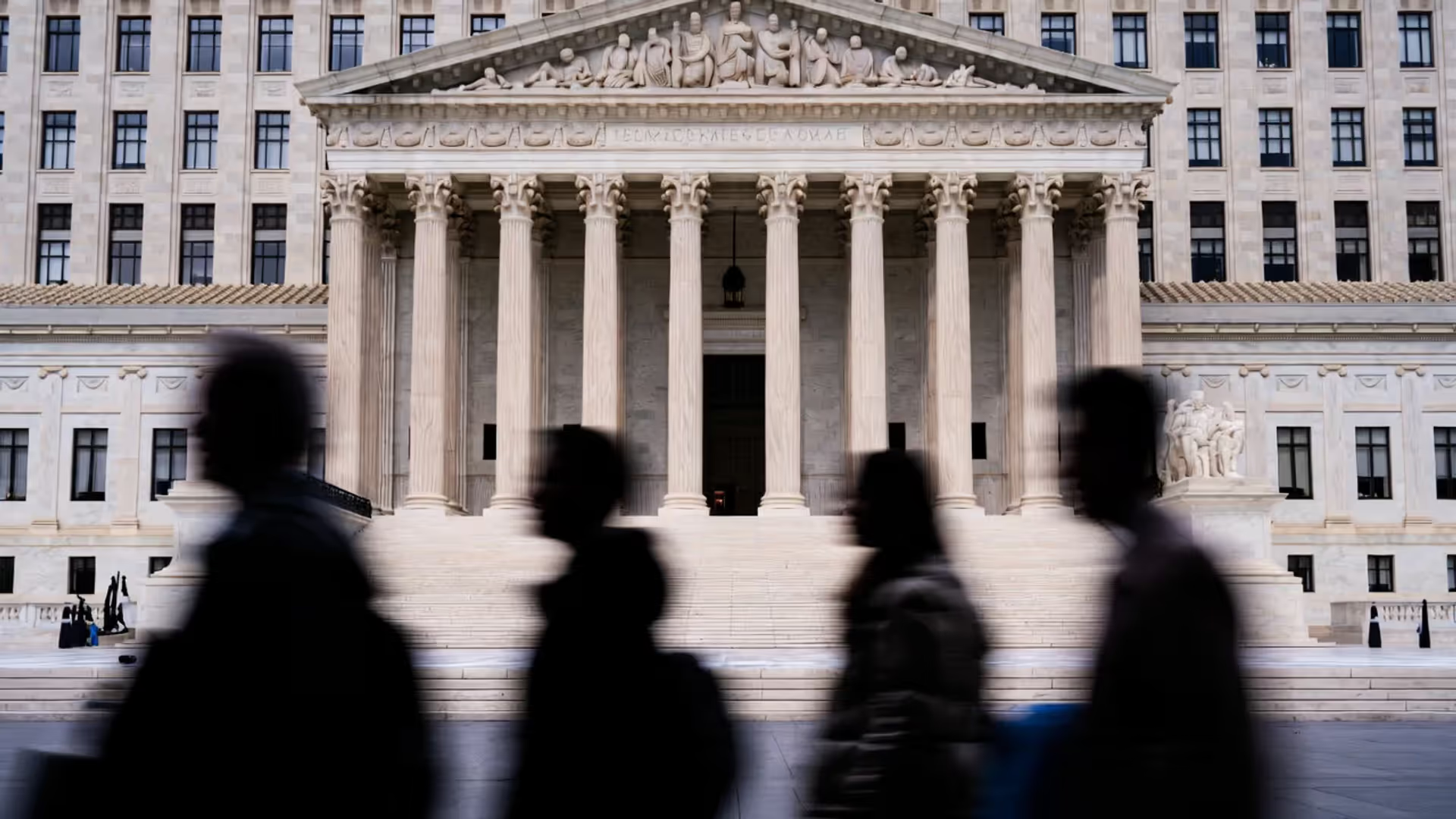
The Supreme Court has spent over a century defining where expression ends and punishable conduct begins. These decisions affect everything from campus protests to corporate campaign contributions, from vulgar bumper stickers to algorithmic content moderation. Understanding the major cases reveals not just legal history, but the practical boundaries of what you can say, where you can say it, and what happens when government tries to silence you.
How Courts Determine Speech Protection Under the First Amendment
Federal judges don't apply a single test to every constitutional expression case. Instead, they select from a toolkit of scrutiny levels based on what kind of restriction government imposed and why. The choice of test often predetermines the outcome.
The Strict Scrutiny Test Explained
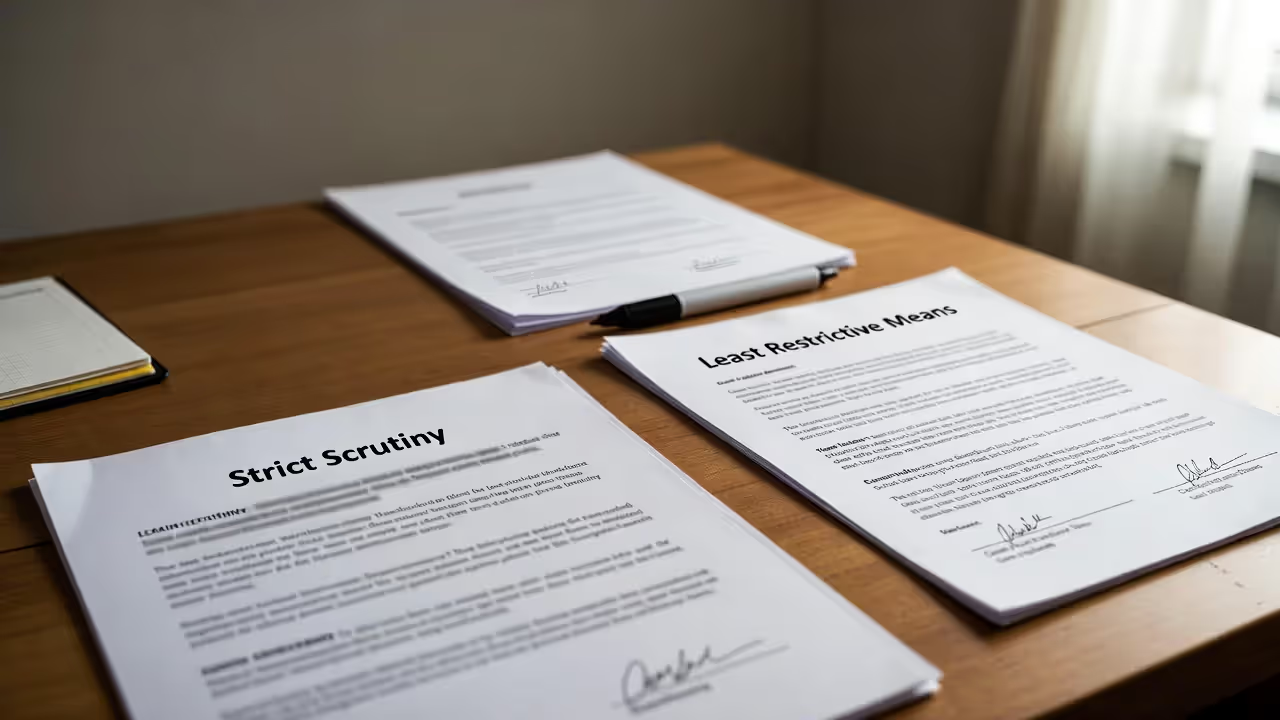
When government targets speech because of its message—banning anti-war protests but allowing pro-military rallies, for example—courts apply strict scrutiny. Under this standard, the restriction survives only if it serves a compelling government interest and uses the least restrictive means possible to achieve that goal. In practice, fewer than 10% of laws subjected to strict scrutiny survive judicial review.
The test emerged from cases like Ashcroft v. ACLU (2004), where the Court struck down the Child Online Protection Act. Congress wanted to shield minors from harmful online content, a legitimate goal. But the law swept too broadly, potentially blocking adults from accessing constitutionally protected material. Filtering software offered a less restrictive alternative, so the statute failed strict scrutiny.
Strict scrutiny applies to prior restraints—government censorship before publication—with near-absolute force. The Pentagon Papers case (New York Times Co. v. United States, 1971) established that government bears an extraordinarily heavy burden to justify blocking publication in advance. The Nixon administration claimed national security risks, but couldn't prove immediate, irreparable harm to military operations. The newspapers published.
The best test of truth is the power of the thought to get itself accepted in the competition of the market.
— Justice Oliver Wendell Holmes Jr.
Content-Based vs. Content-Neutral Restrictions
A city ordinance banning all political signs larger than six square feet receives intermediate scrutiny because it regulates size without targeting specific viewpoints. The same city banning only signs criticizing the mayor triggers strict scrutiny because it discriminates based on content.
Reed v. Town of Gilbert (2015) tightened this distinction. Gilbert, Arizona allowed temporary directional signs for qualifying events but imposed stricter rules on political and ideological signs. The town argued its code was content-neutral because it didn't favor one viewpoint over another. The Court disagreed: if you must read the sign to determine which rule applies, the law is content-based and presumptively unconstitutional.
Author: Andrew Whitaker;
Source: skeletonkeyorganizing.com
This ruling created practical headaches for municipalities trying to regulate visual clutter. A blanket size limit passes muster; categorical exemptions for garage sale signs but not protest signs do not. The lesson: government can regulate the time, place, and manner of speech through neutral rules, but faces steep barriers when sorting messages into different regulatory buckets.
Landmark Supreme Court Decisions on Political and Protest Speech
The Court's earliest freedom of speech cases arose during wartime, when government sought to suppress dissent it deemed dangerous. These disputes produced tests that courts still reference, even though subsequent rulings modified or abandoned the original frameworks.
Schenck v. United States and the "Clear and Present Danger" Standard
Charles Schenck distributed flyers urging men to resist the World War I draft. His 1919 conviction under the Espionage Act reached the Supreme Court, which unanimously affirmed. Justice Oliver Wendell Holmes wrote that speech creating a "clear and present danger" of substantive evils falls outside First Amendment protection. His famous analogy: falsely shouting fire in a crowded theater isn't protected expression.
The standard sounds speech-protective but functioned as the opposite. Lower courts upheld convictions for distributing leaflets, giving speeches, and publishing newspapers critical of government policy. Any criticism of the war effort during wartime qualified as a "clear and present danger" in judges' eyes.
Holmes himself grew uncomfortable with how courts applied his test. In Abrams v. United States (1919), he dissented when the majority upheld convictions of Russian immigrants who'd thrown socialist leaflets from a New York City window. Holmes argued the leaflets posed no immediate danger and that the marketplace of ideas should determine which views prevail.
Brandenburg v. Ohio: When Advocacy Becomes Incitement
Author: Andrew Whitaker;
Source: skeletonkeyorganizing.com
Clarence Brandenburg, a Ku Klux Klan leader, invited a television crew to a 1964 rally where hooded figures burned a cross and threatened violence against Black Americans and Jews. Ohio convicted him under a criminal syndicalism statute prohibiting advocacy of violence for political reform.
The 1969 Supreme Court decision overturned his conviction and established the modern incitement test: government may prohibit speech only when it's directed to inciting imminent lawless action and likely to produce such action. Both elements must be present. Advocacy of illegal conduct in the abstract receives constitutional protection; only speech that functions as a trigger for immediate violence loses protection.
This standard protects most protest speech, even when heated. Chanting "No justice, no peace" at a demonstration doesn't meet the Brandenburg test because it doesn't direct listeners to commit specific violent acts immediately. Telling a mob "Let's burn down that building right now" while handing out torches crosses the line.
Federal prosecutors applying Brandenburg face high bars in first amendment lawsuits. After the January 6 Capitol riot, the Justice Department charged participants with crimes like obstruction and trespassing rather than incitement, knowing Brandenburg's requirements would be difficult to prove for most defendants.
Tinker v. Des Moines: Student Speech Rights
When Mary Beth Tinker, her brother John, and friend Christopher Eckhardt wore black armbands to school in 1965 to protest the Vietnam War, administrators suspended them. The students sued, and the case reached the Supreme Court in 1969.
The Court ruled that students don't "shed their constitutional rights to freedom of speech or expression at the schoolhouse gate." Schools may restrict student speech only when it materially disrupts classwork or involves substantial disorder. Silent, passive expression like armbands didn't meet that standard.
Tinker remains the baseline for student speech cases, but subsequent decisions carved out exceptions. Schools may censor school-sponsored speech like newspapers (Hazelwood v. Kuhlmeier, 1988), prohibit lewd or vulgar expression (Bethel v. Fraser, 1986), and restrict speech promoting illegal drug use (Morse v. Frederick, 2007). A student wearing a "Bong Hits 4 Jesus" banner at a school event lost protection under Morse because schools have a compelling interest in discouraging drug use.
The practical result: students can express political views through clothing, buttons, and peaceful demonstrations unless administrators can show specific, concrete evidence that the expression will cause substantial disruption. Vague concerns about controversy aren't enough.
Censorship Litigation Involving Obscenity and Offensive Expression
Not all expression receives First Amendment protection. The Court has consistently held that obscenity falls outside constitutional boundaries, but defining obscenity proved notoriously difficult. Justice Potter Stewart's famous admission—"I know it when I see it"—captured the challenge courts faced for decades.
Miller v. California and the Three-Part Obscenity Test
Marvin Miller conducted a mass mailing campaign for adult material, sending illustrated brochures to people who hadn't requested them. California convicted him of distributing obscene material. The 1973 Supreme Court decision upheld the conviction and established the test courts still use.
Material is obscene if: (1) the average person, applying contemporary community standards, would find that the work, taken as a whole, appeals to the prurient interest; (2) the work depicts or describes, in a patently offensive way, sexual conduct specifically defined by applicable state law; and (3) the work, taken as a whole, lacks serious literary, artistic, political, or scientific value.
All three prongs must be satisfied. The "community standards" component means juries in conservative jurisdictions may find material obscene that urban juries would protect. Internet distribution complicated this framework—which community's standards apply when content is accessible nationwide? Courts generally apply standards from the jurisdiction where the defendant transmitted the material or where the recipient accessed it.
The third prong provides significant protection. A novel with explicit sexual content but literary merit receives constitutional protection even if it offends local sensibilities. Pornography marketed purely for sexual arousal and lacking any redeeming value doesn't.
Author: Andrew Whitaker;
Source: skeletonkeyorganizing.com
FCC v. Pacifica Foundation: Broadcasting Restrictions
George Carlin's "Seven Words You Can Never Say on Television" monologue aired on a New York radio station one afternoon in 1973. A father listening with his young son complained to the Federal Communications Commission, which sanctioned the station.
The Supreme Court's 1978 decision upheld the FCC's authority to restrict indecent (but not obscene) broadcasts during hours when children might be listening. Broadcasting receives less First Amendment protection than print media because it enters the home uninvited and is uniquely accessible to children.
The ruling created the "safe harbor" period—currently 10 p.m. to 6 a.m.—when broadcasters face fewer content restrictions. Cable and satellite providers aren't subject to the same rules because viewers must affirmatively subscribe. Internet content receives full First Amendment protection under Reno v. ACLU (1997), which struck down the Communications Decency Act's restrictions on online indecency.
Speech restriction rulings in this area reflect medium-specific analysis. The same content receives different protection depending on whether it appears in a book, on broadcast television, on cable, or online. This fragmented approach frustrates advocates seeking consistent standards but reflects practical differences in how media reach audiences.
Corporate Speech and Commercial Expression Rulings
Corporations didn't always enjoy robust First Amendment protection. Early 20th-century courts treated commercial speech as unprotected. The modern era brought dramatic expansion of corporate expression rights, with significant implications for campaign finance and advertising regulation.
Citizens United v. FEC: Campaign Finance as Free Speech
Citizens United, a conservative nonprofit, wanted to air a documentary critical of Hillary Clinton during the 2008 presidential primary. The Bipartisan Campaign Reform Act prohibited corporations and unions from funding "electioneering communications" within 30 days of a primary. Citizens United sued.
The 2010 Supreme Court decision struck down the restriction, holding that political speech doesn't lose First Amendment protection because a corporation rather than an individual funds it. The majority reasoned that the First Amendment protects speech, not speakers, and that corporate spending for political expression is protected activity.
Critics argue the ruling unleashed unlimited corporate money into politics through super PACs and dark money groups. Supporters contend it vindicated the principle that government can't suppress political speech based on the speaker's identity. The decision remains among the most controversial constitutional expression cases in modern history.
Practical effects include the proliferation of independent expenditure committees that can raise unlimited funds from corporations, unions, and individuals, provided they don't coordinate directly with candidates. Disclosure requirements remain constitutional—government can require speakers to identify themselves without prohibiting the speech itself.
Central Hudson Test for Commercial Speech
Commercial advertising receives intermediate First Amendment protection under the four-part test from Central Hudson Gas & Electric Corp. v. Public Service Commission (1980). The framework asks: (1) Does the speech concern lawful activity and is it not misleading? (2) Is the government interest in restriction substantial? (3) Does the regulation directly advance that interest? (4) Is the restriction no more extensive than necessary?
This standard allows government to prohibit false or misleading advertising, require disclaimers, and restrict advertising for harmful products like tobacco. A state can ban billboards advertising cigarettes near schools but can't prohibit truthful advertising for legal products to adults.
Sorrell v. IMS Health Inc. (2011) applied heightened scrutiny to a Vermont law restricting how pharmaceutical companies could use prescriber data for marketing. The Court found the law impermissibly targeted speech based on content and speaker identity. Even commercial speech receives robust protection when government discriminates based on the message.
The practical line: false or misleading commercial speech receives no protection; truthful advertising for lawful products receives substantial protection; government can impose reasonable restrictions to serve legitimate interests, but blanket bans on truthful advertising rarely survive judicial review.
Digital Age First Amendment Lawsuits and Social Media Disputes
The internet and social media platforms created novel speech questions the Founders never contemplated. Do platforms have editorial discretion to remove content, or must they host all viewpoints? Can government officials block critics on social media? Does algorithmic amplification constitute speech? Courts are actively developing answers.
Section 230 and Platform Moderation Challenges
Author: Andrew Whitaker;
Source: skeletonkeyorganizing.com
Section 230 of the Communications Decency Act provides that interactive computer services aren't liable for content posted by users and can't be held liable for good-faith efforts to remove objectionable material. This provision enabled platforms to host user content without facing the crushing liability that would result from treating them as publishers of everything users post.
Recent censorship litigation challenges this framework. Conservative critics argue platforms abuse Section 230 protection to censor right-leaning viewpoints. Progressive critics contend platforms don't remove enough harmful content. Texas and Florida passed laws restricting platforms' ability to moderate content based on viewpoint.
The Fifth Circuit upheld Texas's law in NetChoice v. Paxton (2022), reasoning that platforms function as common carriers that shouldn't discriminate based on viewpoint. The Eleventh Circuit struck down Florida's similar law in NetChoice v. Moody (2022), finding that content moderation constitutes editorial judgment protected by the First Amendment.
The Supreme Court will likely resolve the circuit split. The central question: Are platforms more like newspapers with editorial discretion, or more like telephone companies that must transmit all messages neutrally? The answer determines whether states can prohibit viewpoint-based moderation.
Separately, proposals to modify or eliminate Section 230 would fundamentally alter online speech. Without liability protection, platforms would likely remove far more content to avoid legal risk, or abandon user-generated content entirely. The trade-off between platform accountability and robust online expression remains unresolved.
If there is any fixed star in our constitutional constellation, it is that no official… can prescribe what shall be orthodox in politics, nationalism, religion, or other matters of opinion.
— Justice Robert H. Jackson
Government Officials Blocking Users: Knight First Amendment Institute v. Trump
President Trump blocked critics from his @realDonaldTrump Twitter account. The Knight First Amendment Institute sued, arguing the account functioned as a public forum where government couldn't exclude people based on viewpoint.
The Second Circuit agreed in 2019. Once government creates a forum for expression—even on a private platform—it can't discriminate based on viewpoint. Trump's account wasn't purely personal; he used it to announce policy, communicate with foreign leaders, and conduct official business. The interactive space where users could reply constituted a public forum.
The Supreme Court later vacated the decision as moot after Trump left office, but the reasoning influences ongoing disputes. Public officials at all levels block constituents on social media. Courts generally ask: Does the official use the account for governmental purposes? If yes, blocking based on viewpoint violates the First Amendment.
The analysis differs for purely personal accounts versus official government accounts. A mayor's personal Facebook page where she occasionally mentions city business occupies a gray area. A city council's official page clearly constitutes a public forum subject to First Amendment constraints.
Practical guidance for officials: create separate personal and official accounts; establish clear, viewpoint-neutral policies for removing comments (profanity, threats, spam); apply policies consistently; consider hiding or muting rather than blocking, which preserves the user's access while limiting your exposure to their comments.
When Speech Restrictions Survive Constitutional Challenge
Despite broad First Amendment protection, certain categories of speech receive no constitutional protection, and government can impose reasonable time, place, and manner restrictions even on protected speech. Understanding these boundaries helps predict when speech restriction rulings will uphold government action.
Speech Type
Constitutional Status
Key Case Example
Practical Application
Political speech
Highest protection
Brandenburg v. Ohio (1969)
Government can restrict only if directed to inciting imminent lawless action and likely to produce it
Material appealing to prurient interest, patently offensive, and lacking serious value can be banned
True threats
No protection
Virginia v. Black (2003)
Statements expressing serious intent to commit unlawful violence against persons or groups
Defamation
No protection (if false)
New York Times v. Sullivan (1964)
Public figures must prove actual malice; private figures need only negligence for damages
Incitement
No protection
Brandenburg v. Ohio (1969)
Speech directed to producing imminent lawless action and likely to do so
Symbolic speech
Protected (usually)
Texas v. Johnson (1989)
Expressive conduct like flag burning receives protection unless regulation serves important interest unrelated to suppressing expression
Hate speech
Protected (generally)
R.A.V. v. City of St. Paul (1992)
Offensive speech based on race, religion, etc. protected unless it falls into unprotected category like true threats
True threats require an objective assessment of whether a reasonable person would interpret the statement as expressing serious intent to harm. Context matters enormously. "I'm going to kill you" said during a heated argument between neighbors may constitute a true threat; the same words in a novel are protected fiction.
Defamation law balances reputation protection against free expression. Public figures like politicians and celebrities must prove the defendant made false statements with actual knowledge of falsity or reckless disregard for truth. Private individuals suing over matters of public concern need only prove negligence. This asymmetry reflects the judgment that public figures have greater access to channels of communication to rebut false statements and have voluntarily exposed themselves to public scrutiny.
Fighting words—face-to-face insults that tend to provoke immediate violent reaction—theoretically lack protection under Chaplinsky v. New Hampshire (1942). But courts rarely apply this category. The words must be directed at a specific person in a confrontational manner and likely to provoke an immediate breach of peace. Generalized profanity, even if offensive, doesn't qualify.
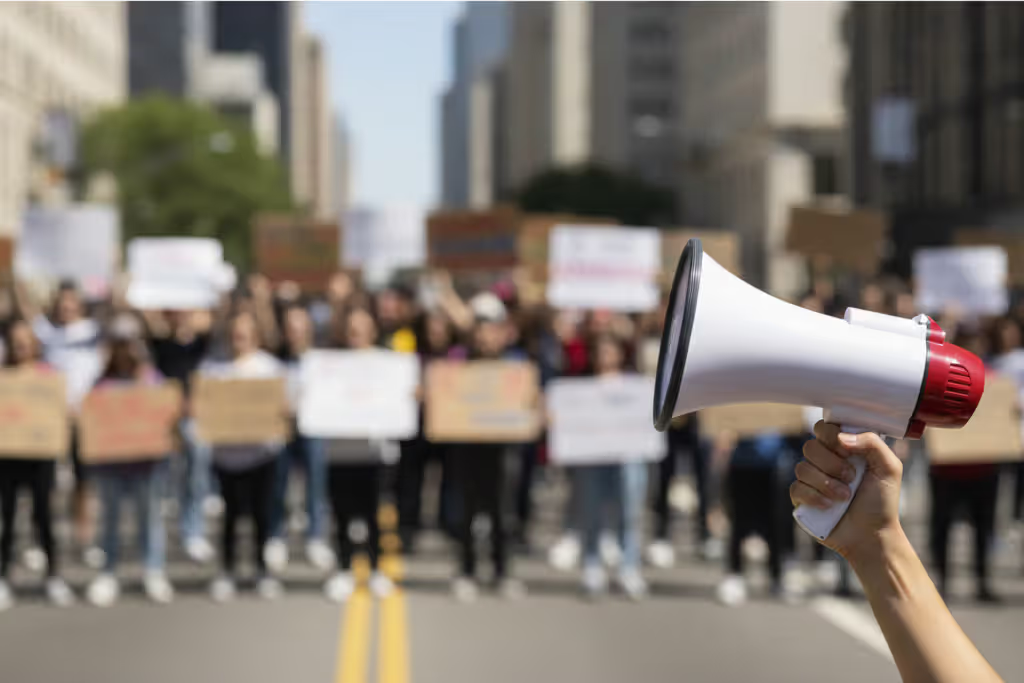
Time, place, and manner restrictions must be content-neutral, serve a significant government interest, and leave open ample alternative channels for communication. A city can require parade permits, limit sound amplification after 10 p.m., and restrict demonstrations near courthouse entrances. It can't require permits only for protests it dislikes, allow amplification for some messages but not others, or ban demonstrations entirely.
The trade-off: society tolerates offensive, harmful, and false speech to preserve breathing room for truth. Empowering government to suppress "bad" speech risks suppressing dissent, unpopular views, and challenges to authority. The First Amendment reflects a judgment that the cure of censorship is worse than the disease of harmful expression.
Frequently Asked Questions About Constitutional Expression Cases
Can private companies violate your First Amendment rights when they censor content?
No. The First Amendment restricts government action, not private conduct. When Twitter suspends your account or Facebook removes your post, no constitutional violation occurs because these companies aren't government actors. You have no First Amendment right to use a private platform.
Exceptions exist when private entities perform traditional government functions or act under government compulsion. A private company operating a company town can't restrict speech because it's performing municipal functions (Marsh v. Alabama, 1946). If government pressures platforms to remove specific content, that may constitute state action triggering First Amendment scrutiny.
State laws attempting to prohibit platform content moderation face constitutional challenges because platforms themselves have First Amendment rights to curate content. Forcing a platform to host speech it finds objectionable may violate the platform's editorial discretion, similar to forcing a newspaper to publish content against its wishes.
What's the difference between hate speech and speech protected by the Constitution?
The Supreme Court has never recognized a "hate speech" exception to the First Amendment. Speech expressing hatred toward groups based on race, religion, gender, sexual orientation, or other characteristics generally receives constitutional protection, however offensive.
Hate speech loses protection only when it crosses into unprotected categories like true threats, incitement, or fighting words. Saying "I hate [group]" is protected. Saying "Let's go attack [specific person] right now" may constitute incitement. Sending someone a message stating "I know where you live and I'm coming to kill you" likely qualifies as a true threat.
R.A.V. v. City of St. Paul (1992) struck down a hate speech ordinance prohibiting symbols like burning crosses that arouse anger based on race, religion, or gender. The Court found the law impermissibly discriminated based on content—it prohibited some fighting words but not others based on the message.
This doesn't mean hate speech is consequence-free. Private employers can fire workers for racist statements, universities can discipline students under conduct codes, and social platforms can remove hateful content. Constitutional protection means government can't criminally punish or civilly sanction the speech, not that the speaker faces no repercussions.
Do students have the same free speech rights as adults?
Students have First Amendment rights, but schools may impose restrictions that would be unconstitutional in other contexts. The key question is whether the speech materially disrupts school operations or interferes with the rights of others.
Tinker v. Des Moines protects student political expression that doesn't cause substantial disruption. Schools can't prohibit armbands, buttons, or T-shirts with political messages simply because administrators or other students find them offensive. They must show specific evidence of disruption.
Schools have broader authority over school-sponsored speech like newspapers, yearbooks, and theatrical productions (Hazelwood v. Kuhlmeier). Educators can exercise editorial control over expression that might reasonably be perceived as bearing the school's imprimatur, provided their actions are reasonably related to legitimate pedagogical concerns.
Off-campus speech receives greater protection. The Supreme Court held in Mahanoy Area School District v. B.L. (2021) that schools have diminished authority to regulate student speech occurring off school grounds and outside school hours, even when it causes on-campus disruption. A student's profane Snapchat post criticizing the cheerleading team couldn't justify suspension.
When can the government legally restrict protest activities?
Government can impose reasonable time, place, and manner restrictions on protests without violating the First Amendment, provided the restrictions are content-neutral, narrowly tailored to serve a significant government interest, and leave open ample alternative channels for communication.
Permit requirements for large demonstrations in public parks are constitutional if applied evenhandedly. Cities can establish noise limits, restrict blocking traffic, and create buffer zones around sensitive locations like hospitals. They can't require permits only for protests expressing certain viewpoints or impose fees based on the message.
Ward v. Rock Against Racism (1989) upheld New York's requirement that concerts in Central Park use city-provided sound equipment and technicians to control volume. The regulation served the significant interest of preventing excessive noise without suppressing any particular message.
Buffer zones around abortion clinics illustrate the balance. Hill v. Colorado (2000) upheld a statute prohibiting approaching within eight feet of someone entering a clinic without consent. McCullen v. Coakley (2014) struck down a 35-foot fixed buffer zone around clinic entrances as broader than necessary. The difference: the Colorado law restricted approaching individuals; the Massachusetts law created a large speech-free zone.
How do courts decide if social media platforms must host all viewpoints?
This question is actively being litigated with no settled answer. Platforms argue they're private companies with First Amendment rights to curate content, similar to newspapers exercising editorial discretion. Critics argue platforms function as public forums or common carriers that shouldn't discriminate based on viewpoint.
Pruneyard Shopping Center v. Robins (1980) held that California could require a private shopping center to allow pamphleteering without violating the owner's First Amendment rights. But Manhattan Community Access Corp. v. Halleck (2019) ruled that private operation of a public access channel doesn't make the operator a state actor subject to First Amendment constraints.
The circuit split over Texas and Florida social media laws will likely reach the Supreme Court. If platforms are treated as editors, they can remove content based on viewpoint. If they're treated as common carriers, states may be able to prohibit viewpoint discrimination while still allowing removal of illegal content, spam, and material violating neutral policies.
The practical stakes are enormous. A ruling that platforms must host all viewpoints would prevent removal of misinformation, harassment, and extreme content. A ruling that platforms have unfettered editorial discretion might enable politically motivated censorship. Courts must balance platform rights, user expression, and the government's interest in ensuring diverse viewpoints reach the public.
What remedies are available if your constitutional speech rights are violated?
When government violates your First Amendment rights, you can sue under 42 U.S.C. § 1983, which provides a cause of action for deprivation of constitutional rights under color of state law. Available remedies include injunctive relief, declaratory judgment, and monetary damages.
Injunctive relief stops ongoing violations. If a school principal suspends you for wearing a political T-shirt, a court can order your reinstatement and prohibit future punishment for similar expression. Preliminary injunctions can provide immediate relief before trial if you show likelihood of success and irreparable harm.
Monetary damages compensate for harm caused by the violation. Nominal damages (typically $1) are available even without proof of actual injury when rights are violated. Compensatory damages require showing concrete harm—lost wages, emotional distress, damage to reputation. Punitive damages are available when the defendant acted with malice or reckless indifference to your rights.
Qualified immunity protects government officials from damages liability unless they violated clearly established law that a reasonable official would have known. This doctrine makes damages difficult to obtain in novel cases where the law wasn't clearly settled. Injunctive relief remains available regardless of qualified immunity.
Attorney's fees are recoverable if you prevail, making it economically feasible to bring claims even when damages are modest. The Civil Rights Attorney's Fees Award Act allows courts to award reasonable fees to the prevailing party in civil rights litigation.
Freedom of speech cases form the backbone of American constitutional law, defining the boundary between protected expression and government authority to regulate. From Schenck's wartime restrictions to Brandenburg's incitement test, from Miller's obscenity standard to Citizens United's campaign finance revolution, these decisions shape daily life in ways most people never recognize.
The digital age presents challenges the Founders couldn't anticipate—algorithmic amplification, platform moderation, viral misinformation, and the concentration of speech power in private companies. Courts are adapting century-old doctrines to novel contexts, sometimes awkwardly. The public forum doctrine developed for parks and sidewalks must now address social media. Incitement standards crafted for soapbox speakers apply to posts reaching millions instantly.
Understanding these cases provides more than legal knowledge. It reveals the values underlying American democracy: distrust of government censorship, faith in the marketplace of ideas, tolerance for offensive speech, and recognition that expression sometimes causes real harm. These principles create tension that courts must continually negotiate.
Whether you're a student wearing a protest shirt, a business owner advertising services, a protester organizing a demonstration, or a social media user navigating platform policies, these precedents affect your rights and obligations. The First Amendment doesn't protect all speech, but it establishes a strong presumption against government censorship that has made American speech protections among the most robust in the world.
Twelve real trademark disputes reveal where courts draw the line between brand protection and overreach. From Adidas' $304M verdict against Payless to Louboutin's red sole defense against YSL, this guide covers the likelihood-of-confusion standard, dilution claims for famous marks, why parody defenses fail for competitors, small business vulnerability to trademark bullying, and the costly mistakes
Patent disputes reshape entire markets — shutting down billion-dollar product lines and forcing nine-figure payouts. This guide covers infringement types, landmark cases from Apple v. Samsung to Polaroid v. Kodak, claim construction mechanics, damages calculations, common defenses, FRAND licensing battles, and why 85-95% of cases settle before trial with real cost breakdowns.
Every negligence claim demands proof of four elements — and falling short on just one collapses the case entirely. This guide traces real verdicts from Palsgraf's foreseeability limits to Ford Pinto's punitive damages, covering medical malpractice, premises liability, motor vehicle accidents, product defects, comparative fault systems across states, and how courts calculate compensatory vs. puniti
Bad outcomes don't automatically mean malpractice — courts draw strict lines between unfortunate results and compensable negligence. This guide covers all four required legal elements, common claim types from surgical errors to birth injuries, real verdict examples ranging from defense wins to $41.5M awards, damage caps by state, filing deadlines, and how 90% of cases actually resolve.
The content on Legal Insights is provided for general informational purposes only. It is intended to offer insights, commentary, and analysis on legal topics and developments, and should not be considered legal advice or a substitute for professional consultation with a qualified attorney.
All information, articles, and materials presented on this website are for general informational purposes only. Laws and regulations may vary by jurisdiction and may change over time. The application of legal principles depends on specific facts and circumstances.
Legal Insights is not responsible for any errors or omissions in the content, or for any actions taken based on the information provided on this website. Users are encouraged to seek independent legal advice tailored to their individual situation before making any legal decisions.