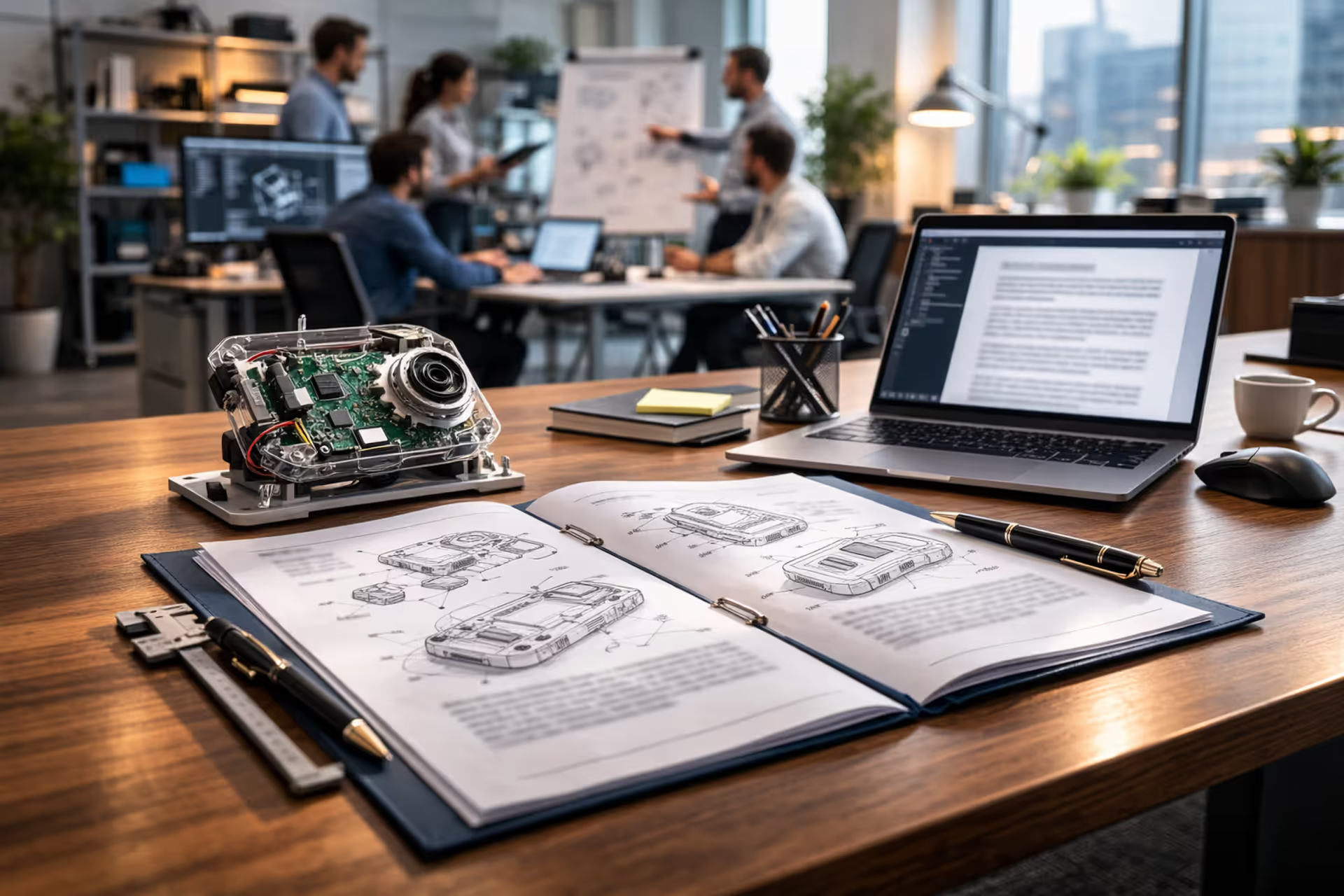
Picture this: Your engineering team just discovered that a competitor's new product looks suspiciously like the device you've been selling for three years—the one protected by two utility patents and a design patent. What happens next? You're probably headed to federal court, where the outcome could mean anything from a nine-figure payout to watching your patents get invalidated entirely.
Here's what most people don't realize about patent disputes in America: they're not just legal technicalities argued by attorneys in suits. These cases reshape entire markets. They've shut down billion-dollar product lines overnight. They've forced companies to pay damages that bankrupted them. And yes, they've also protected small inventors from getting steamrolled by corporate giants with deeper pockets.
Whether you're an inventor who just got a nasty cease-and-desist letter, a startup worried about accidentally infringing someone's IP, or a business owner trying to understand why your competitor just sued you, here's how the system actually works.
What Constitutes Patent Infringement Under US Law
Let's start with the basics. You infringe a patent when you make, use, sell, offer for sale, or import a patented invention without permission while the patent's still active. Sounds simple, right? It's not.
Courts recognize three different types of infringement, and the distinction matters a lot for how much you might owe.
Direct infringement is the easiest to understand. Your product contains every single element listed in at least one of the patent's claims? You infringe directly. Courts use what they call the "all elements rule"—think of it like a recipe. If the patent claims require flour, eggs, sugar, and vanilla, and your product only has flour, eggs, and sugar, you're usually off the hook. Miss even one ingredient, and you typically don't infringe.
The name of the game is the claim.
— Judge Giles S. Rich
That said, there's a catch called the "doctrine of equivalents." Even if you're missing an element, you might still infringe if your substitute performs basically the same function, in basically the same way, to achieve basically the same result. Swapping butter for margarine probably triggers this doctrine. Replacing a combustion engine with an electric motor probably doesn't.
Indirect infringement comes in two flavors, and both can nail you even if you never directly infringe yourself.
Induced infringement means you encouraged or helped someone else infringe. Selling a product with instructions that lead buyers to infringe counts. Marketing your device specifically for infringing uses counts. One famous example involved a company selling software designed to help users copy DVDs—even though the company wasn't copying DVDs themselves, they induced others to do it.
Contributory infringement involves selling a component that's especially made for infringing use and has no substantial non-infringing purpose. Think of it this way: if you manufacture a specialized part that only fits into one product, and that product is patented, you're probably a contributory infringer. The part needs to be pretty specific though—selling generic screws doesn't count, even if some people use them in patented devices.
Willful infringement deserves its own spotlight because it can triple your damages. The Federal Circuit clarified in a 2016 case (Halo Electronics v. Pulse Electronics) that willfulness requires truly egregious behavior—not just knowing about a patent and infringing anyway. You need to have acted in a way that shows reckless disregard for the patent holder's rights.
Author: David Kessler;
Source: skeletonkeyorganizing.com
Smart companies get what's called a "freedom to operate" opinion from patent counsel before launching products. If that opinion reasonably concludes you don't infringe, you've got solid protection against willfulness findings. Even if the opinion turns out wrong, you weren't being reckless.
How do you actually prove infringement? It's a two-step dance. First, the court figures out what the patent claims actually mean (that's claim construction, which we'll get to later). Second, a jury compares the accused product to those interpreted claims. The patent holder needs to prove infringement by a preponderance of evidence—fancy legal speak for "more likely than not," which translates to just over 50% certainty.
Landmark Patent Violation Litigation That Shaped American Business
Some technology patent cases changed how entire industries operate. Let's look at the battles that matter.
Apple v. Samsung became the defining smartphone war of the 2010s. Apple claimed Samsung copied the iPhone's look and feel—everything from rounded corners to the grid of app icons. After years of fighting across multiple trials and appeals, Samsung ultimately paid Apple roughly $539 million, mostly for design patent infringement.
The case established something crucial: design patent damages can equal all the profits from a product, not just the portion attributable to the patented design. The Supreme Court later clarified (Samsung v. Apple, 2016) that "article of manufacture" for damages purposes might be a component rather than the entire phone, but that distinction's still being worked out. When a phone costs $800 to buy and $200 to manufacture, which number matters? Courts are still wrestling with this.
Author: David Kessler;
Source: skeletonkeyorganizing.com
Polaroid v. Eastman Kodak delivered probably the most devastating verdict in patent history. Polaroid sued Kodak in 1976 for infringing its instant photography patents. Fourteen years later—yes, fourteen years—the court awarded Polaroid $909.5 million. But the money wasn't even the worst part for Kodak.
Kodak had to completely exit instant photography. They shut down manufacturing plants representing $1.5 billion in investment. They stopped making all instant cameras and film. Thousands of workers lost their jobs. The case proved that innovation disputes don't just transfer money—they can eliminate product lines worth billions and destroy decades of investment.
NTP v. Research In Motion showed how a small patent-holding company could nearly shut down BlackBerry service for millions of users. NTP owned patents on wireless email technology. RIM (BlackBerry's maker) faced an injunction that would've disabled service for government officials, emergency responders, and countless business users. The settlement? $612.5 million in 2006. The case highlighted tensions around "patent trolls" (though that term's controversial) and demonstrated the enormous leverage an injunction threat creates.
Pharmaceutical patent cases like Pfizer's Lipitor litigation illustrate the "patent cliff" problem. Drug companies file multiple patents covering different aspects of medications—the active ingredient, the formulation, the manufacturing method, and approved uses. When Lipitor faced generic competition, billions in annual revenue hung on whether those patents would survive validity challenges. Generic manufacturers file what's called a Paragraph IV certification, essentially declaring "your patent's invalid or we don't infringe it." These cases directly affect drug prices and patient access, making their impact incredibly broad.
Qualcomm's licensing battles demonstrate how standard-essential patents function in modern tech. Qualcomm holds thousands of patents essential to 3G, 4G, and 5G cellular standards. They've fought with Apple, Samsung, Huawei, and faced regulatory investigations worldwide over their licensing practices. The core question: are they honoring their commitment to license on FRAND terms (fair, reasonable, and non-discriminatory)? The FTC sued them for antitrust violations, won at trial, then partially lost on appeal. It's still ongoing, with billions at stake and fundamental questions about how standard-essential patents work.
How Patent Enforcement Rulings Are Decided in Federal Courts
Patent cases follow a specialized path through federal courts. You file in a US district court—patent disputes fall exclusively under federal jurisdiction. You can file where the defendant's incorporated, where they have a regular physical place of business, or where infringement occurred. The Supreme Court tightened these rules in 2017 (TC Heartland v. Kraft Foods), making it harder for plaintiffs to "forum shop" by filing in notoriously plaintiff-friendly districts like the Eastern District of Texas.
Typical timeline? Plan on two to four years from filing to trial verdict. Complex cases stretch longer—five or six years isn't unusual. Here's how it breaks down:
Initial pleadings (three to six months): The complaint identifies which patents are asserted and which products allegedly infringe. Defendants answer and might file early motions to dismiss.
Discovery (six to twelve months of fact discovery, plus another four to six months for expert discovery): This phase generates massive costs. Companies exchange millions of pages of technical documents, source code, financial records, and internal communications. Engineers sit for multi-day depositions. It's expensive and brutal.
Claim construction (happens throughout, but the hearing typically occurs 12-18 months after filing): This deserves special attention because it often determines who wins.
Summary judgment (two to three months for briefing): Parties argue there's no factual dispute requiring a jury. Courts might grant summary judgment if the accused product clearly doesn't infringe or if prior art obviously invalidates the patent. More commonly, enough factual questions exist to require trial.
Trial (one to three weeks): Juries typically decide infringement, validity, and damages. Judges handle equitable issues like injunctions. Patent trials are theater—expert witnesses try explaining complex technology to jurors with no technical background. The presentation challenge is real.
Post-trial motions and appeals (12-18 months): Losing parties appeal to the Federal Circuit, which has exclusive jurisdiction over patent appeals. About 40% of appealed cases get reversed or modified somehow.
There's also a parallel track through the Patent Trial and Appeal Board (PTAB) at the USPTO. Accused infringers can file an inter partes review (IPR) asking PTAB's administrative judges to invalidate the patent. IPRs are faster and cheaper than district court validity challenges. Many defendants file IPRs to pressure plaintiffs into settling. The Supreme Court upheld IPR constitutionality in 2018 (Oil States v. Greene's Energy), though debates continue about whether letting the patent office revoke previously-granted patents undermines property rights.
The Role of Expert Witnesses in Technology Patent Cases
Expert witnesses translate technical concepts for judges and juries. Both sides hire them—often professors, industry veterans, or specialized consultants who bill $500-$1,000+ per hour.
Patent holders' experts demonstrate infringement. They create claim charts, which are detailed side-by-side comparisons showing how the accused product practices each claim element. They reverse-engineer products, run technical tests, analyze source code, and explain why the product meets every claim limitation. Good infringement experts make complex technology understandable without oversimplifying.
Defendants' experts do the opposite—identify differences between the claims and accused products. They'll testify that a particular claim element is missing, or that the product works fundamentally differently than the patent describes. They're looking for gaps in the claim charts.
Validity experts hunt for prior art that should've prevented the patent from issuing. Was the invention already known? Would it have been obvious to combine existing techniques? A single prior art reference showing every claim element anticipates the patent and invalidates it. Obviousness requires more—typically showing that someone skilled in the field would've found the invention obvious based on combinations of prior art and common knowledge.
Damages experts calculate compensation using economic models. They analyze lost profits, determine reasonable royalty rates, and quantify market harm. These experts pour over sales data, financial statements, market surveys, and comparable licensing agreements. Their testimony often determines award size—the difference between a $5 million verdict and a $50 million verdict.
Expert costs add up fast. Retaining qualified experts for infringement, validity, and damages easily runs $500,000 to $1 million per case. Their credibility matters enormously, so parties invest heavily in finding experts with strong credentials who communicate well.
Claim Construction and the Markman Hearing
Claim construction shapes everything else in patent litigation. Patent claims define the invention using technical language that often needs interpretation. What does "substantially" mean? How about "adapted to" or "configured to"? These seemingly minor word choices can determine whether a product infringes.
The patent system added the fuel of interest to the fire of genius.
— Abraham Lincoln
The court interprets claims from the perspective of someone ordinarily skilled in the relevant technology field at the time of the patent filing. Several sources guide interpretation:
The claim language itself (most important)
The specification—the detailed written description in the patent
The prosecution history—all communications between the inventor and patent examiner during the application process
Extrinsic evidence like expert testimony, technical dictionaries, and treatises (given less weight)
The Markman hearing (named after a 1996 Supreme Court case) is like a mini-trial focused solely on what claims mean. Both sides submit massive briefs—often 100+ pages with hundreds of pages of appendices—arguing for their preferred interpretations. Experts might testify about how skilled engineers would understand disputed terms. The judge issues a written order defining key terms.
Author: David Kessler;
Source: skeletonkeyorganizing.com
Here's the strategic tension: Patent holders generally want broader claim constructions that cover more products. Defendants want narrow constructions that exclude their products. But there's a catch—broader constructions make patents more vulnerable to prior art invalidity arguments. This creates difficult choices. Argue your claims are broad enough to cover the accused product, and you risk the defendant finding prior art that invalidates broadly-construed claims. Argue they're narrow to survive validity challenges, and you might lose infringement.
Claim construction outcomes often trigger settlements. Once claims are construed, both sides can accurately assess their chances. If the construed claims clearly don't cover the defendant's product, plaintiffs face almost certain loss. If construction strongly favors the patent holder, defendants might settle quickly to avoid even larger damages at trial.
Calculating Damages in Intellectual Property Damages Cases
Patent damages compensate for unauthorized use. The Patent Act requires awards "adequate to compensate for the infringement, but in no event less than a reasonable royalty." How courts calculate that varies based on the patent holder's business and available evidence.
Damages Method
Calculation Approach
When Courts Apply It
Typical Range
Lost Profits
Revenue the patent holder would've earned without infringement, minus saved costs from not making those sales
Patent holder competes directly with infringer and can prove the infringement caused specific lost sales
$1M–$500M+ depending on market; requires proving you would've made the infringer's sales
Reasonable Royalty
What a willing licensor and willing licensee would've negotiated knowing the patent's valid and infringed
Default when lost profits can't be proven; patent holder doesn't compete in same market
0.5%–15% of infringing product revenue, heavily dependent on the patent's importance to product value
Enhanced Damages
Multiply compensatory damages by up to 3x for egregious infringement
Infringer knew about the patent and had no reasonable basis for thinking their conduct was lawful
1.5x–2x most common; full 3x enhancement rare and reserved for truly outrageous cases
Lost profits follow the Panduit test (from a 1978 case), requiring proof of four elements:
Demand existed for the patented product
No acceptable non-infringing substitutes were available
You had manufacturing and marketing capability to meet demand
The specific profit amount you would've earned
This gets complicated fast. If ten competitors sell similar products, proving you would've captured the infringer's sales becomes difficult. If the infringing product has additional features yours lacks, maybe customers bought it for those other features, not the patented technology.
Author: David Kessler;
Source: skeletonkeyorganizing.com
Price erosion adds another layer. Even sales you actually made might've occurred at artificially low prices because infringement forced you to cut prices to stay competitive. You can recover the difference between what you charged and what you would've charged without infringing competition.
Reasonable royalty uses a hypothetical negotiation framework. Courts imagine the parties sitting down to negotiate a license right before infringement began, with both sides knowing the patent's valid, infringed, and enforceable. What would they agree to?
The Georgia-Pacific factors (from a 1970 case) provide 15 considerations: existing licenses for the patent, rates paid for comparable patents, the nature and scope of the license, the patent holder's licensing policy, the commercial relationship between the parties, and eight other factors. In practice, courts focus heavily on actual comparable licenses when they exist.
One crucial limit: the smallest salable patent-practicing unit principle. Royalties should be based on the component that actually uses the patent, not the entire product, unless the patent drives demand for the whole thing. Courts reject royalty calculations based on a phone's full price when the patent covers only a minor feature like a notification system. This prevents patent holders from leveraging unrelated value into inflated damages.
Real-world damages vary wildly. Small cases settle for under $1 million. Mid-sized cases typically land between $5-50 million. Blockbuster verdicts reach hundreds of millions. The largest patent jury verdict ever came in 2012 when Apple initially won $1.05 billion from Samsung (later reduced on appeal to around $539 million). Most cases fall somewhere in the low millions.
Enhanced damages for willful infringement allow courts to punish particularly bad behavior. After the Halo decision in 2016, courts have discretion to enhance up to 3x compensatory awards when appropriate. Relevant factors include whether the infringer copied the invention, received clear notice and continued anyway, or tried to conceal their activities. Enhanced damages appear in roughly 10-15% of cases with infringement findings—they're not automatic, even when willfulness is proven.
Common Defenses Against Patent Infringement Claims
Accused infringers have multiple strategies to defeat claims or minimize damages. Success can eliminate cases entirely or force favorable settlements.
Non-infringement arguments challenge whether accused products actually practice the claimed invention. Defendants identify missing claim elements or argue their products work differently than the patent describes. Design-arounds—engineering changes that avoid patent claims—often succeed, especially after narrow claim constructions. Many companies redesign products mid-litigation, eliminating problematic features before trial.
Invalidity defenses attack whether the patent should've been granted initially. This involves hunting for prior art the examiner didn't see—earlier patents, academic publications, products on the market, or public demonstrations that showed the invention before the patent filing date.
Anticipation requires finding a single prior art reference that discloses every claim element. One earlier patent or publication that describes the complete invention invalidates for anticipation.
Obviousness is more nuanced. Even if no single reference shows everything, the invention might be invalid if combining multiple references or applying common knowledge would've made it obvious to someone skilled in the field. About 40% of litigated patents that face serious validity challenges end up invalid.
The presumption of validity protects issued patents, requiring "clear and convincing evidence" to invalidate—a higher standard than the normal "preponderance of evidence" used for most civil claims. But prior art the examiner never saw gets less deference, making it more powerful for invalidity arguments.
Patent exhaustion provides complete defense when patent holders already sold the accused product or authorized its sale. The Supreme Court held in 2017 (Impression Products v. Lexmark) that authorized sales exhaust patent rights. Once you sell a patented product, you can't control what buyers do with it through patent law. This limits patent holders' ability to impose post-sale restrictions, though contractual restrictions might still create breach claims.
Inequitable conduct allegations claim patent holders deceived the USPTO during prosecution—typically by hiding material prior art or making false statements. You need to prove the withheld information was material and the applicant intended to deceive. Success renders the entire patent unenforceable.
The Federal Circuit raised the bar for inequitable conduct in 2011 (Therasense v. Becton Dickinson), making these defenses harder to prove. You can't just show the applicant failed to disclose something relevant—you need evidence of deliberate deception with intent to mislead. These defenses are less common now.
Laches argues the patent holder waited too long to sue, prejudicing the defendant who invested heavily in the accused technology thinking no lawsuit would come. The Supreme Court limited laches in 2017 (SCA Hygiene v. First Quality), holding it can't bar damages within the six-year statutory limitations period. Laches might still prevent injunctions in rare circumstances.
License defenses arise when defendants claim express or implied permission. Express licenses come from written agreements. Implied licenses are trickier—they might arise from conduct, like selling a product that inherently requires using the patent. Courts find implied licenses reluctantly, requiring clear evidence the patent holder intended to grant permission.
Innovation Disputes: When Multiple Patents Collide
Modern products implicate thousands of patents, creating complex situations where numerous parties hold overlapping rights. Smartphones alone incorporate patented technologies for processors, displays, wireless chips, cameras, batteries, software interfaces, security features, and countless other components.
Patent thickets occur when dense webs of patents cover a single technology area. No smartphone manufacturer can build devices without potentially infringing hundreds or thousands of patents owned by competitors, suppliers, universities, and patent-holding companies. This forces extensive licensing arrangements.
Cross-licensing agreements let companies exchange patent rights, each granting the other permission to use their portfolios. Many involve no cash payments when parties hold roughly equivalent patent collections. These deals reduce transaction costs and let companies focus on innovation rather than constant litigation threats.
Apple and Microsoft, despite competing in several markets, have cross-licensed patents. Google and Samsung have done the same. Even fierce competitors often find mutual benefit in these arrangements.
Not everyone plays along though. Some companies refuse cross-licensing, preferring aggressive assertion. This works when you hold particularly strong patents covering essential technologies others can't avoid. Qualcomm built its business model around licensing rather than cross-licensing, charging royalties to virtually all device manufacturers. This generated billions in licensing revenue but also triggered antitrust investigations worldwide.
Standard-essential patents (SEPs) cover technologies required for industry standards compliance. When standards bodies adopt specifications for Wi-Fi, LTE, 5G, Bluetooth, video codecs, or other interoperable tech, those specifications incorporate patented inventions. SEP holders commit to license on FRAND terms—fair, reasonable, and non-discriminatory. These commitments prevent SEP holders from using standards adoption to hold up implementers or charge excessive royalties.
FRAND disputes arise over what constitutes fair and reasonable. SEP holders argue their patents deserve premium rates because they're essential—you literally can't comply with the standard without them. Implementers counter that FRAND commitments require below-market rates precisely because alternatives were eliminated when the standard was adopted.
Courts worldwide struggle with FRAND. What's a fair royalty rate? Can SEP holders seek injunctions, or are they limited to monetary damages? The Federal Circuit generally holds FRAND commitments preclude injunctions, but European courts sometimes reach different conclusions.
Patent pools offer another solution. Multiple patent holders contribute patents to a common pool, which licenses the entire collection to implementers for a single fee. MPEG video compression uses patent pools, letting device makers obtain all necessary patents through one transaction. Pools reduce costs and litigation risks, though they require careful antitrust analysis to ensure they're not facilitating price-fixing.
Non-practicing entities (NPEs)—sometimes called patent trolls, though that's controversial—assert patents without manufacturing products. This category includes universities, individual inventors, bankrupt companies' patent estates, and specialized licensing firms.
NPEs play complex roles. Supporters argue they help inventors monetize patents and facilitate technology transfer from research labs to commercial products. Critics contend many NPEs assert weak patents against operating companies, exploiting litigation costs to extract nuisance settlements below the cost of defense.
NPE litigation differs from disputes between manufacturers because NPEs face no counterclaim risk—they don't make products that could infringe others' patents. This asymmetry changes settlement dynamics substantially. Operating companies can't threaten mutually assured destruction through counter-suits.
Congress and courts have implemented NPE-focused reforms, including fee-shifting provisions that let prevailing parties recover attorney fees in "exceptional cases" and heightened pleading requirements forcing more specific infringement allegations upfront.
Frequently Asked Questions About Patent Infringement Cases
How long does a typical patent infringement lawsuit take in the US?
Most patent cases run two to four years from filing to trial verdict, though complex technology disputes can stretch five to six years. You're looking at several phases: initial pleadings and motions (three to six months), fact discovery where parties exchange documents and take depositions (six to twelve months), expert discovery with competing technical and damages experts (four to six months), claim construction proceedings (throughout), summary judgment briefing (two to three months), and trial itself (one to three weeks). Appeals tack on another 12 to 18 months. Some districts move faster—the Eastern District of Virginia earned the nickname "rocket docket" for pushing cases to trial in 18-24 months. Parallel PTAB proceedings can extend timelines when district courts stay litigation pending administrative review. That said, most cases settle before trial, particularly after claim construction when both sides can better predict outcomes.
What is the average cost of defending a patent infringement case?
Brace yourself. The American Intellectual Property Law Association's most recent survey found median defense costs of $3-6 million for cases with over $25 million at risk through trial. Cases involving $1-25 million in potential damages average $1-3 million. Even smaller cases with under $1 million at stake still cost $500,000-$1 million to defend through verdict. Discovery drives major costs—reviewing millions of pages of documents, taking and defending depositions, responding to interrogatories. Expert witnesses run $300,000-$500,000+ per expert for reports, depositions, and trial testimony. Attorney fees for experienced patent litigators range $400-$1,000+ hourly. Costs concentrate during discovery and expert phases. Companies facing multiple patent suits simultaneously can easily spend $20-50 million annually on patent litigation. This explains why nuisance settlements happen—paying $500,000 to settle a weak case beats spending $2 million to win it.
Can I be sued for patent infringement if I independently invented the same technology?
Yes, absolutely. US patent law grants rights to whoever files first, regardless of who actually invented first. Independent invention provides zero defense to infringement. If someone patents an invention before you, and you later independently develop identical technology without any knowledge their patent exists, you still infringe by making, using, or selling it. This differs fundamentally from copyright and trade secret law, where independent creation does provide a defense. The patent system's rationale is that patents provide public notice through publication, letting others search databases to avoid infringement. Independent invention might help you avoid willful infringement findings, potentially reducing enhanced damages, but it doesn't eliminate basic liability. This reality makes pre-development patent clearance searches critical. Many companies conduct freedom-to-operate analyses before launching new products, searching for patents that might be infringed and either designing around them or seeking licenses proactively.
What happens if I lose a patent infringement case?
Several consequences follow adverse verdicts. First, you pay damages—lost profits the patent holder would've earned, a reasonable royalty, or potentially enhanced damages up to triple compensatory amounts for willful infringement. Second, courts might issue injunctions prohibiting future infringement, forcing you to stop making, using, or selling accused products. Injunctions can devastate businesses, requiring complete product redesigns or withdrawal from lucrative markets. Third, you might pay the patent holder's attorney fees if the court finds your case "exceptional" under Section 285, though fee-shifting remains discretionary and uncommon. Fourth, you face ongoing royalty obligations if you want to continue activities that previously infringed—courts often impose compulsory licenses with judicially-determined rates. Fifth, adverse judgments may trigger indemnification obligations to customers and damage business relationships. Finally, your stock price might tank and customers might flee to competitors. These collective consequences explain why defendants often settle—paying negotiated amounts for past infringement and licensing future use beats the risk of catastrophic verdicts.
Do I need to sue immediately after discovering infringement?
No strict deadline requires immediate filing, though waiting creates risks. Patent holders get six years from each infringement act to sue for damages from that act under Section 286. Waiting beyond six years bars recovery for older infringement, though you can still sue for recent violations. Unreasonable delay might support laches defenses in limited circumstances, potentially barring injunctions. Strategically, immediate action often makes no sense. Smart patent holders investigate thoroughly before filing—confirming infringement, assessing damages magnitude, identifying all relevant patents, and gathering evidence. Some send cease-and-desist letters before suing, giving potential infringers chances to take licenses or design around patents. Others file immediately to prevent accused infringers from building larger businesses on infringing technology. Filing too quickly with incomplete preparation can result in weak complaints that get dismissed or amended multiple times. However, extended delay lets infringers become more entrenched, making eventual remedies less effective and damages harder to prove. There's no perfect answer—timing depends on your specific situation, the strength of your evidence, and strategic considerations about settlement prospects.
Can patent infringement cases be settled out of court?
Absolutely, and most do. Somewhere between 85-95% of patent cases settle before trial verdicts. Settlements offer compelling advantages to both sides: outcome certainty, dramatically reduced legal costs, faster resolution, and confidentiality. Patent holders get guaranteed compensation without trial risks—no chance the jury invalidates their patents or finds no infringement. Accused infringers avoid potentially massive damages and product-killing injunctions. Settlement terms vary enormously. Some involve one-time lump-sum payments for past infringement. Others include ongoing royalties for future use, essentially creating licenses. Many settlements include cross-licenses granting both parties rights to each other's patent portfolios. Some involve no monetary payment at all when validity or infringement questions create mutual risks—both sides just walk away. Courts actively encourage settlement through mandatory mediation programs and settlement conferences. Parties can settle at any litigation stage—before filing through pre-suit negotiations, during litigation at any point, even after trial while appeals pend. Some of the biggest headline patent cases settled after years of fighting—both sides eventually realized settlement beat continued uncertainty and expense.
Moving Forward With Patent Protection and Enforcement
Patent infringement cases sit at the intersection of law, technology, and business strategy. Understanding how courts analyze these disputes—from claim construction mechanics through damages methodologies—helps everyone from solo inventors to multinational corporations make smarter decisions about protecting innovations and responding to allegations.
The landscape keeps shifting. Recent Supreme Court decisions narrowed patent scope, tightened venue rules, and limited when courts grant injunctions. PTAB proceedings created new channels for challenging validity outside traditional litigation. Damage calculations face ongoing refinement, especially for products incorporating thousands of patented features. International dimensions grow increasingly important as technology markets globalize and enforcement occurs across multiple jurisdictions simultaneously.
For patent holders, successful enforcement starts with solid patents—clear claims, thorough specifications, and good prosecution histories. Building strategic portfolios, documenting development carefully, and monitoring markets for potential infringement creates stronger enforcement positions. For companies facing allegations, early case assessment with competent counsel and realistic analysis of settlement versus litigation options minimizes costs and business disruption.
The patent system exists to encourage innovation by providing limited monopolies in exchange for public disclosure. Patent infringement cases enforce these bargains, ensuring inventors benefit from breakthroughs while preventing patents from stifling competition unfairly. Whether you're asserting patents, defending claims, or navigating the patent landscape, understanding how courts handle these disputes provides essential knowledge for participating in America's innovation economy. The stakes are real, the outcomes matter, and the details determine who wins.
Twelve real trademark disputes reveal where courts draw the line between brand protection and overreach. From Adidas' $304M verdict against Payless to Louboutin's red sole defense against YSL, this guide covers the likelihood-of-confusion standard, dilution claims for famous marks, why parody defenses fail for competitors, small business vulnerability to trademark bullying, and the costly mistakes
Every negligence claim demands proof of four elements — and falling short on just one collapses the case entirely. This guide traces real verdicts from Palsgraf's foreseeability limits to Ford Pinto's punitive damages, covering medical malpractice, premises liability, motor vehicle accidents, product defects, comparative fault systems across states, and how courts calculate compensatory vs. puniti
Bad outcomes don't automatically mean malpractice — courts draw strict lines between unfortunate results and compensable negligence. This guide covers all four required legal elements, common claim types from surgical errors to birth injuries, real verdict examples ranging from defense wins to $41.5M awards, damage caps by state, filing deadlines, and how 90% of cases actually resolve.
Fifteen Supreme Court cases that rewrote American law — from Marbury v. Madison establishing judicial review to Dobbs overturning Roe. Each ruling is examined through its real-world impact on policing, schools, marriage, privacy, and free speech, with tables comparing before-and-after effects on daily life and guidance on researching case law yourself.
The content on Legal Insights is provided for general informational purposes only. It is intended to offer insights, commentary, and analysis on legal topics and developments, and should not be considered legal advice or a substitute for professional consultation with a qualified attorney.
All information, articles, and materials presented on this website are for general informational purposes only. Laws and regulations may vary by jurisdiction and may change over time. The application of legal principles depends on specific facts and circumstances.
Legal Insights is not responsible for any errors or omissions in the content, or for any actions taken based on the information provided on this website. Users are encouraged to seek independent legal advice tailored to their individual situation before making any legal decisions.