

An ounce of prevention is worth a pound of cure.
— Benjamin Franklin
Breach of Contract Case Examples
Breach of Contract Cases: Real Examples and What Courts Actually Award
Author: Michelle Granton;Source: skeletonkeyorganizing.com
Content
Advertisement
Contract disputes land in court every day, but understanding how judges actually rule—and what plaintiffs walk away with—requires looking at real outcomes, not just theory. Whether you're a business owner facing a vendor who didn't deliver or an individual dealing with a contractor who abandoned a project, knowing what courts consider, how they calculate damages, and which precedents guide their decisions can mean the difference between recovering your losses and walking away empty-handed.
What Qualifies as a Breach of Contract in Court
Courts don't treat every broken promise as grounds for a lawsuit. To bring a successful breach of contract case, you must prove four elements: a valid contract existed, you performed your obligations (or had a valid reason not to), the other party failed to perform, and you suffered measurable harm. That last point trips up many plaintiffs—being annoyed isn't enough. You need documented financial losses, missed opportunities with dollar values, or other quantifiable damages.
Material vs. Minor Breaches
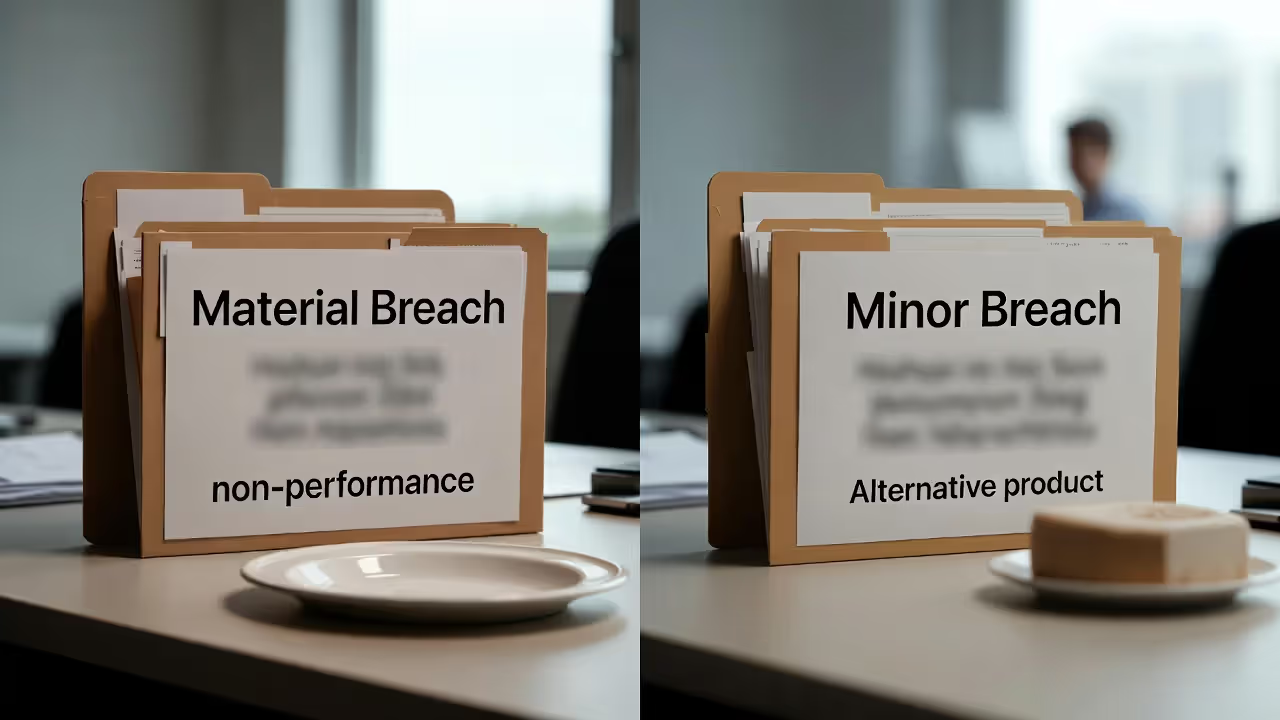
Not all breaches carry the same weight. A material breach goes to the heart of the agreement and substantially defeats its purpose. If you hired a caterer for 200 guests at your corporate event and they simply didn't show up, that's material—the entire contract became worthless. Courts allow the non-breaching party to stop performing their own obligations and sue for all damages.
Most disputes are about the facts, not the law.
— John Roberts
Minor breaches (sometimes called partial breaches) involve small deviations that don't destroy the contract's core value. The caterer arrives but serves chicken instead of the specified beef, yet the meal is comparable quality and price. You still got a catered event. Courts typically require you to complete your end of the deal (pay the agreed price) but allow you to recover the cost difference or any additional expenses caused by the deviation.
The distinction matters enormously. In material breach cases, you can cancel the contract and pursue full expectation damages. With minor breaches, you're stuck completing the contract while seeking much smaller adjustments.
Author: Michelle Granton;
Source: skeletonkeyorganizing.com
Anticipatory Repudiation
Sometimes breaches happen before the performance date arrives. If your software vendor emails you three weeks before launch saying they won't deliver the custom platform they promised, that's anticipatory repudiation. You don't have to wait until the deadline passes to sue—courts recognize that you need to protect yourself and find alternatives.
The repudiation must be clear and unequivocal. Expressing doubt about meeting deadlines doesn't count. Saying "we might need an extension" differs vastly from "we're not building this for you." Once anticipatory repudiation occurs, you can immediately seek damages and hire a replacement vendor. Courts will even credit you for mitigating damages by finding that replacement quickly rather than waiting and letting your losses compound.
7 Notable Breach of Contract Cases That Shaped Contract Law
Real breach of contract cases examples reveal how courts think through damages, interpret vague terms, and balance competing interests. These seven cases remain cited in courtrooms today.
Hadley v. Baxendale (1854) – A mill owner hired a shipping company to transport a broken crankshaft to the manufacturer for repairs. The shipper delayed delivery by several days, forcing the mill to stay closed longer and lose additional profits. The court ruled the mill owner couldn't recover those lost profits because the shipper had no reason to know the mill would be completely shut down during the delay. This case established that consequential damages must be reasonably foreseeable at the time of contracting. If you want to recover special damages, communicate the stakes upfront.
Hawkins v. McGee (1929) – A surgeon promised to make a patient's scarred hand "one hundred percent perfect" but the surgery made it worse, leaving it hairy and unusable. The New Hampshire Supreme Court ruled the patient could recover expectation damages—the difference between a perfect hand (what was promised) and his current condition. This case cemented the principle that when someone guarantees a specific result, they're liable for the value of that result, not just reasonable care.
Peevyhouse v. Garland Coal & Mining Co. (1962) – A coal company promised to restore farmland after strip mining but refused, arguing restoration would cost $29,000 while only increasing the land's value by $300. The Oklahoma Supreme Court limited damages to $300, the diminished property value. This controversial ruling established that when the cost of performance vastly exceeds any economic benefit, courts may award diminished value rather than cost of completion. Many jurisdictions still debate this rule.
Jacob & Youngs v. Kent (1921) – A contractor built a home but used a different brand of pipe than specified in the contract, though the substitute was identical in quality and price. Judge Benjamin Cardozo ruled this was a minor breach, and tearing down walls to replace functional pipe would be economic waste. The homeowner recovered nominal damages only. This case reinforced that courts look at practical substance, not just technical compliance.
Alaska Packers' Ass'n v. Domenico (1902) – Fishermen sailed to Alaska under contract, then refused to work unless paid more, knowing the company had no alternatives mid-season. The company agreed but later refused to pay the higher amount. The court sided with the company, ruling the modification lacked consideration because the fishermen were already obligated to perform. This contract law precedent established that threatening to breach an existing contract doesn't create valid consideration for modification.
Lumley v. Wagner (1852) – An opera singer contracted to perform exclusively at one theater but then agreed to sing at a competitor's venue. The court granted an injunction preventing her from performing elsewhere, even though it couldn't force her to sing at the original theater. This case established that specific performance can take the form of negative enforcement—stopping someone from breaching even when you can't compel the exact performance promised.
Lefkowitz v. Great Minneapolis Surplus Store (1957) – A store advertised "1 Black Lapin Stole, Beautiful, worth $139.50... $1.00 First Come First Served" but refused to sell to the plaintiff, claiming the offer was only for women. The Minnesota Supreme Court held the advertisement was a binding offer (not just an invitation to negotiate) because it was specific, left nothing to negotiation, and explicitly limited quantity. The plaintiff recovered the difference between the advertised price and the stole's actual value.
Types of Damages Courts Award in Contract Breach Cases
Understanding what you can actually recover shapes whether litigation makes financial sense. Courts don't award damages to punish (except in rare cases)—they aim to put you in the position you'd occupy if the contract had been performed.

Author: Michelle Granton;
Source: skeletonkeyorganizing.com
Compensatory Damages
These form the backbone of damages for breach cases. Compensatory damages cover direct losses caused by the breach: the money you paid that you didn't get value for, the additional cost of hiring a replacement vendor, or the difference between what you were promised and what you received.
A contractor abandons your kitchen renovation halfway through. You paid $15,000 and now must pay a new contractor $22,000 to complete the same work. Your compensatory damages would be $7,000—the additional cost above what you'd already budgeted. If you can prove the delay forced you to eat restaurant meals for three extra months at $400/month, that's another $1,200 in direct damages.
Courts require reasonable certainty. You can't claim a new vendor will charge $50,000 when three quotes show $22,000-$25,000. Bring documentation: contracts, invoices, quotes, receipts. "I think it'll cost around..." doesn't win cases.
Consequential and Incidental Damages
Consequential damages (also called special damages) flow indirectly from the breach but were foreseeable. Your e-commerce platform crashes during Black Friday because your hosting company's servers failed, and you can prove $80,000 in lost sales. Those lost profits are consequential damages—if the hosting company knew you were an online retailer with major holiday traffic.
Incidental damages cover the costs of dealing with the breach itself: hiring an attorney to review the situation, paying rush shipping to get replacement materials, or traveling to inspect defective goods. These are usually smaller but add up. Keep every receipt.
The foreseeability requirement matters enormously. When negotiating contracts, if a breach would cause you unusual or substantial consequential damages, state that explicitly in the contract or in pre-contract communications. "Our entire production line depends on this delivery; any delay costs us $10,000 per day" creates a record that makes those damages recoverable.
Liquidated Damages vs. Penalties
Many contracts include liquidated damages clauses specifying a predetermined amount for breach. Construction contracts often include "$500 per day for each day past the completion deadline." Courts enforce these if the amount represents a reasonable forecast of actual damages and calculating real damages would be difficult.
The amount must be proportional. If you're renting a vacation cabin for $2,000/week and the contract says $10,000/day for cancellation, courts will void that as an unenforceable penalty. But $2,000 for canceling within seven days of arrival would likely stand—it approximates the owner's difficulty re-booking on short notice.
Well-drafted liquidated damages clauses save enormous litigation costs. Instead of spending months proving actual damages, you point to the contract. The breaching party can argue the clause is a penalty, but if the amount was reasonable when the contract was signed, courts usually enforce it.
Specific Performance and Injunctive Relief
Money doesn't always make you whole. Courts order specific performance—forcing the breaching party to actually do what they promised—when the subject matter is unique. Real estate contracts routinely result in specific performance because every property is considered one-of-a-kind. Courts will order the seller to transfer title rather than just pay damages.
For services or goods, specific performance is rare. Courts won't force someone to work for you (that raises Thirteenth Amendment concerns) or manufacture custom goods when damages can compensate you. But for truly irreplaceable items—a family heirloom, a business with unique market position, intellectual property—specific performance becomes available.
Injunctive relief prevents ongoing or future breaches. If your former employee is violating a non-compete agreement, an injunction stops them from continuing to compete while you litigate damages. If a supplier is selling your proprietary designs to competitors, an injunction halts those sales.
| Damage Type | Definition | When Awarded | Typical Amount Range | Example Scenario |
| Compensatory | Direct losses from breach | Nearly all breach cases | Actual documented losses | Cost to hire replacement contractor after abandonment |
| Consequential | Indirect, foreseeable losses | When defendant knew special circumstances | Varies widely; requires proof of foreseeability | Lost business profits from delayed product launch |
| Liquidated | Pre-agreed amount in contract | When reasonable estimate of damages | Per contract terms (if not a penalty) | $500/day for late construction completion |
| Nominal | Token amount when breach proven but no real harm | Technical breaches without measurable loss | $1-$100 | Wrong brand of pipe installed but equal quality |
| Punitive (rare) | Punishment for malicious conduct | Only when breach also involves fraud/bad faith tort | Varies; often capped by state law | Fraudulent misrepresentation inducing contract |
How Commercial Contract Disputes Differ from Consumer Cases
Author: Michelle Granton;
Source: skeletonkeyorganizing.com
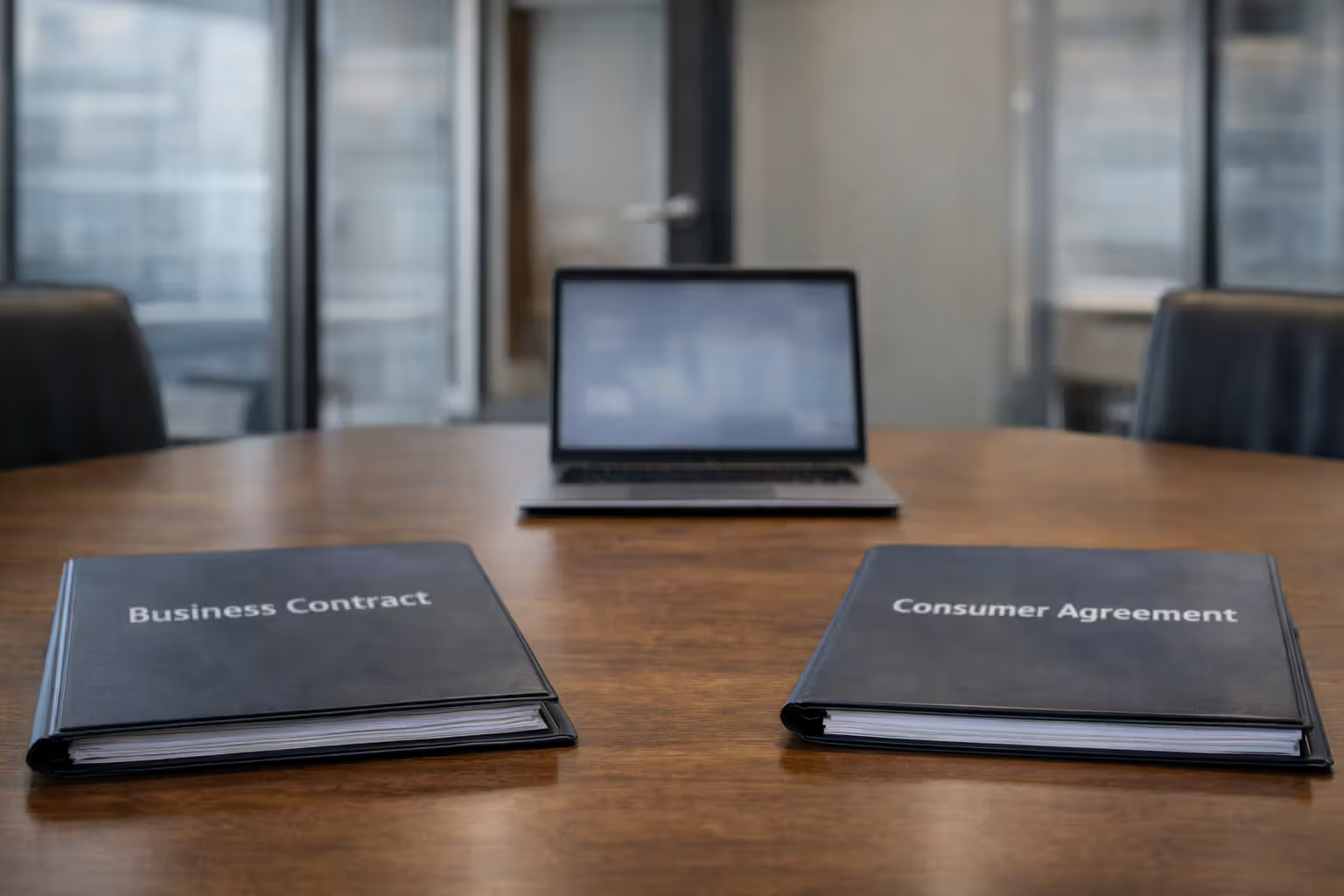
Commercial contract disputes operate in a different universe than consumer cases. The stakes are higher, the contracts more sophisticated, and the procedural landscape more complex.
Business-to-business agreements routinely include choice-of-law and forum-selection clauses. Your California company might find itself litigating in Delaware courts under New York law because that's what the contract specified. Courts generally enforce these provisions, meaning you can't just sue in your local courthouse. Before signing, understand where you'd need to travel and which state's laws would apply.
Arbitration clauses appear in most commercial contracts. Unlike mediation (which is non-binding), arbitration produces a final, enforceable decision with extremely limited appeal rights. Arbitration can be faster and cheaper, but you lose the right to a jury trial and your ability to appeal an arbitrator's mistakes. Some industries favor arbitration; others see it as favoring repeat players (large companies that arbitrate frequently) over one-time participants.
Discovery in commercial cases dwarfs consumer litigation. Businesses have extensive records: emails, internal communications, financial statements, meeting minutes. A commercial contract dispute litigation might involve reviewing hundreds of thousands of documents. This drives up costs but also provides more evidence. Small businesses sometimes settle not because they'd lose but because they can't afford $100,000 in discovery costs.
Damages in commercial cases often include lost profits, which require expert testimony. You'll need an accountant or economist to calculate and testify about what your business would have earned but for the breach. These experts charge $300-$500 per hour or more. Consumer cases rarely justify that expense.
Commercial parties also have more sophisticated defenses. Force majeure clauses excuse performance during unforeseeable events. Material adverse change provisions allow parties to exit under certain conditions. Limitation of liability clauses cap damages regardless of actual losses. Consumer contracts include these less frequently, and courts scrutinize them more carefully when they do.
Common Mistakes That Weaken Your Contract Enforcement Case
Even strong cases fall apart due to preventable errors. Recognizing these pitfalls before filing saves money and heartache.
Inadequate documentation kills more cases than bad law. You claim the vendor promised 24/7 support, but the signed contract says "business hours only" and you have no emails clarifying otherwise. Courts enforce written agreements. If you negotiate changes verbally or via email, immediately document them in a written amendment signed by both parties. Save all communications. That casual text message might prove the other party acknowledged missing a deadline.
Missing statute of limitations deadlines ends cases before they start. Every state sets time limits for filing breach of contract lawsuits—typically 3-6 years for written contracts, 2-3 years for oral agreements. The clock usually starts when the breach occurs, not when you discover damages. If a contractor did defective work in 2019 but you didn't notice until 2024, you might be out of luck. Check your state's specific deadlines immediately when a breach occurs.
Failing to mitigate damages reduces your recovery even if you win. You can't let damages pile up when reasonable efforts would minimize them. If a supplier doesn't deliver materials, you must try to find alternatives, not just wait while your project sits idle for months. Courts reduce awards by the amount you could have prevented through reasonable mitigation. Document your mitigation efforts: quotes from alternative vendors, attempts to negotiate solutions, steps taken to minimize losses.
Unclear contract terms create ambiguity that courts resolve against the drafter. If your contract says "reasonable quality" or "timely delivery" without specifics, you'll spend thousands litigating what those terms mean. The other side will claim their interpretation was reasonable. Define key terms precisely: "delivery within 14 calendar days of order," "materials meeting ASTM D-1234 specifications," "response to support tickets within 4 business hours."
Continuing to perform after material breach can waive your right to cancel the contract. If the other party materially breaches but you keep performing your obligations without objection, courts may find you accepted the breach or treated it as minor. When a material breach occurs, document it immediately in writing, state that you consider it material, and clarify whether you're suspending your own performance. Don't stay silent and sue later.
Poor record-keeping of your own performance lets defendants claim you breached first. Keep proof you met every deadline, delivered every milestone, and followed every specification. If you're accused of breaching, you need evidence showing full compliance. Time-stamped emails, delivery confirmations, signed acceptance forms, and payment records all matter.
When to Pursue Litigation vs. Alternative Dispute Resolution
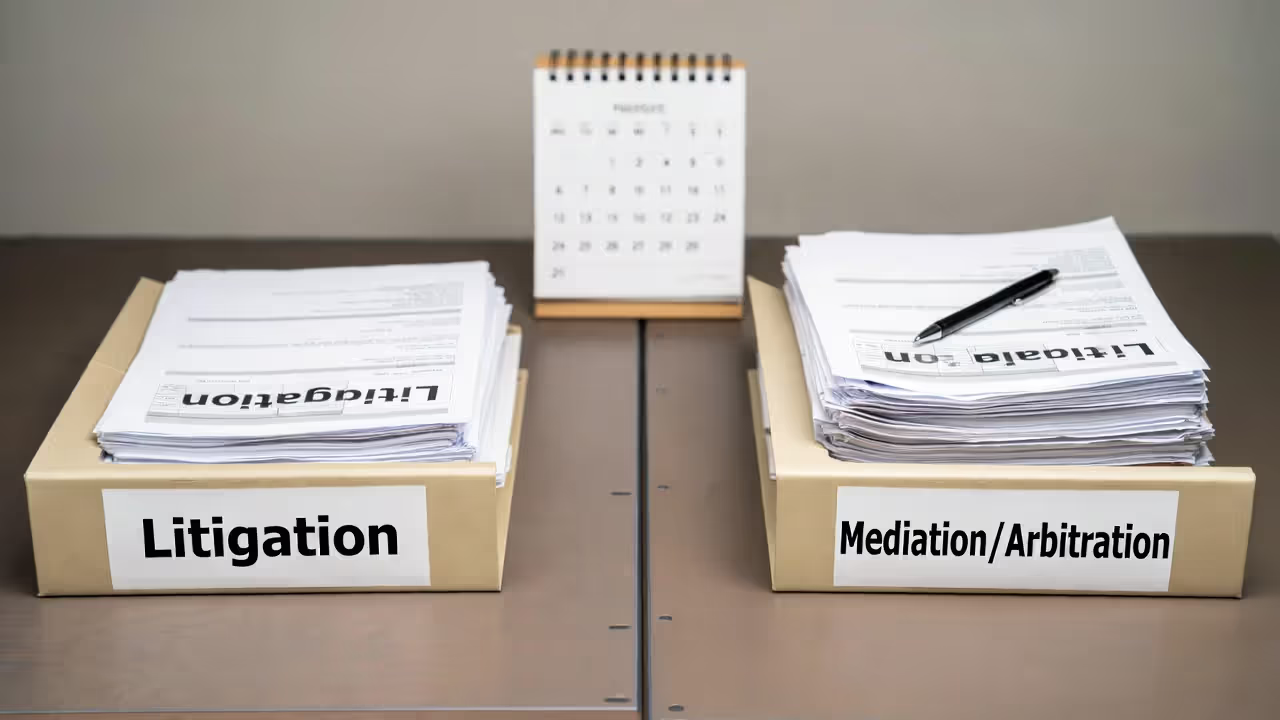
Not every breach belongs in court. The decision involves cold math: potential recovery minus costs and risks, multiplied by probability of success.
Author: Michelle Granton;
Source: skeletonkeyorganizing.com
Cost-benefit analysis starts with realistic damages. If your maximum recovery is $15,000 and litigation will cost $20,000 in attorney fees, you're paying to prove a point. Small claims court handles cases up to $5,000-$10,000 (depending on state) without attorneys, making it cost-effective for smaller disputes. For mid-sized cases ($10,000-$100,000), consider whether you can handle some work yourself or find an attorney willing to work on contingency (rare in contract cases but possible if damages are clear).
Timeline matters more than people expect. Contract dispute litigation takes 1-3 years from filing to trial in most jurisdictions. Complex commercial cases can stretch to 5 years. During that time, you're paying legal fees, dealing with discovery, and living with uncertainty. If you need resolution quickly—perhaps to satisfy your own creditors or move forward with business plans—even a less favorable settlement might beat waiting years for a judgment.
Arbitration offers speed and finality. Most arbitrations resolve within 6-12 months. You skip court backlogs and get a decision-maker with relevant expertise (many arbitrators are retired judges or industry specialists). The downside: arbitration often costs as much as litigation once you factor in arbitrator fees ($300-$500/hour split between parties), and you have almost no appeal rights. If the arbitrator makes a legal error, you're stuck with it.
Mediation preserves relationships and flexibility. A mediator facilitates negotiation but doesn't impose a decision. You control the outcome. Mediation works brilliantly when both parties want to resolve the dispute but need help finding middle ground, or when preserving the business relationship matters. It fails when one party has no incentive to settle (perhaps they're judgment-proof) or when the legal issues are so clear-cut that one side knows they'll win in court.
| Method | Average Timeline | Cost Range | Binding? | Best For |
| Court litigation | 18-36 months (trial); 6-12 months more for appeals | $25,000-$150,000+ (attorney fees, expert witnesses, court costs) | Yes, but appealable | High-stakes cases, need for precedent, when other party likely to pay judgment |
| Arbitration | 6-12 months | $15,000-$75,000+ (attorney fees, arbitrator fees, administrative costs) | Yes, very limited appeal rights | Contracts requiring arbitration, need for expertise, desire for privacy |
| Mediation | 1-3 months | $2,000-$15,000 (mediator fees, attorney prep time) | No, voluntary settlement only | Ongoing relationships, both parties motivated to settle, creative solutions needed |
Consider enforceability before choosing a forum. Winning a judgment means nothing if you can't collect. If the defendant has no assets or operates in a jurisdiction that won't enforce your judgment, even a court victory leaves you with legal bills and no recovery. Arbitration awards are often easier to enforce internationally under the New York Convention. Small claims judgments can be hard to collect if the defendant simply ignores them.
Attorney fee provisions flip the calculus. If your contract includes a prevailing party attorney fee clause, litigation becomes more attractive—you can recover your legal costs if you win. Without such a clause in most states, you pay your own attorneys regardless of outcome. Before signing contracts, negotiate for attorney fee provisions; they discourage frivolous defenses and make enforcement economically viable.
Frequently Asked Questions About Contract Breach Lawsuits
Making Strategic Decisions About Contract Enforcement
Contract breaches force business and legal decisions simultaneously. The strongest legal case still requires economic sense—spending $50,000 to recover $30,000 might feel righteous but leaves you $20,000 poorer. Before filing, get three things clear: your realistic damages (not wishful thinking), the defendant's ability to pay a judgment, and your tolerance for the time and stress litigation demands.
Documentation built before disputes arise matters more than brilliant lawyering after. Clear contract terms, written confirmations of changes, and organized records of performance turn uncertain cases into winners. If you're entering significant contracts, spending $1,000-$3,000 for attorney review now prevents $50,000 litigation bills later.
When breach occurs, act quickly but thoughtfully. Document the breach in writing, notify the other party, preserve evidence, and consult an attorney before taking positions you can't walk back. Sometimes a well-drafted demand letter resolves disputes that would otherwise spiral into litigation. Other times, immediate filing prevents the other party from hiding assets or destroying evidence.
Understanding how courts actually rule in breach of contract cases—what damages they award, which defenses succeed, and how they interpret ambiguous terms—transforms abstract contract language into concrete risk assessment. These cases aren't just legal theory; they're real disputes where businesses survive or fail based on whether contracts can be enforced. Knowing the landscape means making informed choices about which contracts to sign, which breaches to pursue, and which battles to walk away from.
Related stories
Trademark Infringement Examples
Twelve real trademark disputes reveal where courts draw the line between brand protection and overreach. From Adidas' $304M verdict against Payless to Louboutin's red sole defense against YSL, this guide covers the likelihood-of-confusion standard, dilution claims for famous marks, why parody defenses fail for competitors, small business vulnerability to trademark bullying, and the costly mistakes

Patent Infringement Case Examples
Patent disputes reshape entire markets — shutting down billion-dollar product lines and forcing nine-figure payouts. This guide covers infringement types, landmark cases from Apple v. Samsung to Polaroid v. Kodak, claim construction mechanics, damages calculations, common defenses, FRAND licensing battles, and why 85-95% of cases settle before trial with real cost breakdowns.
Negligence Cases in Personal Injury Law
Every negligence claim demands proof of four elements — and falling short on just one collapses the case entirely. This guide traces real verdicts from Palsgraf's foreseeability limits to Ford Pinto's punitive damages, covering medical malpractice, premises liability, motor vehicle accidents, product defects, comparative fault systems across states, and how courts calculate compensatory vs. puniti

Medical Malpractice Case Examples
Bad outcomes don't automatically mean malpractice — courts draw strict lines between unfortunate results and compensable negligence. This guide covers all four required legal elements, common claim types from surgical errors to birth injuries, real verdict examples ranging from defense wins to $41.5M awards, damage caps by state, filing deadlines, and how 90% of cases actually resolve.
Disclaimer
The content on Legal Insights is provided for general informational purposes only. It is intended to offer insights, commentary, and analysis on legal topics and developments, and should not be considered legal advice or a substitute for professional consultation with a qualified attorney.
All information, articles, and materials presented on this website are for general informational purposes only. Laws and regulations may vary by jurisdiction and may change over time. The application of legal principles depends on specific facts and circumstances.
Legal Insights is not responsible for any errors or omissions in the content, or for any actions taken based on the information provided on this website. Users are encouraged to seek independent legal advice tailored to their individual situation before making any legal decisions.