When someone's wrongful behavior injures you or damages your property, tort law creates the legal pathway to compensation. Think of it as the civil justice system's answer to the question: "Who pays when things go wrong?"
Unlike criminal prosecutions—where district attorneys charge defendants on behalf of society—tort lawsuits are fights between private parties. You're the plaintiff seeking money from the defendant who harmed you. The Latin root tortus translates to "twisted," which makes sense when you consider these cases involve conduct that society considers crooked or wrong.
Here's what separates tort law from other legal areas: If a contractor vanishes halfway through your kitchen remodel, that's contract law territory—you're enforcing a broken promise. But if that contractor's sledgehammer slips and crushes your foot? Now you're dealing with a tort. No written agreement is necessary; the contractor's carelessness alone creates liability.
Courts focus on restoration, not retribution. A successful tort plaintiff walks away with a check, not the satisfaction of watching the defendant hauled off in handcuffs. When someone rear-ends you at a stoplight, they'll face a damage award calculated to cover your medical bills and lost income. They won't serve time—unless the incident was severe enough to trigger separate criminal charges like vehicular assault.
This system accomplishes three goals simultaneously. It compensates people who've been hurt. It discourages dangerous behavior by hitting wrongdoers in the wallet. And it draws bright lines around what society considers acceptable conduct. A teenager who causes a five-car pileup while livestreaming on social media might get a traffic citation from police (criminal law) and lawsuits from every injured driver (tort law). The ticket addresses the rule violation; the lawsuits address the actual harm.
These cases require proving the defendant meant to do what they did. Battery means making physical contact someone didn't consent to—could be a bar fight punch, or a surgeon performing an unauthorized procedure. The contact itself must be intentional, though the harm doesn't have to be. Pull a chair out from under someone as a prank, and you've committed battery if they fall and crack a rib, even though you thought it'd be hilarious rather than harmful.
Assault is different: it's making someone genuinely afraid they're about to be hurt. Swinging a baseball bat at someone's head creates assault liability the moment they flinch, whether you connect or not. Wave an obviously fake plastic gun around, though? Probably not assault—the fear has to be reasonable.
Defamation comes in two flavors. Libel is lies published in writing or recorded media. Post on Facebook that your neighbor is a convicted sex offender when you know that's false? That's libel. Slander is spoken falsehoods that damage someone's reputation. Tell potential clients at a networking event that your competitor bribes building inspectors—making it up out of thin air—and you've committed slander if they lose business as a result.
The roster of intentional torts includes false imprisonment (restraining someone's movement unlawfully—store security holding a suspected shoplifter in a back room for six hours without calling police), trespass (walking onto posted private land despite "No Entry" signs), and intentional infliction of emotional distress. That last one requires truly outrageous behavior—courts have found liability when defendants staged fake funerals for living relatives or repeatedly threatened to kill someone's children.
What matters isn't whether the defendant wanted harm to occur. A prankster who "didn't mean anything by it" still committed battery. The question is whether they meant to do the action that caused damage.
Negligence (most common tort type)
This category represents about 90% of tort litigation. Negligence doesn't require deliberate wrongdoing—just a failure to act reasonably that results in someone getting hurt. The distracted driver checking Instagram at 40 mph who plows into stopped traffic didn't wake up planning to injure anyone. Their careless decision created the wreck anyway.
Negligence is the failure to do what a reasonable person would do under the same circumstances.
— Prosser & Keeton (torts scholars)
Medical malpractice lives here: the emergency room doctor who misses obvious stroke symptoms, the anesthesiologist who miscalculates dosage, the surgeon who operates on the wrong limb. So do premises liability cases—the grocery store that ignores a spill in the produce section for two hours until someone slips, the apartment complex that fails to replace burned-out parking lot lights where assaults have occurred, the restaurant with a broken wheelchair ramp.
Professional negligence extends beyond healthcare. Accountants who botch tax returns, lawyers who miss filing deadlines, architects who design structurally unsound buildings, and engineers who approve faulty bridge plans all face potential negligence liability when their mistakes cause measurable harm.
Most states apply comparative fault rules now. Say you're texting while driving 10 mph over the limit when someone runs a stop sign and T-bones you. A jury might decide you're 20% at fault for the collision. You can still recover damages—just reduced by your percentage of blame. If your total losses hit $100,000, you'd collect $80,000. Four states (Alabama, Maryland, North Carolina, Virginia) plus D.C. still follow the harsh contributory negligence rule where even 1% of plaintiff fault bars any recovery whatsoever.
Sometimes liability attaches regardless of how careful someone was. Courts impose this standard when activities are inherently risky or when negligence analysis wouldn't adequately protect public safety.
Product defects trigger strict liability across three categories. Manufacturing defects mean something went wrong during production—one airbag in a thousand fails to deploy because a sensor wasn't installed properly, even though the design is sound. Design defects affect entire product lines—every unit of a particular SUV model is prone to rollover because of a high center of gravity. Warning defects involve inadequate safety information—a prescription drug that causes birth defects but carries no pregnancy warning.
The manufacturer faces liability even if their quality control procedures were exemplary, their design process followed industry best practices, and their testing exceeded regulatory requirements. The defective product itself establishes the claim.
Wild animal ownership creates automatic liability in most jurisdictions. Your pet lion might be bottle-fed and declawed, raised from a cub around humans. Escapes and mauls a jogger? You're paying damages without the victim needing to prove you were careless in securing the enclosure.
Abnormally dangerous activities get the same treatment. Demolition crews using high explosives to bring down a building, chemical plants storing toxic materials, companies transporting radioactive waste—courts hold these operations strictly liable for resulting harm. A perfectly executed controlled demolition that still sends unexpected debris through a nearby office window creates liability even if the contractor followed every possible safety protocol.
How Negligence Works: Elements and Real-World Examples
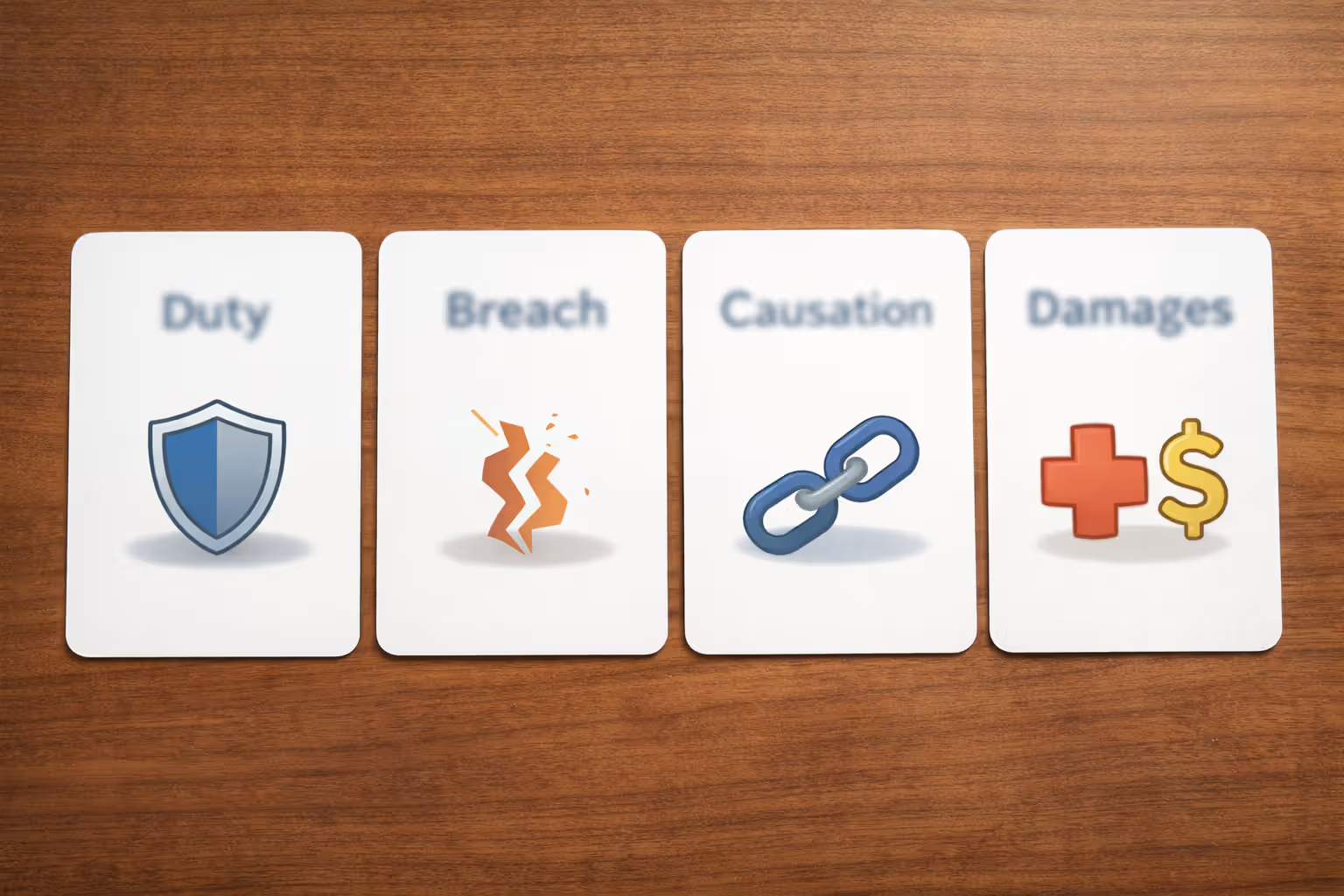
Winning a negligence case requires proving four separate elements. Miss one, and you lose—doesn't matter how sympathetic your injuries are or how careless the defendant seems.
Author: Andrew Whitaker;
Source: skeletonkeyorganizing.com
Element one establishes duty. Did the defendant have a legal responsibility to act carefully toward you? Motorists must drive safely and obey traffic regulations to protect other drivers, pedestrians, and cyclists. Someone hosting a backyard pool party must warn guests about diving hazards. Healthcare providers must deliver treatment consistent with accepted standards in their field and specialty.
Sometimes no duty exists. You generally don't have a legal obligation to rescue strangers from danger—if you walk past a drowning child in a public pool and do nothing, that's morally reprehensible but not typically grounds for a lawsuit from the parents. Vermont and Minnesota are exceptions with "duty to rescue" statutes imposing limited obligations to call for help.
Element two is breach—did the defendant's actual conduct fall short of what a reasonable person would have done? Picture a hypothetical prudent individual in the same situation. Would they have mopped a restaurant floor during dinner rush without posting caution signs or cordoning off the wet area? Would they have prescribed a medication without checking the patient's allergy history? Would they have driven 55 mph in a residential 25 mph zone while scrolling through text messages?
Causation, the third element, splits into two parts. Cause-in-fact asks whether the injury would have happened anyway absent the defendant's breach—legal shorthand calls this the "but for" test. But for the defendant running that red light, would the collision have occurred? Proximate cause addresses foreseeability: was this type of harm a predictable result of the careless conduct?
Here's where proximate cause gets tricky. A speeding ambulance runs a red light and crashes into your sedan. That collision causes you to miss your flight to Las Vegas. The plane you would have boarded crashes in the desert. You sue the ambulance driver for wrongful death of your family members who were on that flight. Should the driver be liable? Most courts would say no—the plane crash is too remote, too unforeseeable as a consequence of running a red light. The causal chain broke.
Element four requires actual damages. You can't sue for "almost got hurt" or "could have been injured." Near-misses don't count. If a distracted driver swerves into your lane but you successfully evade them, suffering nothing but elevated blood pressure and jangled nerves, there's no negligence claim. Courts need quantifiable harm to calculate an award: medical expenses, property repairs, documented wage losses, or physical injuries causing measurable pain.
Real-world negligence comes in familiar varieties. Rear-end collisions at traffic lights where the trailing driver was checking their phone. Slip-and-fall accidents on icy commercial sidewalks the property owner never salted despite freezing overnight temperatures. Medical malpractice like the orthopedic surgeon who operates on the right knee when the patient's left knee needed the procedure. Nursing homes that leave confused dementia patients unattended near stairwells.
Defendants fire back with multiple defenses. Assumption of risk applies when you voluntarily encountered obvious danger—getting injured on a black-diamond ski slope clearly marked as expert-only, for instance. Statutes of limitations bar claims filed too late. Some defendants argue the causal chain was broken by an intervening event or superseding cause. Others claim they owed no duty to the plaintiff under the specific circumstances. And comparative/contributory negligence shifts fault onto plaintiffs based on their own careless behavior.
Types of Damages Available in Tort Cases
Compensatory damages attempt to make you financially whole. Economic damages cover bills and receipts: hospital charges, physical therapy costs, prescription medications, ambulance rides, medical equipment, lost paychecks during recovery, and diminished future earning capacity. A fractured femur might generate $75,000 in surgical and hospital costs, $8,000 in rehabilitation, and $22,000 in missed wages for someone out of work three months.
Future losses require expert testimony to calculate. A 28-year-old construction worker paralyzed from the waist down in a workplace accident can present vocational experts who'll testify about lost earnings over the next four decades, economists who'll adjust those figures for inflation and discount them to present value, and medical professionals who'll estimate lifetime care costs potentially reaching seven figures.
Non-economic damages compensate suffering that doesn't come with price tags: physical pain, mental anguish, scarred appearance, loss of life's enjoyment, and damage to family relationships (called "loss of consortium"). These awards are inherently subjective. How much is chronic back pain worth? What about PTSD that prevents you from driving? Permanent facial scars on a 19-year-old? Juries consider injury severity, recovery timeline, impact on daily activities, and their own sense of fairness.
A temporary injury that heals completely in three months typically generates modest non-economic damages—maybe one to three times the medical bills. Permanent disability, chronic pain, or disfigurement can push non-economic awards to multiples of five, ten, or more times the economic losses.
Punitive damages serve a different purpose entirely: punishment. Courts reserve these for conduct so reckless or malicious it deserves extra financial consequences beyond compensating the plaintiff. The drunk driver on their fifth DUI who kills someone. The corporation that knew its product was lethally defective but sold it anyway to avoid an expensive recall. The nursing home that systematically neglected residents while pocketing government payments meant for their care.
Many states cap punitive awards. Georgia limits them to $250,000 except in cases involving specific intentional conduct. Texas caps them at the greater of $200,000 or two times economic damages plus non-economic damages up to $750,000. California has no statutory cap but requires constitutional review of very large punitive awards. The Supreme Court has suggested ratios above 9:1 (punitive to compensatory) typically violate due process.
Nominal damages—often literally one dollar—acknowledge a legal violation occurred even when no significant harm resulted. These rarely appear in negligence cases but sometimes show up in intentional tort claims where the principle matters more than monetary recovery.
Damage Type
What It Covers
Real Examples
When Courts Award It
Economic (Compensatory)
Bills and financial losses you can document
$47,000 in surgery costs, $12,000 lost wages, $200,000 future care needs
Every tort case where plaintiff proves financial harm
Non-Economic (Compensatory)
Harm without receipts—pain, suffering, trauma
Chronic pain from back injury, PTSD after assault, permanent scarring
Cases involving physical injury, emotional trauma, or disfigurement
Punitive
Extra money to punish outrageous behavior
Drunk driver with multiple prior DUIs, company that hid known product defects
Gross negligence, intentional harm, fraud, or reckless disregard for safety
Nominal
Token amount recognizing rights were violated
$1 award when trespasser caused no actual damage
Intentional torts proved but minimal harm occurred
Some jurisdictions cap damages in specific case types. California famously limits non-economic damages in medical malpractice cases to $250,000—a cap unchanged since 1975 despite inflation. Florida previously capped wrongful death non-economic damages at $500,000 when no minor children survived, though courts struck down parts of that law. Texas limits medical malpractice non-economic damages to $250,000 per defendant physician and healthcare institution.
Author: Andrew Whitaker;
Source: skeletonkeyorganizing.com
These caps generate fierce debate. Proponents argue they control insurance costs and keep doctors practicing in high-risk specialties. Critics counter that they unfairly punish the most severely injured victims—a young person rendered permanently brain-damaged faces a lifetime of suffering that $250,000 hardly addresses.
Tort Law vs. Criminal Law vs. Contract Law: Key Differences
These three legal systems address fundamentally different problems through distinct procedures. Criminal law protects society by identifying conduct harmful to public order—murder, robbery, arson, drug trafficking—and authorizing the state to punish it. Prosecutors employed by the government decide whether to file charges. Convictions can send defendants to prison, put them on probation, or impose fines paid to government coffers rather than victims.
The burden of proof is "beyond a reasonable doubt," typically explained to juries as being around 95% certain or more. This high bar reflects the stakes involved: someone's liberty hangs in the balance.
Author: Andrew Whitaker;
Source: skeletonkeyorganizing.com
Tort law focuses on individual victims seeking compensation from people whose wrongful acts caused them harm. You file the lawsuit yourself (through an attorney) as a private citizen. Success means collecting money damages designed to make you whole—repair bills, medical costs, wage replacement, and pain-and-suffering compensation. Nobody faces incarceration based on a tort judgment alone, though courts can garnish wages or seize assets to satisfy unpaid verdicts.
The burden of proof drops to "preponderance of the evidence"—often described as 50.01%, or "more likely than not." Since tort defendants face financial rather than criminal penalties, courts require less certainty before imposing liability.
Contract law enforces voluntary agreements between parties who made mutual promises. When someone breaches a contract, the injured party sues to recover the benefit they expected from the deal. Remedies aim to give plaintiffs what they would have gotten had the contract been performed—money damages equal to the contract value, or sometimes a court order forcing the breaching party to complete their obligations.
Legal System
What It's For
Who Sues
How Strong Proof Must Be
What You Get If You Win
Tort Law
Make victims whole after civil wrongs
The injured person (plaintiff)
More likely than not (50.01%)
Money to cover losses plus pain/suffering; sometimes punitive damages
Criminal Law
Punish harmful conduct and protect society
Government (state or federal prosecutor)
Beyond reasonable doubt (95%+)
Defendant faces jail, probation, or fines to the state
Contract Law
Force people to keep promises they made
The person harmed by broken agreement
More likely than not (50.01%)
Money equal to contract value, or court order to perform, or contract cancellation
The same incident frequently spawns both criminal and civil cases. The O.J. Simpson trials remain the most famous example: a criminal jury acquitted him of murder using the reasonable-doubt standard, while a civil jury found him liable for wrongful death using the preponderance standard. Both verdicts can coexist legally because the standards differ and different evidence rules apply.
A driver who runs a red light while drunk and kills a pedestrian faces criminal vehicular manslaughter charges from the district attorney plus a wrongful death lawsuit from the victim's spouse. The criminal case might result in five years in prison; the civil case might produce a $3 million damage award. Different objectives, different remedies, different courtrooms—but stemming from one tragic incident.
Statute of Limitations for Tort Claims by State
Every state establishes firm deadlines for filing lawsuits, and missing these cutoffs typically annihilates your claim forever—even ironclad liability and catastrophic injuries won't save it. Personal injury cases commonly allow two or three years from the date of injury. California gives you two years. Tennessee allows one year. Maine provides six years.
Medical malpractice deadlines are often shorter and trickier. Some states allow just twelve months from when you discover (or reasonably should have discovered) the error. Others impose absolute caps—you might have two years from discovery but no more than four years from when the malpractice occurred, whichever comes first. A surgeon who leaves a sponge inside you during a 2020 operation might not face a lawsuit when you finally get imaging that reveals it, but if your state has a three-year absolute limit, you're out of luck.
The discovery rule extends limitation periods when injuries or their causes weren't immediately obvious. Exposure to asbestos in 1985 might not cause detectable mesothelioma until 2023. Most states start the clock when you're diagnosed and understand the connection to asbestos, not from the exposure date decades earlier.
Tolling provisions pause the clock under specific circumstances. Nearly all states toll limitation periods while the injured party is under 18—if you're hurt at age 12, the clock typically doesn't start until your 18th birthday, giving you the full limitation period as an adult. Mental incapacity tolls the deadline in many jurisdictions until you regain competence. Some states pause the clock when defendants leave the jurisdiction to hide from process servers.
Different tort types carry different deadlines. Defamation claims frequently require filing within one year—Tennessee allows just six months. Fraud might give you three to five years from discovery. Property damage sometimes has longer limitation periods than personal injury. Intentional torts and negligence claims may operate on different schedules even within the same state.
These aren't flexible guidelines—courts enforce them ruthlessly. File one day late and defendants will move to dismiss, judges will grant the motion, and your case evaporates regardless of merit. The policy rationale is fairness: evidence deteriorates, witnesses relocate and forget details, and defendants deserve finality rather than indefinite liability exposure.
The statute of limitations is a statute of repose.
— John F. Kennedy
Wait three years to sue over a two-year-old injury? The courthouse door has slammed shut. Your medical bills remain unpaid, your lost wages uncompensated, your pain unacknowledged—all because you missed an arbitrary deadline.
Frequently Asked Questions About Tort Law
What does tort mean in law?
The term describes a civil wrong—excluding contract breaches—where someone's improper conduct injures another person, creating a legal obligation to pay for the harm. Examples range from car crashes caused by careless driving to deliberate acts like punching someone or spreading damaging lies about them. It gives injured people a path to collect money from whoever caused their losses, whether through negligence, intentional misconduct, or in some cases regardless of fault.
Can you go to jail for a tort?
Not through the tort case itself. These are civil lawsuits resulting in money judgments, not criminal penalties like incarceration. However, the same behavior can violate both civil and criminal law simultaneously. Someone who assaults you might face criminal charges from prosecutors (potentially resulting in jail time) and a separate civil battery lawsuit from you (resulting in a damage award). The two cases proceed independently on parallel tracks with different rules and burdens of proof.
How long do I have to file a tort claim?
It depends on your state and the injury type—typically anywhere from one to six years. Most states give you two or three years from the injury date to file personal injury claims. Medical malpractice often has shorter windows, sometimes just one year after you discover the error. These deadlines are rigid; miss one by even a single day and courts will dismiss your case regardless of how valid it is. Since evidence degrades and witnesses' memories fade, getting prompt legal advice after an injury helps ensure you don't forfeit your rights by waiting too long.
What's the difference between a tort and a crime?
Crimes are offenses against society that government prosecutors charge on behalf of the public, potentially resulting in imprisonment or fines paid to the state. Torts are wrongs against specific individuals who file private lawsuits seeking money to compensate for their injuries. Criminal cases require proof beyond a reasonable doubt; tort cases need only a preponderance of the evidence—a much lower bar. The same incident can spawn both: a drunk driver causing serious injuries faces criminal DUI charges from the state and tort claims from injured victims. The government might send them to prison; the victims collect damages.
Do I need a lawyer for a tort case?
Small-dollar disputes belong in small claims court where attorneys aren't necessary—or even allowed in some jurisdictions. But for anything involving significant injuries, substantial property damage, or complex liability issues, legal representation dramatically improves your outcome. Attorneys know how to value claims accurately, marshal evidence effectively, handle procedural requirements, and negotiate with insurance companies that employ entire legal departments. Most personal injury lawyers work on contingency, collecting one-third to 40% of your recovery only if you win. That arrangement makes representation accessible even without upfront payment. Facing an insurance company's experienced legal team alone puts you at a severe disadvantage.
What are the most common types of tort cases?
Vehicle collisions dominate tort dockets—car crashes, motorcycle accidents, truck wrecks, and pedestrian injuries. Premises liability cases follow closely: customers slipping on wet floors, visitors injured by inadequate security, tenants hurt by building code violations. Medical malpractice generates substantial litigation despite being less common numerically—surgical errors, misdiagnoses, medication mistakes, birth injuries. Product liability suits target manufacturers of dangerous goods: defective cars, contaminated food, hazardous drugs, malfunctioning medical devices. Dog bite cases, nursing home abuse and neglect, wrongful death claims, and workplace injuries (in states allowing tort claims beyond workers' comp) round out the typical caseload. Negligence provides the legal foundation for most of these disputes, though some involve intentional wrongdoing or strict liability theories.
Tort law exists because life is messy—people get hurt through others' carelessness, victims of deliberate attacks need recourse, and defective products injure consumers who deserve compensation. This legal system offers a structured approach to identifying who's responsible and requiring them to pay for the damage they caused.
The process has flaws, no question. Litigation burns time and money. Arbitrary damage caps in some states prevent fair compensation for catastrophic injuries. Tight filing deadlines can bar legitimate claims before victims even understand they have one. Insurance companies contest valid claims aggressively, forcing plaintiffs into expensive trials. Defendants with limited assets may be judgment-proof—winning a verdict against someone with no insurance and no savings leaves you holding worthless paper.
Yet tort law remains the primary mechanism Americans use to seek justice after civil wrongs. The system processes millions of claims annually and distributes tens of billions in compensation to injured parties. It's far from perfect, but for someone facing six-figure medical bills after a drunk driver ran a red light, or a family whose mother died because a nursing home neglected her pressure sores, tort law provides the only realistic path to accountability and recovery.
Whether you're sizing up a potential claim, researching for a class assignment, or just building general legal knowledge, understanding these fundamentals gives you insight into how civil justice operates. Next time you sign a waiver at a rock-climbing gym, read about a massive jury verdict in the news, or witness a fender-bender in a parking lot, you'll recognize the tort law machinery working underneath the surface—the elements of negligence being weighed, the damage calculations being made, the limitation periods ticking away.
Every time you drive, run a business, or host a party, you're making decisions that could put you on the hook for someone else's losses. This guide covers four liability types from strict to vicarious, civil vs. criminal distinctions, negligence elements, fault-sharing rules by state, product liability claims, insurance coverage gaps, and why minimum policy limits leave you dangerously exposed.
Half of all patent applications die during examination — and most failures trace back to preventable mistakes. This guide walks through pre-filing essentials including prior art searches and documentation, provisional vs. non-provisional strategy, all seven filing steps from drawings to claim drafting, realistic cost breakdowns for micro to large entities, typical 24-36 month timelines, and the c
Mediation puts you in the driver's seat for $2,000-$10,000. Arbitration hands decision-making to someone else for $30,000-$100,000. This guide compares both processes step by step — from session structure and binding rules to appeal rights, confidentiality protections, and hidden costs — then shows exactly when each method works best and why trying mediation first saves money even if it fails.
Every court ruling builds on — or breaks from — what came before. This guide explains stare decisis, the difference between binding and persuasive precedent, how federal and state court hierarchies determine which decisions control, why circuit splits create geographic legal variations, when courts can distinguish or overrule prior rulings, and how attorneys use case law strategically to build win
The content on Legal Insights is provided for general informational purposes only. It is intended to offer insights, commentary, and analysis on legal topics and developments, and should not be considered legal advice or a substitute for professional consultation with a qualified attorney.
All information, articles, and materials presented on this website are for general informational purposes only. Laws and regulations may vary by jurisdiction and may change over time. The application of legal principles depends on specific facts and circumstances.
Legal Insights is not responsible for any errors or omissions in the content, or for any actions taken based on the information provided on this website. Users are encouraged to seek independent legal advice tailored to their individual situation before making any legal decisions.