Think back to the last legal drama you watched. The attorney discovers a smoking-gun document, delivers a passionate closing argument, and the jury returns a verdict—all within an hour. Real courtrooms? They're drowning in paperwork, scheduling conflicts, and procedural arguments that would never survive a writer's room. A lawsuit that starts today might not see a courtroom until 2027.
Here's what actually happens when Americans sue each other. More than 20 million civil cases get filed in state courts yearly, covering everything from fender-benders to billion-dollar business disputes. Federal courts handle another 300,000. Every single one follows rules that shift depending on your location and case type.
What Triggers a Lawsuit: When Legal Action Becomes Necessary
Someone damages your property. A business partner breaks your agreement. Your employer fires you for reporting safety violations. These situations might justify legal action—but "might" is doing heavy lifting here.
Courts want to see measurable harm. A neighbor's tree dropping leaves on your lawn? Annoying, sure. But you'll struggle to show damages worth a judge's time. That same tree crashing through your roof during a storm and causing $40,000 in damage? Now you've got a case worth pursuing.
The clock starts ticking the moment harm occurs. In Texas, you've got two years to sue for injuries from a car accident. Wait 731 days? Your claim dies, even if you have video evidence and eyewitness testimony. Contract disputes in New York? You've got six years. California gives you four. These deadlines—statutes of limitations—vary wildly across claim types and state lines.
The law helps the vigilant, not those who sleep on their rights.
— Legal maxim
Some exceptions exist. Discover your business partner embezzled funds in 2018, but you didn't find out until 2023? Many states start the clock when you discovered (or should have discovered) the fraud. Minor children often get extra time—the deadline pauses until they turn 18.
Before anyone files anything, smart parties explore alternatives. Mediation brings in a neutral person to guide negotiations. You're paying maybe $200-400 hourly instead of $300+ for attorneys to wage procedural war. Arbitration works like trial-lite: you present evidence, an arbitrator decides, and you're typically stuck with the result. Check your contracts carefully—many require arbitration and eliminate your right to sue in court at all.
Small claims court handles disputes under $10,000 in most states (California allows up to $12,500 for businesses). No attorney required. Simplified rules. Decision in weeks, not years.
Litigation makes sense when negotiations collapse, your damages exceed small claims limits, you need court orders forcing someone to do (or stop doing) something, or the other side ignores reasonable settlement demands. Just remember—winning a lawsuit and collecting money are two entirely different battles.
Pre-Lawsuit Requirements: What Happens Before You File
Demand Letters and Settlement Negotiations
Most jurisdictions won't reject your lawsuit if you skip the demand letter. Send one anyway.
A demand letter is your opening bid delivered via certified mail. You're saying: "Here's what happened, here's why you're responsible, here's what I lost, and here's what I want—respond in 30 days." Keep it factual, not emotional. "Your negligence destroyed my business" reads worse than "Your failure to deliver the contracted materials by June 1 caused my construction project to miss its deadline, resulting in $45,000 in penalty clauses and lost revenue."
Include copies of relevant documents: contracts, invoices, repair estimates, medical bills, photographs. Make your case on paper before spending thousands making it in court.
Insurance adjusters receive thousands of demand letters. A well-documented claim with clear liability? They'll often settle rather than pay attorneys to fight it. Even rejections provide value—their response reveals defenses you'll face and suggests their settlement range.
Gathering Evidence and Documentation
Start building your evidence file now, not six months from now when your attorney asks for documents.
Paper trail matters most. Contracts, emails, text messages, invoices, receipts, repair estimates, medical records, employment files—collect everything remotely relevant. Screenshot text exchanges with dates visible. Back up emails to external drives. That damaging email thread? Your opponent's IT department might accidentally lose it unless you preserve your copy.
Create a timeline. What happened on March 15? Who said what on April 3? Which doctor did you see on May 12? Memory fades frighteningly fast. What's crystal-clear today becomes fuzzy six months into discovery.
Identify witnesses while they're findable. Your coworker who heard the supervisor's discriminatory comment? She might take a job across the country next month. Get a written statement now, with her current contact information. Even if she can't testify at trial (she moved to Tokyo), her contemporaneous statement carries weight during settlement negotiations.
Many attorneys offer free consultations. Bring your organized evidence. They'll evaluate whether your facts support legal claims, estimate potential recovery, identify evidence gaps, and give you realistic cost-benefit analysis before you've spent a dime.
Filing Your Lawsuit: Court Documents and Initial Procedures
Drafting and Submitting the Complaint
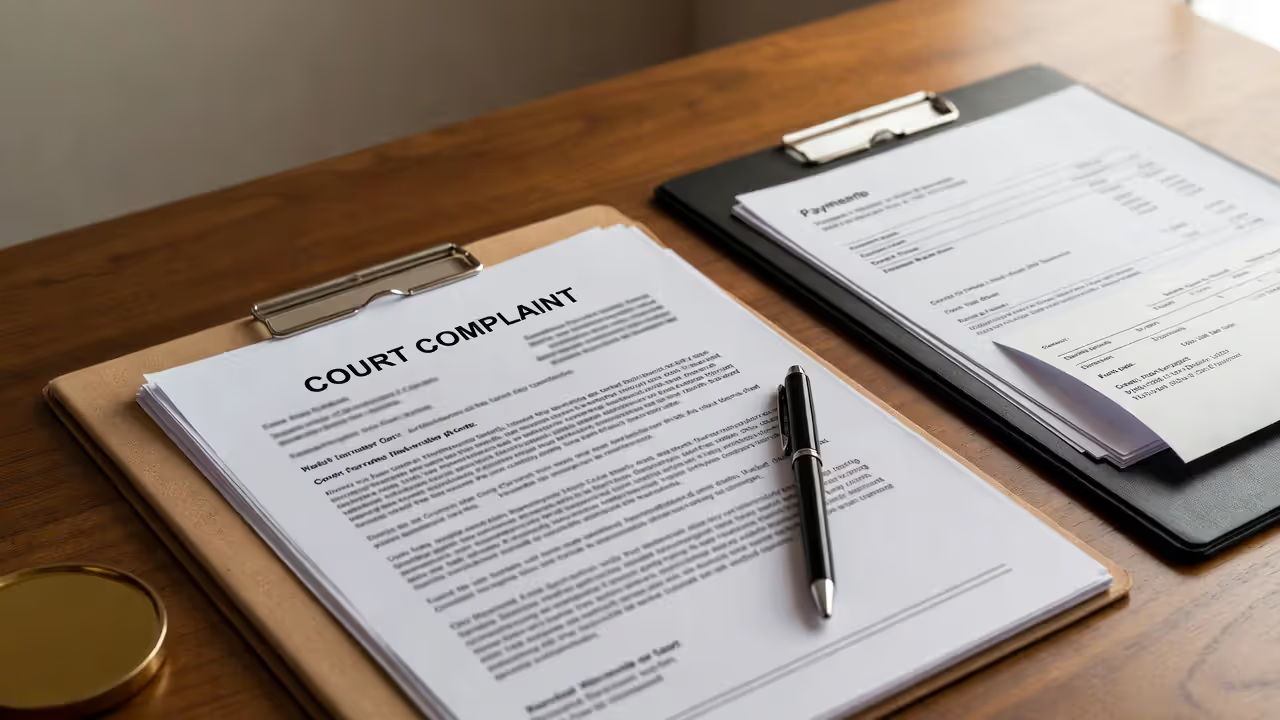
Your complaint establishes what this case is actually about. Courts don't accept vague accusations—you're filing a formal legal document with specific required components.
Author: Andrew Whitaker;
Source: skeletonkeyorganizing.com
Start with the caption: which court, which county, parties' names, and space for the assigned case number. Then explain why this particular court has authority to hear your dispute. Federal courts need diversity jurisdiction (parties from different states with $75,000+ at stake) or federal question jurisdiction (your claim arises under federal law). State courts vary—some restrict jurisdiction by dollar amount.
The heart of your complaint is numbered factual paragraphs. Tell your story chronologically without legal conclusions. Don't write "Defendant breached our contract." Instead: "Paragraph 15: Plaintiff and Defendant signed a construction contract on January 5, 2024. Paragraph 16: The contract required Defendant to complete work by March 1, 2024. Paragraph 17: Defendant abandoned the project on February 20, 2024, with only 40% completion."
Next, identify your legal claims. Breach of contract requires an enforceable agreement, your performance, their breach, and your damages. Negligence needs duty, breach of that duty, causation, and damages. Fraud requires false statements, knowledge of falsity, intent to deceive, your reasonable reliance, and resulting damages. Every element needs supporting facts from your earlier paragraphs.
End with your "prayer for relief"—what you want the court to award. Compensatory damages, punitive damages, injunctive relief, attorney fees (if your contract or statute allows), and "such other relief as the court deems just and proper."
Filing fees run $200-400 for most state courts. Federal court charges around $402. Courts waive fees if you complete a form proving you can't afford them (typically earning under 125% of federal poverty guidelines).
Pick the wrong court and you're starting over. Subject matter jurisdiction means this court type handles your claim—you can't file a divorce in bankruptcy court. Personal jurisdiction requires adequate connections between the defendant and the forum. A Delaware corporation that's never operated in Montana, never shipped products there, and never contacted Montana residents? Montana courts probably lack jurisdiction. Venue rules narrow it further—even if Nebraska has jurisdiction, you might need to file in Lancaster County rather than Douglas County based on where the defendant resides or where events occurred.
Serving the Defendant
Filing your complaint with the court isn't enough. Defendants must receive actual notice through proper service.
You can't serve papers yourself—courts require a disinterested person over 18. Many plaintiffs hire process servers who charge $50-150 and know the rules cold. Personal service means physically handing papers to the defendant. Substituted service allows leaving papers with another adult at their home or workplace. Some states accept certified mail with return receipt.
Corporations have registered agents—attorneys or commercial services designated to receive legal papers. Serving a Fortune 500 company? Look up their registered agent in that state's Secretary of State database. Serving some guy who owns a small business? You'll need to personally serve him or follow your state's rules for business service.
Defendants typically get 20-30 days to respond after service. Ignore a lawsuit and risk default judgment—you lose automatically. Courts will sometimes vacate defaults if defendants show good cause for missing the deadline, but you're fighting uphill after defaulting.
File proof of service with the court. Your process server completes a form confirming who was served, where, when, and how. Without filed proof of service, your case stalls. The court has no power over defendants who weren't properly served, making any judgment you obtain worthless.
The Discovery Phase: Exchanging Information Between Parties
Discovery is where lawsuits go to drain your bank account. This phase routinely consumes 60-80% of total litigation costs and stretches six months minimum, often over a year.
Sunlight is said to be the best of disinfectants.
— Justice Louis D. Brandeis
Both sides dig into each other's evidence. The theory is transparency—everyone knows the evidence before trial, preventing surprise witnesses and gotcha moments. The reality is mountains of documents, tedious questioning, and fights over what must be disclosed.
Types of Discovery Tools (Interrogatories, Depositions, Requests for Production)
Author: Andrew Whitaker;
Source: skeletonkeyorganizing.com
You've got several tools for extracting information:
Interrogatories are written questions requiring written answers under oath. Most courts cap them at 25 questions, though clever attorneys embed subparts ("Identify each person, their job title, their employment dates, their current contact information, and their knowledge of the incident" technically counts as one question). Use interrogatories for basic information: list your witnesses, explain your damages calculation, identify relevant documents, disclose insurance coverage. Expect attorney-drafted responses that give minimal useful information.
Depositions put witnesses in a room with attorneys and a court reporter. You're under oath. Attorneys ask questions. You answer. The reporter types every word, creating a transcript that costs you $500-1,500 depending on length. Depositions reveal how witnesses present themselves. Are they credible? Do they have damaging information? Will they crumble under cross-examination or confidently defend their story? Attorneys use depositions to lock witnesses into positions. Contradict your deposition at trial, and opposing counsel will gleefully read your earlier testimony to the jury.
Requests for Production demand documents and physical evidence. "Produce all emails between you and Smith regarding the 2023 contract" or "Produce the maintenance records for the equipment that failed." Modern document production includes electronically stored information—emails, text messages, databases, metadata. E-discovery alone can cost tens of thousands in complex cases.
Requests for Admission ask opponents to admit or deny specific facts. "Admit that you received Plaintiff's email on June 5, 2024." "Admit that Exhibit A is a true copy of the signed contract." Admissions eliminate the need to prove those facts at trial. Deny something obvious, and you might pay the opponent's costs for proving what you should have admitted.
Discovery Tool
Primary Purpose
Format
Typical Timeline
Cost Implications
Interrogatories
Get basic facts and identify what evidence exists
Written questions requiring written responses
30 days to answer
Relatively cheap—mainly attorney time drafting and responding
Depositions
Lock in testimony and evaluate witness credibility
Face-to-face questioning recorded by court reporter
Scheduled by party agreement or court order
Expensive—$500-1,500+ per session for court reporters, plus several attorney hours
Requests for Production
Collect documents and tangible evidence
Written demands with document delivery
30 days to produce materials
Moderate to very expensive—searching files, reviewing for privilege, copying, and e-discovery vendor fees
Requests for Admission
Establish uncontested facts and authenticate evidence
Written statements requiring admission or denial
30 days to respond; no response = deemed admitted
Usually inexpensive, but denying facts later proven can trigger cost sanctions
How Long Discovery Takes
Judges issue scheduling orders setting discovery cutoff dates—often six months to a year from filing. Complex commercial cases with millions of pages of documents or dozens of potential witnesses? Discovery can stretch 18-24 months.
Parties constantly battle over discovery scope. One side claims requests are "overly broad and unduly burdensome." The other argues responses are "evasive and incomplete." Judges resolve these disputes, adding more delay while motion practice unfolds.
Electronic discovery creates particular headaches. Companies must preserve relevant electronic data the moment litigation becomes reasonably foreseeable. That means issuing "litigation holds" instructing employees not to delete potentially relevant emails, texts, or documents. Accidentally destroy evidence and face sanctions ranging from monetary penalties to instructions telling juries to assume destroyed evidence would have supported your opponent's claims.
Pre-Trial Motions and Settlement Conferences
Before anyone enters a courtroom, parties file motions testing the case's legal foundations.
Motions to dismiss argue the complaint is legally insufficient. Even if everything the plaintiff alleged is true, they haven't stated a valid legal claim. These are decided purely on the complaint's four corners—no evidence considered. Win a motion to dismiss, and the case ends (though plaintiffs can often amend their complaints addressing the deficiencies).
Summary judgment motions claim no genuine factual dispute exists and the moving party deserves judgment without trial. Unlike motions to dismiss, these include evidence—affidavits, deposition excerpts, documents. The judge views evidence in the light most favorable to the non-moving party. If reasonable people could disagree about material facts, the motion fails and the case proceeds to trial.
Many judges require settlement conferences. A magistrate or judge meets separately with each side, evaluating strengths and weaknesses. They can't force settlement, but their neutral assessment often prompts realistic negotiations. "Counsel, you're claiming $500,000 damages but your expert report only supports $150,000" or "Defendant, you're arguing no liability, but this email chain is devastating—you should seriously consider settling."
Mediation brings in a professional neutral who shuttles between rooms, carrying offers and counteroffers, identifying common ground, and pushing parties toward compromise. Mediators have zero decision-making power but high success rates—60-70% of mediated cases settle.
Roughly 95% of cases settle before trial. Trials are expensive (tens of thousands in attorney fees alone for a three-day trial), risky (juries are unpredictable), and time-consuming (scheduling trial dates 12-18 months out is common). Settlement provides certainty and control. Even parties confident they'll win face appeal risks, collectability concerns, and opportunity costs of years spent litigating.
Author: Andrew Whitaker;
Source: skeletonkeyorganizing.com
The Trial Process: What to Expect in Court
The 3-5% of cases reaching trial enter litigation's most public phase.
Jury Selection and Opening Statements
Jury selection—voir dire—starts the trial. Attorneys and judges question potential jurors about backgrounds, biases, and relevant experiences. Can you be impartial toward insurance companies? Have you sued anyone before? Do you know any witnesses?
Attorneys eliminate jurors through challenges. Challenges "for cause" identify demonstrable bias—"the defendant rear-ended my daughter last year, I can't be fair." Unlimited challenges for cause are allowed. Peremptory challenges require no reason but are limited (typically 3-6 per side) and can't be used to discriminate based on race or gender.
Opening statements follow jury selection. Attorneys preview what evidence will show, framing the narrative in their favor. You're not arguing—you're telling the jury what they'll hear. "The evidence will show Mr. Garcia ran a red light at 65 mph, never touched his brakes, and T-boned Mrs. Chen's minivan in the intersection." Credibility matters enormously. Promise evidence you can't deliver, and jurors remember when those promises go unfulfilled.
Presenting Evidence and Witness Testimony
Plaintiffs present first. They're carrying the burden of proof—preponderance of evidence, meaning "more likely than not" or roughly 51% certainty. That's substantially easier than criminal cases requiring proof beyond reasonable doubt.
Witnesses testify under direct examination by the calling party. Questions should be open-ended: "What did you observe?" not "You saw the defendant run the red light, correct?" Leading questions are generally prohibited on direct examination.
Cross-examination follows. Now opposing counsel can (and will) ask leading questions designed to undermine the witness. "You were 200 feet away when this happened, correct?" "You didn't measure the skid marks, did you?" "You testified differently in your deposition six months ago, didn't you?"
Documents and physical evidence come in through witnesses who can authenticate them. "Do you recognize Exhibit 7?" "What is it?" "How do you know?" "Is this a true and accurate copy?"
Hearsay fights erupt constantly. Hearsay is an out-of-court statement offered to prove the truth of the matter asserted. "My friend told me the light was red" is hearsay—you're trying to prove the light was actually red based on what someone said outside of court. Dozens of exceptions exist, making hearsay law maddeningly complex.
After plaintiffs rest their case, defendants present theirs. They might call witnesses, offer contrary evidence, or simply argue plaintiffs failed to prove their claims. Defendants need not prove anything—they win if plaintiffs don't meet their burden.
Plaintiffs get limited rebuttal to address new issues defendants raised. Courts restrict rebuttal to genuinely new matters.
Verdict and Judgment
Closing arguments let attorneys interpret evidence and advocate for their positions. Unlike openings, these are pure persuasion. "Remember Dr. Johnson's testimony about the permanent nerve damage? That's why we're asking for $750,000."
Judges instruct juries on applicable law. These instructions are heavily negotiated—slight phrasing differences influence outcomes. Juries then deliberate privately, discussing evidence and applying law to facts.
Civil verdicts don't require unanimity in many jurisdictions. Federal courts need unanimous verdicts in civil cases, but states vary—some allow 5/6 or 3/4 agreement. Verdicts specify liability and damage amounts.
Judges enter judgment based on verdicts, creating enforceable court orders. Post-trial motions and appeals deadlines immediately start running.
After the Verdict: Appeals and Collecting Your Judgment
Losing parties can appeal, but appeals aren't second trials. Appellate courts review whether trial judges correctly applied legal rules—not whether they agree with the jury's factual findings.
Author: Andrew Whitaker;
Source: skeletonkeyorganizing.com
Standard of review matters enormously. Jury verdicts get substantial deference. Appellants claiming "insufficient evidence" face steep hills—appellate courts view evidence in the light most favorable to the verdict. Legal errors (wrong jury instructions, improperly admitted evidence, incorrect legal standards) receive closer scrutiny.
File a notice of appeal within 30 days of judgment or lose your appeal rights. You'll need trial transcripts (court reporters charge $3-7 per page, and multi-day trials generate thousands of pages). Appellate briefs argue specific legal errors prejudiced the outcome. Oral arguments may follow. The entire appellate process adds 12-24 months before final resolution.
Securing a judgment doesn't mean you've collected a penny. Judgment winners become judgment creditors and must now collect through enforcement mechanisms. Wage garnishment takes up to 25% of disposable earnings. Bank account levies seize funds on deposit. Property liens attach to real estate. Personal property can be seized and sold.
Many defendants prove judgment-proof. They lack collectible assets, shield property through exemptions, or file bankruptcy discharging debts. Homestead exemptions protect home equity (amounts vary drastically—$75,000 in Minnesota, unlimited in Florida). Retirement accounts generally can't be touched. Basic personal property (clothing, furniture, household items) is exempt.
Investigate defendants' financial condition before filing. Suing someone with no collectible assets means spending thousands to get an unenforceable judgment.
Frequently Asked Questions About Lawsuits
How long does the average lawsuit take from start to finish?
Straightforward cases settle or reach trial within 12-18 months. That assumes cooperative parties, minimal discovery disputes, and reasonably available court dates. Complex litigation involving extensive document production, expert witnesses, or multiple parties regularly takes 3-5 years. Federal courts generally move faster than state courts, though this varies dramatically by district—Northern District of California moves faster than Eastern District of Texas. Add appeals and you're looking at another 1-2 years minimum. Specific timelines depend heavily on court congestion (some jurisdictions have multi-year trial backlogs), case complexity, and whether parties cooperate or fight over every procedural step.
How much does it cost to file a lawsuit in the US?
Filing fees range $200-400 for state courts, around $402 for federal court. But filing fees are like buying a concert ticket and thinking that covers your entire night out. Total litigation costs include attorney fees (typically $250-600+ hourly depending on location and attorney experience), expert witness fees ($5,000-50,000+ depending on specialty and testimony scope), deposition costs (court reporters, transcripts, videography), document production expenses, and trial costs. Simple contract disputes might run $10,000-30,000 total. Complex commercial litigation easily reaches six or seven figures. Personal injury attorneys often work on contingency—taking 33-40% of any recovery instead of charging hourly, making representation accessible even if you're broke.
Can I represent myself in a lawsuit without a lawyer?
Yes, you've got the constitutional right to self-representation (appearing "pro se"). Should you? Probably not, unless you're in small claims court. Procedural rules fill volumes. Miss a filing deadline by one day, and your case might be dismissed—judges won't excuse your ignorance of deadlines. File an improper motion, and judges deny it. Violate evidence rules, and your best evidence gets excluded. Courts hold pro se litigants to identical standards as licensed attorneys with years of training. That said, if you genuinely cannot afford representation, investigate legal aid organizations (income-restricted), law school clinics (free or low-cost), or attorneys offering "unbundled" services where they handle specific tasks like drafting your complaint or reviewing settlement offers while you handle other aspects yourself.
What percentage of lawsuits actually go to trial?
Only 3-5% of civil cases reach trial. The other 95-97% settle (most commonly), get dismissed on motions, or resolve through arbitration or other alternative dispute resolution. Why so few trials? They're expensive (a three-day trial can cost $30,000-75,000+ in attorney fees alone), unpredictable (juries are wild cards), and time-consuming (scheduling trials 12-24 months out is common). After discovery reveals both sides' evidence, parties can usually calculate settlement ranges. A plaintiff facing weak evidence might accept $50,000 rather than risk losing at trial. A defendant recognizing damaging evidence might pay $200,000 rather than risk a $500,000 verdict.
What happens if I can't afford to pay a judgment against me?
Creditors can garnish up to 25% of your disposable wages (after taxes and mandatory deductions). They can levy bank accounts, seizing whatever's on deposit when the levy hits. Liens attach to real property, getting paid when you eventually sell. Personal property can be seized and auctioned. However, exemption laws protect certain assets. Homestead exemptions shield home equity—$25,000 in Utah, $600,000 in California, unlimited in Florida and Texas. Retirement accounts (401(k)s, IRAs) are generally protected under federal law. You can keep basic necessities—clothing, furniture, household goods, tools of your trade up to certain values. If you're truly overwhelmed by debt, bankruptcy might discharge judgments, though some survive bankruptcy (fraud judgments, certain intentional torts like assault).
How do I know if my case is strong enough to file a lawsuit?
Strong cases check several boxes: clear liability (the defendant obviously did something wrong), documented damages (you can prove financial losses with receipts, records, and expert testimony), a collectible defendant (they have assets or insurance to pay a judgment), and solid evidence supporting your version (witnesses, documents, physical evidence—not just your word against theirs). Consult an attorney for case evaluation. Most offer free initial consultations. They'll assess whether your facts support legal claims, estimate potential recovery ranges, evaluate the defendant's ability to pay, and identify weaknesses opponents will exploit. Consider basic economics too. Pursuing a $15,000 claim that costs $25,000 to litigate makes no financial sense unless you're chasing principle over profit. Also consider collectability—even ironclad liability means nothing if the defendant is judgment-proof with no assets to seize.
Understanding the Litigation Journey
Lawsuits follow structured paths from filing through discovery, motion practice, trial, and potentially appeals. Each stage serves specific purposes within the civil justice system, theoretically balancing parties' rights to present claims against efficiency and access concerns.
Expect litigation to consume more time and money than you initially imagine. Television compresses months into minutes and skips the tedious parts—document review, scheduling disputes, endless procedural motions. Real cases involve mountains of paperwork, procedural disputes over seemingly trivial matters, and long stretches of inactivity between bursts of intense activity.
Success requires patience, meticulous organization, and substantial financial resources or contingency representation. Cases with clear-cut liability, well-documented damages, and collectible defendants offer the best prospects. Marginal cases where fault is disputed, damages are speculative, or defendants lack collectible assets might not justify the investment.
Whether you're contemplating filing suit or defending against one, understanding litigation mechanics helps you navigate the system more effectively. The procedural framework exists to ensure fair dispute resolution, though the journey from grievance to judgment is rarely quick or straightforward. Weigh litigation costs—financial, temporal, and emotional—against potential benefits before committing to this lengthy process.
Every time you drive, run a business, or host a party, you're making decisions that could put you on the hook for someone else's losses. This guide covers four liability types from strict to vicarious, civil vs. criminal distinctions, negligence elements, fault-sharing rules by state, product liability claims, insurance coverage gaps, and why minimum policy limits leave you dangerously exposed.
When someone's wrongful behavior injures you, tort law creates the path to compensation — but miss one of four required elements and your case collapses. This guide covers intentional torts from battery to defamation, negligence claims comprising 90% of tort litigation, strict liability for defective products, compensatory vs. punitive damage calculations, state-by-state filing deadlines, and how
Half of all patent applications die during examination — and most failures trace back to preventable mistakes. This guide walks through pre-filing essentials including prior art searches and documentation, provisional vs. non-provisional strategy, all seven filing steps from drawings to claim drafting, realistic cost breakdowns for micro to large entities, typical 24-36 month timelines, and the c
Mediation puts you in the driver's seat for $2,000-$10,000. Arbitration hands decision-making to someone else for $30,000-$100,000. This guide compares both processes step by step — from session structure and binding rules to appeal rights, confidentiality protections, and hidden costs — then shows exactly when each method works best and why trying mediation first saves money even if it fails.
The content on Legal Insights is provided for general informational purposes only. It is intended to offer insights, commentary, and analysis on legal topics and developments, and should not be considered legal advice or a substitute for professional consultation with a qualified attorney.
All information, articles, and materials presented on this website are for general informational purposes only. Laws and regulations may vary by jurisdiction and may change over time. The application of legal principles depends on specific facts and circumstances.
Legal Insights is not responsible for any errors or omissions in the content, or for any actions taken based on the information provided on this website. Users are encouraged to seek independent legal advice tailored to their individual situation before making any legal decisions.