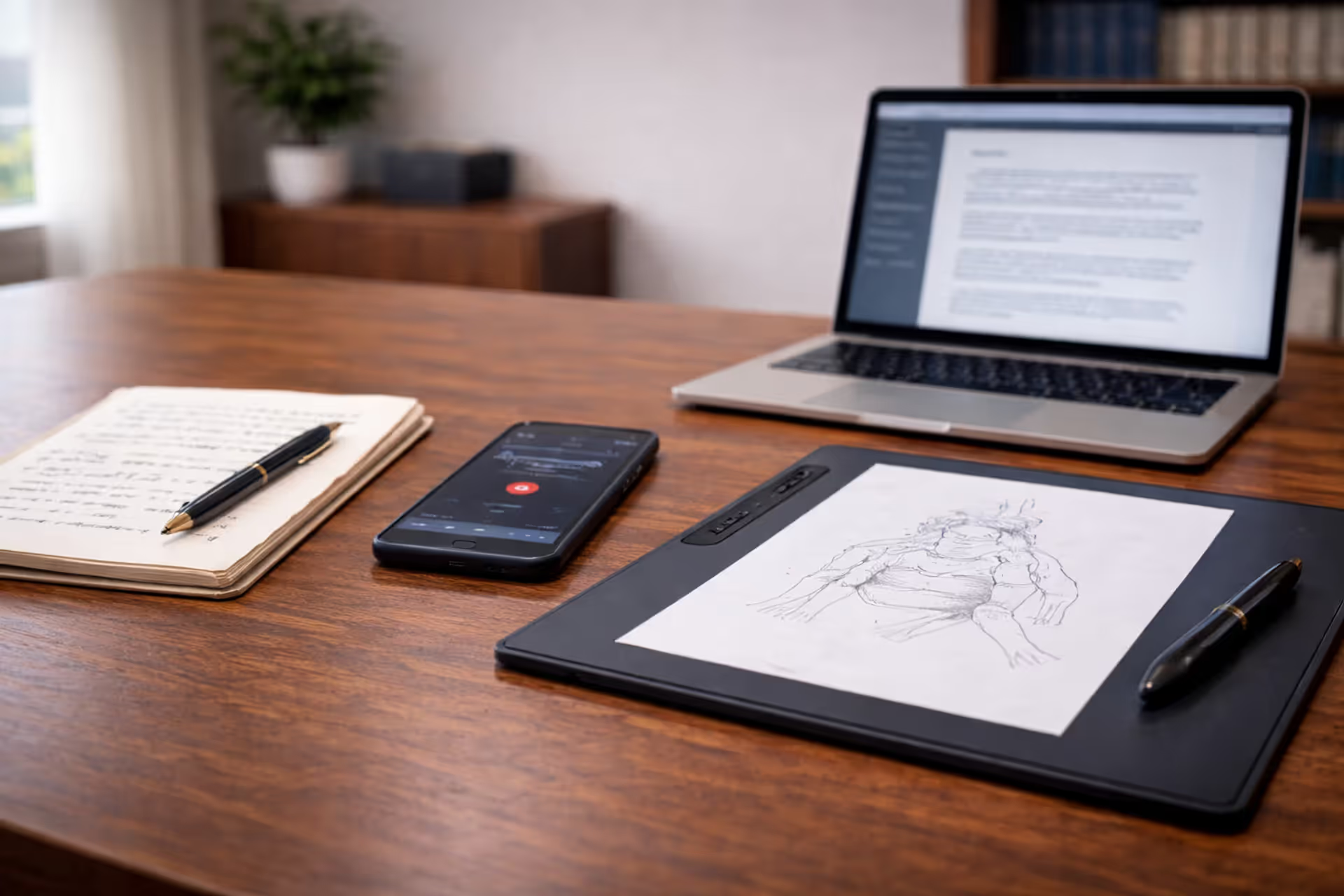
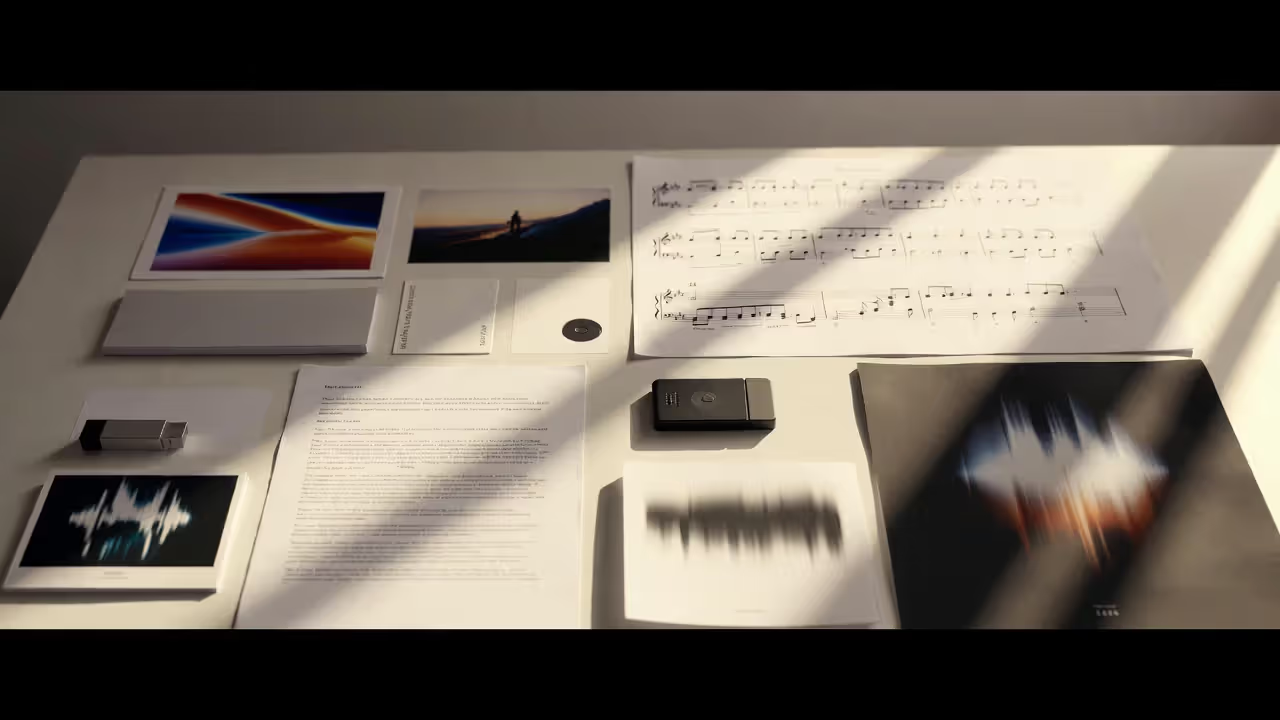
The federal Copyright Act (17 U.S.C.) automatically protects your creative output the instant it takes physical or digital form. That protection covers everything from 500-page manuscripts to six-second video clips, from oil paintings to Python code.
But here's what most creators discover too late: Owning copyright automatically doesn't mean you can enforce it automatically. Skip federal registration and you're locked out of court—literally barred from filing lawsuits against infringers. The serious damages that make litigation worthwhile? Off limits. Think of it like holding a property deed but having zero legal way to defend your land when squatters move in.
I've watched small business owners lose thousands because someone copied their website content word-for-word, only to learn courtroom doors stayed closed until they registered first. One photographer discovered her images on commercial products across three retail chains but couldn't afford litigation because she missed the registration window—no statutory damages meant proving actual financial harm dollar by dollar, and those forensic accounting costs exceeded what she'd ever recover.
Below, we'll walk through exactly which creations qualify for protection, who legally owns rights when multiple people collaborate, how long your protection lasts before works enter public domain, and—most importantly—when to file that registration before problems start.
What Copyright Law Actually Protects (And What It Doesn't)
Copyright law hands you an exclusive monopoly backed by federal courts. You control reproduction, sales, spin-off versions, and public display. Other people can't exercise those rights unless you grant permission.
The primary objective of copyright is not to reward the labor of authors, but to promote the progress of science and useful arts.
— Justice Sandra Day O’Connor
Protection kicks in immediately when you capture creative expression in some lasting medium. Save that Google Doc. Export that audio file. Upload that Photoshop project. Done. You're protected.
The Copyright Office recognizes eight broad categories:
Literary works: Everything from tweet threads to database schemas, instruction manuals to romance novels, even the source code running mobile apps
Musical works: The actual composition—melody lines, chord progressions, lyrics (distinct from the recorded performance)
Dramatic works: Scripts for stage productions, screenplays, teleplays, treatment documents
Pantomimes and choreographic works: Dance routines, mime sequences—but you must write them down or record them somehow
Motion pictures and audiovisual works: YouTube tutorials, feature films, streaming series, animated GIFs, video game cinematics
Sound recordings: The actual recorded performance (separate from the musical composition itself)—podcast episodes, album masters, audiobook narrations
Architectural works: Actual building designs created after December 1, 1990
Courts require minimal creativity. We're talking about a really low bar here. An alphabetized list of names? Too mechanical—that's just arranging data. A travel blog with personal observations about restaurants and hotels? Easily clears the threshold.
Creative work protection law explicitly excludes certain things that can never receive copyright protection:
Ideas, concepts, procedures, and processes: You might write a cookbook explaining your revolutionary bread-making technique, and copyright protects your explanatory text and instructional photos. But anyone can use your actual method without asking
Facts and data: Population statistics, historical dates, scientific measurements, mathematical constants—all freely available for anyone's use
Titles, names, slogans, and short catchphrases: Brand taglines like "Think Different" need trademark registration instead
Government works: Supreme Court opinions, IRS publications, NASA photographs—all in the public domain by default
Generic forms and templates: Blank invoices, standard to-do list printables, basic graph paper layouts
Unoriginal works: Photographing someone else's painting or tracing a public domain illustration doesn't generate new copyright
Here's where confusion runs rampant: Copyright never protects business concepts. Build a platform connecting freelance dog walkers with pet owners using a brilliant matching algorithm? Copyright covers your specific interface design, your written help documentation, and your actual code. Competitors remain completely free to launch similar dog-walking platforms based on the same general idea.
Author: David Kessler;
Source: skeletonkeyorganizing.com
Who Owns Copyright? Understanding Automatic Rights and Exceptions
One simple rule governs most situations: The person who creates something owns it.
The wedding photographer owns those reception photos. The freelance designer owns her logo mockups. The songwriter owns his demo recordings. Ownership rights explained really are that straightforward for individual creators working independently.
Joint authorship occurs when two or more creators intentionally merge their contributions into a unified work—not just collaborate, but actually intend to create something inseparable. Both must contribute original creative expression, not just raw ideas or editorial suggestions. When two musicians co-write lyrics and compose the melody together, both become equal co-owners. Either can license the entire song independently, though each must split proceeds with the other. This differs dramatically from anthologies where ten authors each contribute one chapter—there, each writer owns only their specific section.
Transfer of ownership absolutely requires written contracts with signatures. Verbal agreements mean precisely nothing under copyright law, no matter how many witnesses heard the handshake deal. Many creators license specific limited rights while retaining ownership—letting a magazine publish your article once doesn't surrender your copyright unless your contract explicitly transfers ownership. Exclusive licenses must be written; non-exclusive licenses can technically be oral, though you'd be foolish to rely on verbal promises when disputes arise.
When creators die, copyrights pass to beneficiaries exactly like real estate or bank accounts. A novelist's heirs control her entire catalog for decades, approving movie adaptations and negotiating reprint deals.
The Work-for-Hire Exception Every Creator Should Know
Work-for-hire doctrine completely flips normal ownership rules upside down. When this applies, the employer or client owns the copyright from day one. The actual creator holds zero ownership interest—not even partial rights.
Two distinct scenarios trigger work-for-hire:
1. Employee-created works within the scope of employment: A graphic design studio employs a full-time illustrator who creates client logos during business hours using company equipment. The studio owns those illustrations completely. The illustrator can't use them in their personal portfolio without permission, can't sell them to other clients, can't even claim copyright ownership.
Courts examine the actual employment relationship closely: Does the company control your daily schedule? Provide your equipment and software? Withhold payroll taxes from paychecks? Offer health benefits? True independent contractors typically fail most of these tests, which means work-for-hire often doesn't apply despite what contracts claim.
2. Specially commissioned works in nine narrow statutory categories: Hire an independent contractor—not someone on your payroll—and work-for-hire triggers only under two strict conditions: both parties must sign written documentation explicitly labeling it work-for-hire, AND the deliverable must fit within one of these nine legislatively defined types:
Contribution to a collective work (magazine articles, encyclopedia entries)
Part of a motion picture or other audiovisual work
Translation
Supplementary work (forewords, indexes, bibliographies, test answer keys)
Compilation
Instructional text
Test
Answer material for a test
Atlas
Imagine a tech startup hires a freelance developer to build their mobile app. Without signed work-for-hire documentation explicitly stating ownership transfer—and unless the app qualifies as a contribution to an audiovisual work or collective work—that freelancer retains copyright ownership. The startup receives only whatever narrow license the circumstances reasonably imply.
Author: David Kessler;
Source: skeletonkeyorganizing.com
This catches countless businesses off guard. "We paid for it, so obviously we own it" feels intuitive but is legally wrong. Payment alone never, ever transfers copyright ownership. Always execute written contracts specifying ownership terms, especially with outside contractors producing creative deliverables.
How Long Does Copyright Protection Last in the United States?
Copyright duration rules shift based on when something was created and who created it.
For works created January 1, 1978 or later, protection generally lasts the creator's entire lifetime plus an additional 70 years. A photographer who dies has images protected through December 31, 2094.
Works made for hire—along with works where creators use pseudonyms or remain anonymous—receive either 95 years from first publication or 120 years from creation, whichever expires sooner. A corporate training video published stays protected through 2119.
Duration Terms by Work Category and Date
Type of Work
Protection Length
How Expiration Gets Calculated
Individual creator (1978 onward)
Author's life plus 70 years
December 31 of the 70th year after author dies
Multiple co-authors (1978 onward)
Life plus 70 years
December 31 of the 70th year after final surviving author passes
Work made for hire (1978 onward)
95 years from publication OR 120 years from creation
Shorter of the two terms applies
Anonymous or pseudonymous work (1978 onward)
95 years from publication OR 120 years from creation
Shorter of the two terms applies
Published 1978–March 1, 1989 missing proper notice
Possibly entered public domain
Owner forfeited protection unless corrective action happened within five years
Published 1964–1977 when timely renewal was filed
95 years from original publication date
Counted from the initial publication year
Published before 1928
Public domain already
Protection term already ended
Works published between 1928 and 1977 involve navigating complicated rules about publication dates, mandatory renewal filings, and notice requirements. Thousands of works forfeited protection permanently when copyright owners forgot to file renewal paperwork under the old system. The controversial 1998 Copyright Term Extension Act added an extra 20 years onto all existing terms, delaying public domain entry across the board.
Once copyright finally expires, works enter public domain forever. Anyone can reproduce them, adapt them, distribute them, perform them—all without asking permission or paying royalties. Shakespeare's plays, Beethoven's symphonies, and silent films like The General (1926) belong to everyone now.
These duration rules matter enormously for estate planning purposes. Children's book authors routinely provide income streams for grandchildren born decades after publication. One important note: You can't reset the copyright clock through superficial updates—republishing a 1925 novel with a new foreword doesn't extend copyright protection for the original text.
Registration vs. Automatic Protection: When You Need to File
Here's the confusing paradox at the heart of copyright protection basics: You own copyright automatically, yet registration unlocks the enforcement tools that actually matter.
Automatic protection means copyright vests in you the instant you create something. You can license your work to clients, publish it online, and control who copies it—all without filing anything with the Copyright Office. Hobby photographers posting Instagram shots or bloggers publishing think pieces rarely need formal registration.
Author: David Kessler;
Source: skeletonkeyorganizing.com
Registration becomes absolutely critical in specific situations:
Filing infringement lawsuits: Federal courts refuse to hear your copyright case unless you've registered or your application is pending. Discover someone manufacturing counterfeit prints of your artwork? Registration becomes mandatory before litigation—judges dismiss unregistered cases at the threshold.
Statutory damages and attorney's fees: File your registration before infringement begins (or within 90 days after publication) to unlock statutory damages ranging from $750 to $30,000 per work infringed. Willful infringement by defendants can push awards up to $150,000 per work. Miss that registration deadline and you're stuck proving actual damages—your lost sales plus the defendant's profits—which often costs more in forensic accounting fees than you'll ever recover. Courts may also order losing defendants to pay your attorney's fees, but only when you registered timely. This single benefit makes lawsuits financially viable for individual creators who couldn't otherwise afford litigation.
Public record and legal presumption: Registration creates a public record documenting your ownership claim. File within five years of publication and courts presume validity—your copyright gets treated as genuine and accurate, forcing defendants to disprove it rather than making you prove every element.
Customs protection: U.S. Customs and Border Protection can intercept and seize counterfeit imports arriving at ports, but this intervention happens only for copyrights already on the registration books.
Here's how the actual registration process works: Complete an online application at copyright.gov, pay $45 to $65 for standard electronic filing, and submit a digital copy of your work. Standard processing currently runs several months; expedited handling slashes wait times but adds extra fees.
Strategic timing makes a huge difference: Register high-value commercial works immediately—software before product launch, manuscripts before book publication, professional photography before licensing to commercial clients. Prolific creators can batch-register related items (for example, 12 months of blog posts as one collective work registration) to minimize administrative costs. Registration protects the work as submitted; substantial revisions may justify filing fresh applications.
Registration is akin to a prerequisite to suit.
— Justice Ruth Bader Ginsburg
Plenty of creators wait until discovering infringement, then scramble to register before filing suit. This reactive approach works legally but sacrifices statutory damages and attorney's fees for any infringement that happened before registration, leaving you with weaker remedies and potentially prohibitive litigation costs.
Common Copyright Violations and How to Avoid Them
Copyright law grants owners six exclusive rights. Violating any single one without authorization or legal justification constitutes infringement:
1. Reproduction: Copying in any format whatsoever—photocopying magazine articles, screen-recording streaming shows, duplicating licensed software installations. Even temporary copies created during computer processing can sometimes trigger infringement, though courts frequently permit these under implied licenses or fair use.
2. Distribution: Selling copies, renting them, loaning them out, or giving them away. Share a Hollywood movie file through a BitTorrent tracker? You've triggered distribution infringement before a single person downloads—merely offering the file to others counts.
3. Derivative works: Building adaptations, translations, or modifications based on the original. Converting a bestselling novel into a screenplay, remixing a chart-topping song with new production, colorizing classic black-and-white films, creating illustrated versions of text—all require explicit authorization from the copyright owner. Fan fiction and fan art technically infringe in most cases, though enforcement varies wildly depending on the rights holder's tolerance.
4. Public performance: Playing recorded music in your restaurant dining room, screening movies at a church fundraiser, livestreaming concerts on social media. "Public" encompasses anywhere outside your normal circle of family and close friends—showing a film in a college dormitory lounge qualifies as public performance.
5. Public display: Exhibiting paintings in a commercial gallery, posting photographs on business websites, projecting images at public conferences. The first-sale doctrine lets you display a physical artwork you legally purchased (hanging that framed painting in your home), but doesn't authorize scanning it digitally or displaying it beyond your own premises.
6. Digital audio transmission: Webcasting sound recordings through internet radio stations or subscription streaming platforms triggers separate licensing requirements.
Common mistakes that trip people up constantly:
Assuming social media sharing is automatically fine: Reposting someone's Instagram photo to your Twitter feed infringes their copyright, even with full credit and tags. Platform terms grant Facebook and TikTok licenses for hosting and displaying content, but don't authorize users to copy each other's posts.
The completely fictional "10% rule": No magical safe percentage exists. Sampling eight seconds from a four-minute song or reproducing two chapters from a 20-chapter book can both constitute substantial infringement—fair use analysis examines qualitative importance, not just quantitative amounts.
Believing non-commercial use automatically protects you: Commercial purpose weighs against fair use but doesn't make non-commercial copying lawful by default. Sharing pirated textbook PDFs with classmates to save money still infringes despite zero profit motive.
Thinking attribution substitutes for authorization: Crediting the original creator demonstrates professionalism and may be legally required under some countries' moral rights laws, but citation never replaces permission. Naming the photographer doesn't make reproducing her images without a license lawful.
Fair use defense: Courts analyze four statutory factors—your purpose and character (is it transformative? commercial?), the copyrighted work's nature (factual? highly creative?), how much you used proportionally, and your use's effect on the original's market value. Parody, criticism, news reporting, and educational scholarship frequently qualify, but fair use provides a case-by-case legal defense, not blanket advance permission. When genuinely uncertain? Get permission or consult intellectual property counsel.
Creative work protection law also prohibits circumventing technological protection measures. Crack digital rights management systems or bypass access controls and you've violated the Digital Millennium Copyright Act—even when your underlying purpose would otherwise be lawful. This highly controversial provision restricts how consumers can use content they've legitimately purchased.
Author: David Kessler;
Source: skeletonkeyorganizing.com
Frequently Asked Questions About Copyright Law
Do I need to register my copyright to have protection?
No—protection attaches automatically when you fix creative expression in tangible form. Registration, publication, and copyright notices are all optional. However, registration becomes mandatory before filing federal infringement lawsuits, and registering proactively (before infringement starts or within 90 days after publication) qualifies you for statutory damages ranging from $750 to $150,000 per work plus potential attorney's fee awards. For commercially valuable works or anything you plan to license professionally, register proactively rather than waiting until problems emerge.
What separates copyright from trademark and patent?
These three intellectual property systems protect fundamentally different things. Copyright shields original creative expression—novels, photographs, songs, architectural plans, software code. Trademark shields brand identifiers—company names, logos, product packaging designs, advertising slogans—that distinguish your offerings from competitors'. Patent shields inventions, useful processes, and ornamental designs. A tech company might copyright its program source code, trademark its product name and distinctive logo mark, and patent its innovative algorithm. Occasionally these protections overlap: uniquely designed product packaging might qualify for copyright protection (as sculptural work) and trademark protection (as trade dress signaling commercial source).
Can I copyright my business name or logo?
Business names standing alone don't qualify—they're too short and functional. Logo designs featuring sufficient artistic creativity can receive copyright protection as pictorial works, but trademark registration delivers far stronger protection for brand identifiers used in commerce. Trademark law prevents consumer confusion about commercial source, which aligns much better with how businesses actually deploy names and logos in the marketplace. File trademark applications through the U.S. Patent and Trademark Office rather than pursuing copyright registration for brand elements.
How much of another person's work can I borrow without seeking approval first?
Courts never recognize minimum safe thresholds—no magical percentage, word count, or second count grants immunity. Fair use claims get evaluated by examining your purpose, the copyrighted work's nature, the amount and substantiality of what you used relative to the whole, and your use's impact on the potential market for the original. Reproducing one iconic photograph from a large portfolio might infringe more seriously than quoting several paragraphs from a 400-page textbook. Transformative uses (commentary, criticism, parody) typically fare better than simply redistributing original content unchanged. Unless your use clearly and obviously qualifies as fair use under careful four-factor analysis, obtain explicit permission or purchase a license. Many copyright owners offer reasonably priced licenses or even grant free permission for non-commercial educational uses when asked politely.
Someone is infringing my copyright—what are my options?
Start with a cease-and-desist letter identifying the specific infringement, asserting your ownership rights, demanding they immediately stop using your material, and requesting removal of existing copies. Many conflicts resolve quickly through direct correspondence. For online infringement, file a DMCA takedown notice with the website or platform hosting the infringing material—service providers must expeditiously remove reported content or risk liability themselves. When informal approaches fail or infringement continues, consult an intellectual property attorney about litigation options. Critical reminder: federal registration must occur before filing suit, and timely pre-infringement registration significantly strengthens available remedies. Document everything meticulously—capture screenshots, archive URLs, record all relevant dates.
Does my U.S. copyright provide international protection?
U.S. copyright law governs only within American territorial borders. Fortunately, most nations participate in international treaties—primarily the Berne Convention—establishing reciprocal protection standards. A song copyrighted in the United States receives protection throughout all Berne Convention member countries (currently over 180 nations) without requiring separate registrations in each jurisdiction, though specific enforcement mechanisms and remedies vary by local law. Some countries still require national registration to access full legal remedies. International infringement cases involve complicated jurisdictional questions about which courts have authority and which national laws apply, typically requiring local legal counsel familiar with that country's intellectual property system. The internet compounds these complications since infringement can occur simultaneously across dozens of different countries through a single website.
Copyright law attempts an inherently difficult balance—incentivizing creative production through exclusive ownership rights while ensuring the public eventually gains access to cultural works and accumulated knowledge. Understanding which creations qualify for protection, who legally controls rights in various scenarios, how long protection endures, and when registration becomes strategically important helps you both protect your own creative output and respect what others create.
For creators, practical advice boils down to this: Your work receives protection automatically upon creation, but register commercially valuable works before publication or infringement to maximize available remedies. Use written contracts explicitly specifying ownership terms whenever collaborating with others or hiring creative contractors. For those using creative works, remember that most content encountered online remains fully protected—seek advance permission, purchase appropriate licenses, or carefully verify your use qualifies as fair use before copying, adapting, or redistributing others' material.
The copyright landscape continues evolving as technology advances. Artificial intelligence authorship questions, blockchain authentication systems, and emerging distribution platforms raise unprecedented legal questions about authorship, ownership, and what constitutes infringement. Staying current on these developments and consulting qualified intellectual property attorneys for significant copyright matters protects your interests in today's increasingly digital creative economy.
Every time you drive, run a business, or host a party, you're making decisions that could put you on the hook for someone else's losses. This guide covers four liability types from strict to vicarious, civil vs. criminal distinctions, negligence elements, fault-sharing rules by state, product liability claims, insurance coverage gaps, and why minimum policy limits leave you dangerously exposed.
When someone's wrongful behavior injures you, tort law creates the path to compensation — but miss one of four required elements and your case collapses. This guide covers intentional torts from battery to defamation, negligence claims comprising 90% of tort litigation, strict liability for defective products, compensatory vs. punitive damage calculations, state-by-state filing deadlines, and how
Half of all patent applications die during examination — and most failures trace back to preventable mistakes. This guide walks through pre-filing essentials including prior art searches and documentation, provisional vs. non-provisional strategy, all seven filing steps from drawings to claim drafting, realistic cost breakdowns for micro to large entities, typical 24-36 month timelines, and the c
Mediation puts you in the driver's seat for $2,000-$10,000. Arbitration hands decision-making to someone else for $30,000-$100,000. This guide compares both processes step by step — from session structure and binding rules to appeal rights, confidentiality protections, and hidden costs — then shows exactly when each method works best and why trying mediation first saves money even if it fails.
The content on Legal Insights is provided for general informational purposes only. It is intended to offer insights, commentary, and analysis on legal topics and developments, and should not be considered legal advice or a substitute for professional consultation with a qualified attorney.
All information, articles, and materials presented on this website are for general informational purposes only. Laws and regulations may vary by jurisdiction and may change over time. The application of legal principles depends on specific facts and circumstances.
Legal Insights is not responsible for any errors or omissions in the content, or for any actions taken based on the information provided on this website. Users are encouraged to seek independent legal advice tailored to their individual situation before making any legal decisions.