When the Food and Drug Administration recalls contaminated lettuce or OSHA fines a construction company for fall hazards, they're exercising powers granted under administrative law. This branch of law determines how federal agencies translate broad Congressional mandates into specific rules that govern everything from workplace safety to environmental standards.
Administrative law sits at the intersection of government power and individual rights. Unlike criminal law that punishes wrongdoing or contract law that enforces private agreements, administrative law creates the framework for how bureaucratic agencies operate, make binding rules, and resolve disputes without involving traditional courts.
What Administrative Law Actually Governs
Administrative law meaning centers on the rules and procedures that control federal agency behavior. These agencies—from the Environmental Protection Agency to the Securities and Exchange Commission—handle specialized regulatory areas Congress doesn't have the expertise or time to micromanage.
The scope covers three main functions. First, agencies create regulations that carry the force of law. When the Department of Transportation sets fuel efficiency standards for trucks, those requirements are legally binding even though Congress never voted on the specific miles-per-gallon targets. Second, administrative law governs how agencies enforce their rules through inspections, investigations, and penalties. Third, it establishes how agencies adjudicate disputes, often through administrative law judges who hear cases before they ever reach federal court.
This differs sharply from constitutional law, which defines government structure and fundamental rights. A constitutional challenge might argue that an entire agency violates separation of powers. An administrative law challenge typically argues that an agency exceeded its granted authority or failed to follow proper procedures when making a specific rule.
For citizens and businesses, these distinctions matter because administrative violations carry real consequences without criminal prosecution. A dairy farm facing EPA fines for wastewater runoff isn't accused of a crime, but the penalties can still reach six figures. The farmer can't demand a jury trial—instead, they navigate administrative hearings with different procedural rules than criminal court.
Small businesses often encounter administrative law through compliance requirements they never see coming. A three-person machine shop might need to file annual chemical inventory reports with multiple agencies, maintain specific record-keeping formats, and respond to inspection requests within tight deadlines. Violating these requirements triggers administrative penalties even when no one was harmed and the owner had no intent to break rules.
How Federal Agencies Get Their Authority to Make Rules
Author: Michelle Granton;
Source: skeletonkeyorganizing.com
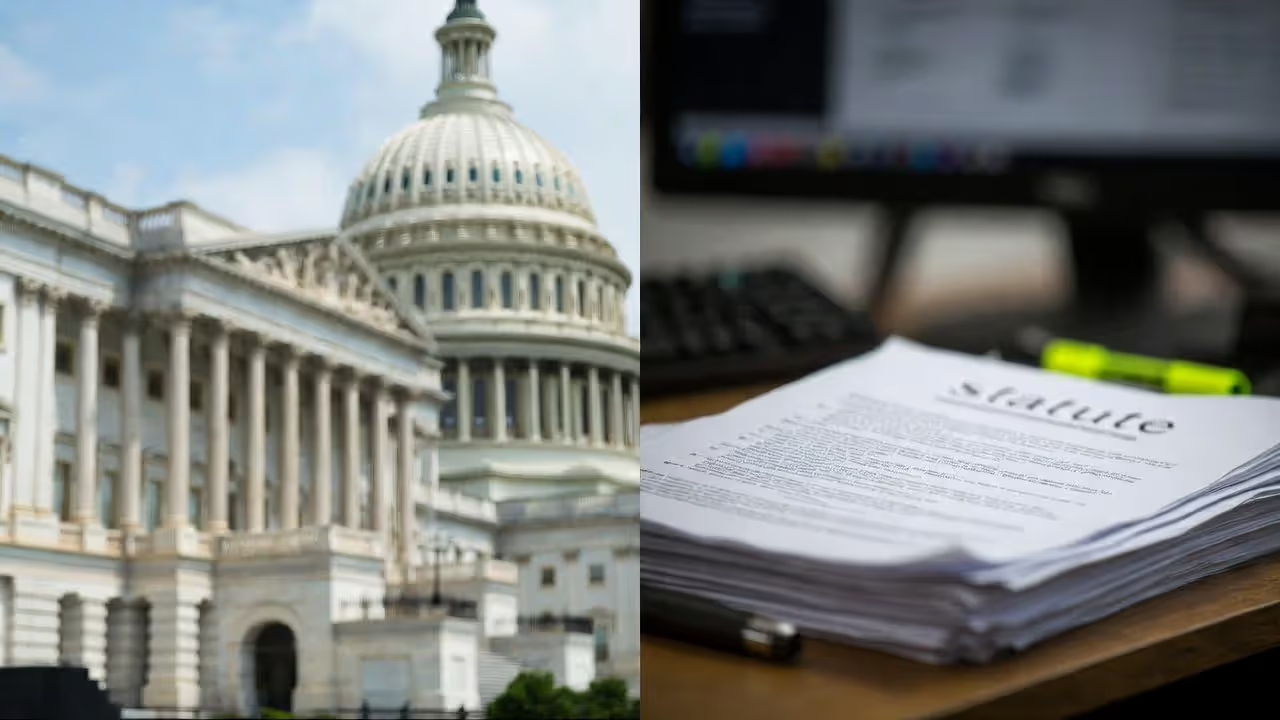
Federal agency authority flows from Congressional delegation. The Constitution grants legislative power to Congress, but Congress routinely passes statutes that outline broad goals and authorize agencies to fill in the details. The Clean Air Act, for example, directs the EPA to set air quality standards that protect public health with "an adequate margin of safety"—but Congress didn't specify the exact permissible levels of particulate matter.
This delegation happens through enabling statutes that create agencies and define their jurisdiction. When Congress established OSHA in 1970, the Occupational Safety and Health Act authorized the agency to promulgate workplace safety standards. The statute set boundaries: OSHA must address "significant risks" and choose regulations that are "technologically and economically feasible." These statutory limits constrain what OSHA can require, even within workplace safety.
The major questions doctrine has recently tightened these constraints. When agencies claim authority over issues of vast economic or political significance, courts now demand clear Congressional authorization. The Supreme Court blocked the EPA's Clean Power Plan in 2022, ruling that transforming the nation's electricity grid exceeded the authority Congress granted in ambiguous statutory language. Agencies can't assume Congress delegated power over major policy questions through vague text.
Different agencies operate under different models. The FDA gets broad authority to ensure drugs are "safe and effective" before reaching consumers. The Federal Communications Commission allocates radio spectrum and regulates telecommunications. The Department of Labor enforces wage and hour laws. Each agency's enabling statute creates a unique scope of authority with specific procedures and limitations.
Agencies can't act outside their statutory jurisdiction. When the Department of Labor tried to require COVID-19 vaccination or testing for all large employers in 2021, courts struck down the rule partly because OSHA's statute addresses workplace-specific hazards, not general public health measures. The agency exceeded its granted authority even though workplace safety was clearly within its subject-matter jurisdiction.
The Rulemaking Process: From Proposal to Final Rule
Author: Michelle Granton;
Source: skeletonkeyorganizing.com
The rulemaking process explained through the Administrative Procedure Act (APA) requires agencies to follow structured steps before regulations become binding. This process balances agency expertise against public accountability.
Informal rulemaking—used for the vast majority of federal regulations—begins when an agency publishes a Notice of Proposed Rulemaking (NPRM) in the Federal Register. This notice must include the proposed rule's text, the legal authority supporting it, and enough explanation for the public to understand what the agency intends and why. The agency then opens a comment period, typically 30-60 days, during which anyone can submit written feedback.
After reviewing comments, the agency publishes a final rule addressing significant concerns raised during the comment period. The agency must respond to major objections with reasoned explanations, though it doesn't need to address every individual comment. If the final rule differs substantially from the proposal, the agency might need to re-propose and open another comment period to avoid surprising regulated parties.
The timeline varies dramatically. Simple technical updates might finalize within six months. Major regulations affecting entire industries often take years as agencies review thousands of comments, conduct additional economic analyses, and coordinate with other departments. The EPA's Clean Water Rule defining "waters of the United States" took over two years from proposal to finalization, generated over one million comments, and was immediately challenged in court.
Feature
Informal Rulemaking
Formal Rulemaking
Requirements
Notice, comment period, reasoned response
Notice, trial-type hearing with witnesses, cross-examination
Timeline
6 months to 3+ years typical
Often 5-10 years due to hearing complexity
When Used
Default for most regulations
Only when statute specifically requires "on the record after opportunity for agency hearing"
Public Involvement
Written comments, occasional public meetings
Oral testimony, witness examination, formal record
Judicial Review Standard
Arbitrary and capricious (highly deferential)
Substantial evidence (moderately deferential)
Informal vs. Formal Rulemaking
Formal rulemaking resembles a trial, with sworn testimony, cross-examination of witnesses, and a hearing examiner. Congress rarely requires this cumbersome process because it drains agency resources. The FDA used formal rulemaking for food standards decades ago, and a single peanut butter standard hearing lasted years and produced a 70,000-page transcript. Agencies avoid formal rulemaking whenever statutory language permits.
Informal rulemaking dominates because it's faster and allows agencies to gather diverse input without litigation-style procedures. Trade associations, public interest groups, individual companies, and citizens all submit comments ranging from one-paragraph letters to hundred-page technical analyses. Agencies must consider this input seriously—courts overturn rules when agencies ignore significant comments or fail to explain their reasoning.
Liberty lies in the hearts of men and women; when it dies there, no constitution, no law, no court can save it.
— Learned Hand
Emergency Rules and Exceptions
The APA allows agencies to skip notice-and-comment procedures for "good cause" when prior notice would be "impracticable, unnecessary, or contrary to the public interest." Agencies invoke this exception sparingly because courts scrutinize it closely. True emergencies—like the FAA grounding aircraft after discovering critical safety defects—clearly qualify. Agencies trying to avoid the inconvenience of public comment don't.
Interim final rules represent a middle ground. The agency publishes a rule that takes effect immediately but accepts post-promulgation comments and may modify the rule based on feedback. This approach works when urgent action is needed but the agency still wants public input. During financial crises, banking regulators sometimes use interim final rules to stabilize markets while gathering industry feedback.
How Agencies Enforce Regulations and Issue Penalties
Author: Michelle Granton;
Source: skeletonkeyorganizing.com
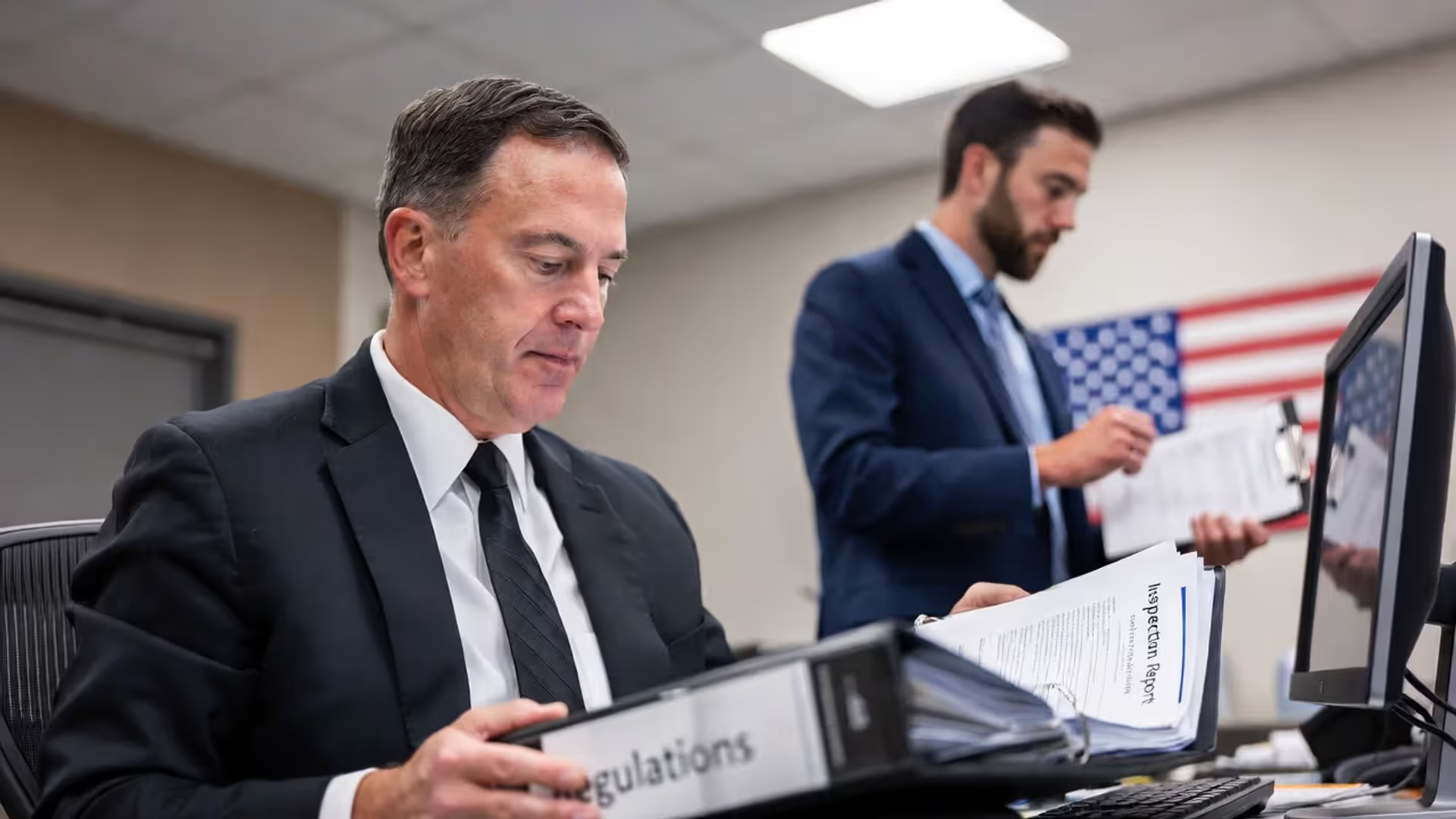
Regulatory enforcement law gives agencies tools ranging from warning letters to criminal referrals. Most enforcement begins with inspections. OSHA compliance officers can enter workplaces without warrants under certain circumstances. FDA inspectors review manufacturing facilities for drug safety compliance. EPA investigators sample wastewater discharge to verify permit compliance.
When inspections reveal violations, agencies typically issue citations describing the problem and required corrective actions. Minor violations might generate warning letters with compliance deadlines. Serious or repeated violations trigger civil penalties calculated using statutory formulas that consider factors like violation severity, company size, and good faith efforts to comply.
Administrative hearings provide a forum to contest violations before paying penalties. Unlike court trials, these hearings occur before administrative law judges (ALJs) who work for the agency bringing the case—though they maintain independence through civil service protections. The agency presents evidence of violations, the regulated party defends itself, and the ALJ issues an initial decision that becomes final unless appealed to agency leadership.
Civil penalties vary wildly by agency and violation type. OSHA's maximum per-violation penalty exceeds $15,000 for serious violations and $150,000 for willful or repeated violations. EPA penalties for Clean Water Act violations can reach $50,000 per day. These aren't theoretical maximums—agencies regularly impose six- and seven-figure penalty packages for significant violations.
Criminal referrals happen when violations involve knowing endangerment, falsification of records, or deliberate misconduct. Agencies lack criminal prosecution authority, so they refer cases to the Department of Justice. Environmental crimes, food safety fraud, and financial fraud generate most administrative-to-criminal referrals. A factory manager who knowingly exposes workers to toxic chemicals without protection might face both OSHA civil penalties and criminal prosecution.
Consent decrees resolve many enforcement actions through negotiated settlements. The company agrees to fix violations, pay reduced penalties, and often implement enhanced compliance programs. Agencies favor this approach because it achieves compliance faster than litigation. Companies benefit from penalty reductions and avoiding admission of liability. A manufacturer facing $2 million in proposed EPA fines might settle for $800,000 plus $400,000 in required pollution control upgrades.
Your Rights When Challenging Agency Decisions
Author: Michelle Granton;
Source: skeletonkeyorganizing.com
Administrative procedure basics require exhausting administrative appeals before seeking judicial review. When an agency denies your permit application or fines your business, you can't immediately file a federal lawsuit. You must first appeal through the agency's internal process—requesting reconsideration, appealing to higher agency officials, or requesting a hearing before an ALJ.
The exhaustion doctrine serves several purposes. It gives agencies opportunities to correct their mistakes, develops a complete factual record for potential court review, and prevents premature litigation over issues the agency might resolve administratively. Courts dismiss cases when plaintiffs skip required administrative steps, even if the underlying challenge has merit.
Once you've exhausted administrative remedies, judicial review becomes available—but courts don't re-decide the case. Instead, they apply deferential standards of review that give agencies substantial leeway. The specific standard depends on what you're challenging.
Standard of Review
What Courts Examine
Difficulty of Winning
Common Examples
Arbitrary and Capricious
Whether agency considered relevant factors, made clear error of judgment, or failed to articulate rational connection between facts and decision
Very difficult; agency wins ~70% of cases
Challenges to informal rulemaking, policy decisions, enforcement discretion
Substantial Evidence
Whether record contains enough evidence that reasonable mind could accept as adequate to support conclusion
Moderately difficult; agency wins ~60% of cases
Challenges to formal rulemaking, formal adjudications
De Novo
Court makes independent determination without deferring to agency
Whether statute is ambiguous and agency interpretation is reasonable
Very difficult; agency wins ~75-80% of cases
Challenges to agency statutory interpretations (though recently narrowed)
Standing requirements limit who can challenge agency actions. You must show concrete injury caused by the agency decision that court relief could remedy. Environmental groups can challenge EPA rules if members use affected areas. Competitors can challenge agency approvals granted to rivals. But general taxpayers can't sue simply because they dislike how agencies spend money.
The timing of judicial review matters. Final agency actions are immediately reviewable. Preliminary steps in ongoing proceedings usually aren't. If the EPA proposes a rule you dislike, you can't sue during the comment period—you must wait until the final rule issues. This ripeness doctrine prevents courts from wasting resources on disputes that might never materialize.
Venue rules determine which court hears your challenge. Some statutes designate specific courts for review—Clean Air Act challenges go directly to the D.C. Circuit or the circuit where the petitioner resides. Other challenges start in federal district court. Choosing the right court and filing within strict deadlines (often 60 days from the final agency action) is critical.
Common Mistakes Businesses Make With Administrative Compliance
Author: Michelle Granton;
Source: skeletonkeyorganizing.com
Ignoring comment periods costs businesses influence over rules that will govern their operations. When agencies propose regulations affecting your industry, submitting detailed comments explaining practical implementation problems or suggesting alternative approaches sometimes leads to meaningful changes. Companies that skip this opportunity then complain about unworkable requirements they could have flagged during the rulemaking process.
Misunderstanding exemptions creates false security. Many regulations include small business exemptions, but the definitions are specific. A company with 48 employees might assume a 50-employee threshold exempts them, not realizing the regulation counts full-time equivalents differently than their payroll system. Reading exemption criteria carefully and documenting why you qualify prevents nasty surprises during inspections.
Inadequate record-keeping undermines defenses to enforcement actions. Agencies expect regulated entities to document compliance efforts. When OSHA inspects a construction site after an injury, they'll request safety training records, equipment inspection logs, and hazard assessments. Missing documentation creates presumptions of non-compliance even if you actually followed safety protocols. Systematic record-keeping with retention schedules matching regulatory requirements is essential.
Missing deadlines triggers automatic consequences in many administrative proceedings. Unlike some court proceedings where judges might accept late filings with good excuses, administrative deadlines are often jurisdictional. File your appeal one day late and the agency can dismiss it without considering the merits. Calendar all deadlines with multiple reminders and file early when possible.
Treating guidance documents as optional suggestions backfires during enforcement. While guidance documents don't carry the legal force of regulations, agencies use them to interpret their own rules. An FDA guidance document explaining current good manufacturing practices for supplements isn't binding law, but inspectors will cite deviations from guidance as evidence of regulatory violations. Smart companies treat relevant guidance as de facto requirements.
Failing to monitor regulatory developments leads to surprise violations. Agencies constantly update regulations, issue new interpretations, and modify enforcement priorities. A compliance program that worked perfectly in 2020 might violate current requirements. Subscribing to relevant Federal Register notices, joining industry associations that track regulatory changes, and periodically auditing compliance programs helps catch changes before they trigger violations.
Frequently Asked Questions About Administrative Law
Can federal agencies create laws without Congress?
Agencies can't create laws in the constitutional sense—that power belongs exclusively to Congress. However, agencies do create binding regulations that have the practical effect of law. The key distinction is that agencies only exercise authority Congress delegated to them through statute. When the EPA sets emission standards for power plants, it's implementing authority Congress granted in the Clean Air Act, not creating law from scratch. If an agency exceeds its delegated authority, courts will strike down the regulation.
How long does the rulemaking process typically take?
Simple rules can finalize within six months, but major regulations typically take two to four years from initial proposal to final rule. Economically significant rules requiring extensive analysis often take even longer. The timeline depends on comment volume, technical complexity, political sensitivity, and whether the agency needs to gather additional data. Some controversial rules have taken over a decade when you include multiple re-proposals, legal challenges, and revisions.
What's the difference between a rule and a guidance document?
Rules (also called regulations) are legally binding requirements that go through notice-and-comment rulemaking. Violating a rule can result in enforcement actions and penalties. Guidance documents explain how agencies interpret their rules or describe recommended practices, but they don't create new legal obligations. Agencies can issue guidance without notice-and-comment procedures, but guidance can't impose binding requirements. That said, agencies often treat guidance as effective requirements during inspections, creating practical pressure to comply even though guidance lacks formal legal force.
Do administrative law judges work for the agency they're judging?
Yes, ALJs are agency employees, which raises obvious concerns about impartiality. However, ALJs receive civil service protections that insulate them from agency pressure. They can't be fired or have their pay reduced except for good cause established through formal proceedings. They don't report to enforcement staff and their performance isn't evaluated based on ruling for or against the agency. Despite these protections, the structural arrangement creates at least an appearance of bias. Some reform proposals would move ALJs to an independent corps serving all agencies.
When can I take an agency decision to federal court?
You can seek judicial review only after exhausting administrative appeals and only after the agency issues a final decision. Preliminary steps, ongoing investigations, and proposed rules generally aren't reviewable. The decision must also cause you concrete injury—you can't challenge agency actions that don't affect you personally. Most statutes require filing within 60 days of the final agency action, though some allow longer periods. Missing the deadline usually means you lose the right to judicial review entirely.
Are state agencies subject to the same administrative procedures?
No, the federal Administrative Procedure Act only governs federal agencies. State agencies follow their own state administrative procedure acts, which vary considerably. Some states have adopted the Model State Administrative Procedure Act with procedures similar to federal requirements. Others have unique systems. A few states provide more procedural protections than federal law requires, while others offer less. If you're dealing with a state environmental agency or professional licensing board, you need to research that state's specific administrative law.
Administrative law shapes daily life in ways most people never notice until they face an inspection, apply for a permit, or receive a violation notice. The system balances efficient government administration against individual rights through procedural requirements that promote transparency and accountability.
Understanding how agencies get their authority, how they must exercise it, and what rights you have when challenging their decisions helps businesses navigate compliance requirements and individuals protect themselves when agency power affects their interests. The process isn't quick and the standards of review favor agencies, but the system does provide meaningful checks on bureaucratic overreach when agencies exceed their authority or ignore their own procedures.
A clear guide to U.S. contract law: definition and purpose, the elements of enforceable agreements, how formation works (including online terms and the Statute of Frauds), key contract types, why contracts become unenforceable, and what remedies apply after breach—plus common pitfalls and FAQs.
A practical guide to contract remedies when someone backs out: how courts award expectation and reliance damages, when restitution applies, and when judges order specific performance. Includes mitigation duties, foreseeability and certainty limits, liquidated damages, and common mistakes that reduce recovery.
A clear guide to public vs private law in the U.S.: how government power differs from person-to-person disputes, what areas fall under each (criminal, constitutional, administrative vs contracts, torts, family/property), and how procedures, proof standards, remedies, and case control change your strategy.
A clear guide to negligence vs recklessness in U.S. injury cases: the mental state line, how courts classify conduct, and what proof you need. See where gross negligence fits, when punitive damages apply, and how insurance exclusions and settlement strategy shift when conduct moves from careless to consciously dangerous.
The content on Legal Insights is provided for general informational purposes only. It is intended to offer insights, commentary, and analysis on legal topics and developments, and should not be considered legal advice or a substitute for professional consultation with a qualified attorney.
All information, articles, and materials presented on this website are for general informational purposes only. Laws and regulations may vary by jurisdiction and may change over time. The application of legal principles depends on specific facts and circumstances.
Legal Insights is not responsible for any errors or omissions in the content, or for any actions taken based on the information provided on this website. Users are encouraged to seek independent legal advice tailored to their individual situation before making any legal decisions.