A service agreement governs the relationship between a service provider and client, spelling out who does what, when payment happens, and what recourse exists when things go sideways. Whether you're a freelance designer, IT consultant, or marketing agency, a well-drafted contract protects your interests and clarifies expectations before work begins.
This guide breaks down the anatomy of an enforceable service agreement, explains critical clauses with real examples, and walks you through a complete template you can adapt for your business.
What Makes a Service Agreement Legally Binding in the US
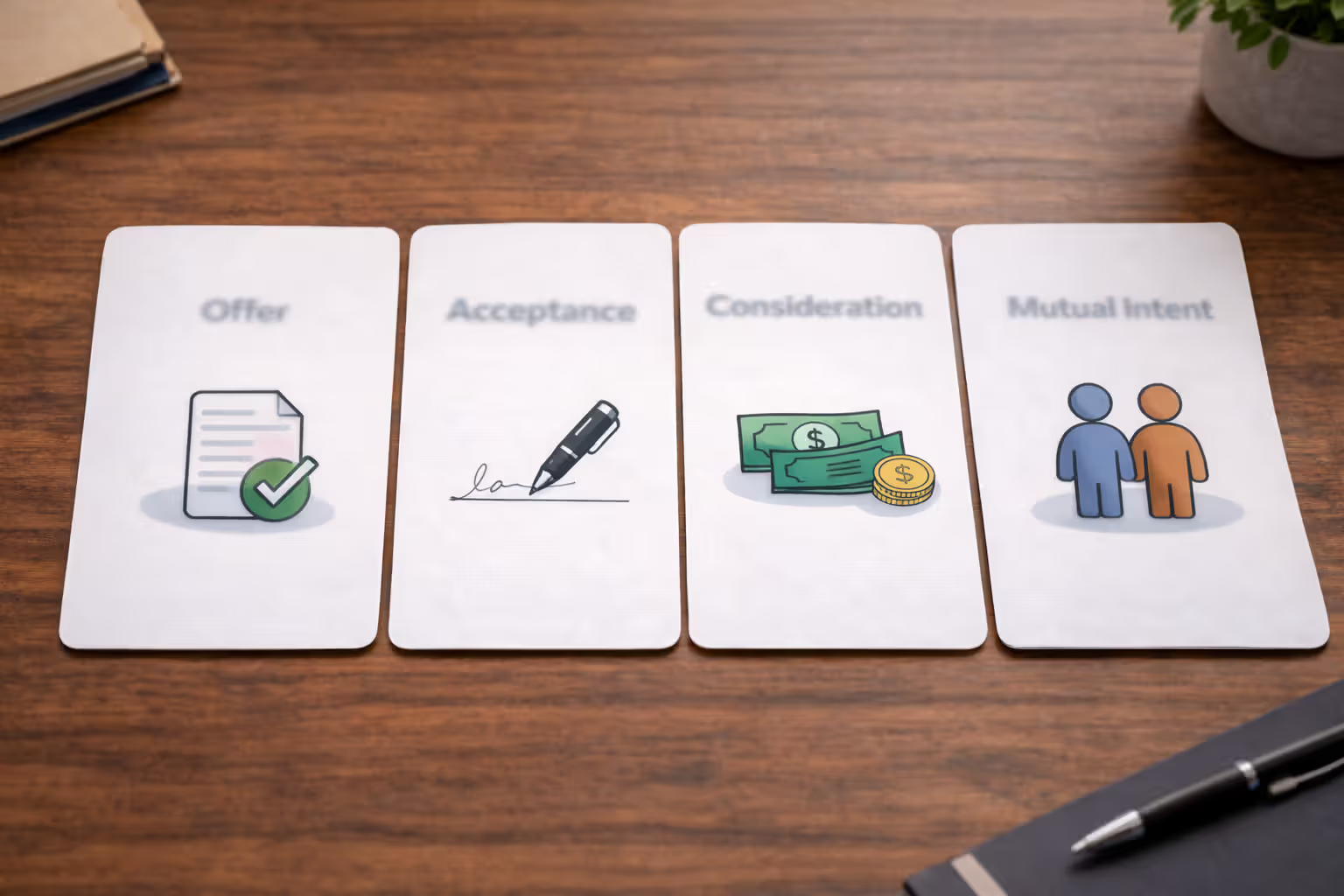
For a service agreement to hold up in court, it must satisfy four fundamental elements: offer, acceptance, consideration, and mutual intent to be bound. The offer describes the services; acceptance occurs when both parties sign; consideration is the exchange of services for payment; and intent means both sides understand they're entering a legal obligation.
Written agreements trump verbal ones every time. While oral contracts can be enforceable, proving their terms becomes a nightmare. Most states require contracts exceeding a certain value or duration to be in writing under the Statute of Frauds. For service agreements, written documentation also establishes independent contractor status, which matters enormously for tax purposes and liability.
State-specific rules can alter enforceability. California, for instance, restricts non-compete clauses severely, while Texas enforces them more readily if reasonable in scope and duration. Choice-of-law provisions let you select which state's rules govern the agreement, but courts may override that choice if it conflicts with public policy or if one party lacks bargaining power.
Author: Rachel Holloway;
Source: skeletonkeyorganizing.com
Capacity and legality round out the requirements. Both parties must have the legal ability to contract—meaning they're adults of sound mind, not incapacitated or bankrupt—and the services themselves must be lawful. A contract to perform illegal activities is void from the start.
Core Components Every Service Agreement Must Include
A contractor agreement structure follows a predictable pattern. Start with identifying information: full legal names, addresses, and entity types (LLC, sole proprietor, corporation). Include an effective date and, if relevant, an expiration date. Many agreements use "Provider" and "Client" labels to avoid repeating names.
Defining Scope of Work and Deliverables
Service scope clauses prevent the most common contract disputes. Vague language like "marketing services" invites disagreement. Instead, enumerate specific tasks: "Provider will deliver three blog posts per week, each 1,200–1,500 words, covering topics approved by Client in advance. Posts will include keyword research, SEO optimization, and one round of revisions."
The devil is in the details.
— Ludwig Mies van der Rohe
Attach a Statement of Work (SOW) as an exhibit when the project is complex. The main agreement covers general terms; the SOW details the nitty-gritty. This modular approach lets you update project specifics without redrafting the entire contract.
Explicitly state what's excluded. "Services do not include graphic design, video production, or paid advertising management" draws a clear boundary. Clients often assume bundled services; exclusions manage those expectations upfront.
Author: Rachel Holloway;
Source: skeletonkeyorganizing.com
Define acceptance criteria for deliverables. "Client will review deliverables within five business days and provide written feedback. Silence constitutes acceptance." Without this, clients can delay approval indefinitely, stalling payment and creating cash-flow headaches.
Payment Terms and Invoice Schedule
Spell out the total fee or rate structure. Fixed-fee arrangements ("$5,000 for the complete website redesign") suit well-defined projects. Hourly rates ("$150/hour for consulting services") work when scope fluctuates. Retainer models ("$3,000/month for up to 20 hours of support") provide predictable revenue.
Specify when invoices are issued and when payment is due. "Provider will invoice on the first of each month; payment is due within 15 days (Net 15)." Include accepted payment methods: ACH transfer, check, credit card. If you charge processing fees for credit cards, say so.
Trust, but verify.
— Ronald Reagan
Address expenses separately. "Client will reimburse pre-approved expenses exceeding $100 within 30 days of receipt of documentation" prevents surprise costs and clarifies who bears travel, software, or material expenses.
Author: Rachel Holloway;
Source: skeletonkeyorganizing.com
Timeline, Milestones, and Deadlines
Break long projects into phases with concrete dates. "Phase 1 (discovery and wireframes) will be completed by March 15. Phase 2 (design mockups) by April 10. Phase 3 (development and testing) by May 20." Tie payments to milestones when possible: "Client will pay 30% upon signing, 40% upon Phase 2 completion, and 30% upon final delivery."
Build in contingencies for client delays. "Timeline assumes Client will provide feedback within five business days of each deliverable. Delays in Client feedback will extend subsequent deadlines proportionally." This protects you from late penalties caused by client inaction.
Include a force majeure clause for unforeseeable events. "Neither party will be liable for delays caused by acts of God, war, pandemic, or government action beyond their reasonable control."
Clause Type
Purpose
Required or Optional
Risk if Omitted
Parties and Effective Date
Identifies who is bound
Required
Contract may be void for indefiniteness
Scope of Work
Defines services and deliverables
Required
Disputes over what's included; scope creep
Payment Terms
Establishes fees, schedule, and method
Required
Unenforceable payment claims
Term and Termination
Sets duration and exit conditions
Required
Indefinite obligation; unclear exit rights
Confidentiality
Protects sensitive information
Optional (highly recommended)
Client data or trade secrets exposed
Indemnification
Allocates liability for third-party claims
Optional
Provider may bear disproportionate risk
Intellectual Property
Assigns ownership of work product
Optional (critical for creative work)
Ownership disputes; unclear usage rights
Dispute Resolution
Specifies arbitration or mediation
Optional
Costly litigation as only recourse
Critical Service Contract Clauses Explained with Examples
Understanding service contract clauses explained in plain language helps you negotiate better terms and spot red flags in client-drafted agreements.
Termination and Cancellation Provisions
Termination clauses come in two flavors: termination for cause and termination for convenience. For-cause termination happens when one party breaches—fails to pay, misses deadlines, or violates terms. For-convenience termination lets either party exit without fault, usually with advance notice.
Example for-cause language: "Either party may terminate this Agreement immediately upon written notice if the other party: (a) fails to cure a material breach within 10 days of written notice; (b) becomes insolvent or files for bankruptcy; or (c) engages in fraud or illegal conduct related to the services."
Example for-convenience language: "Either party may terminate this Agreement for any reason upon 30 days' written notice. Upon termination, Client will pay Provider for all services performed through the termination date, plus reimbursable expenses incurred."
Address work-in-progress explicitly. "If Client terminates for convenience, Client will pay 50% of fees for the next uncompleted milestone as a termination fee, compensating Provider for lost opportunity and planning."
Liability Limitations and Indemnification
Limitation-of-liability clauses cap damages one party can recover from the other. Providers typically limit liability to the amount paid under the contract. "Provider's total liability for any claims arising from this Agreement will not exceed the total fees paid by Client in the 12 months preceding the claim."
Carve out exceptions for gross negligence, willful misconduct, or breaches of confidentiality. Courts often refuse to enforce liability caps for intentional wrongdoing.
Indemnification shifts risk for third-party claims. A mutual indemnification clause might read: "Each party will indemnify and hold harmless the other from claims arising from: (a) its breach of this Agreement; (b) its negligence or willful misconduct; or (c) its infringement of third-party intellectual property rights."
Clients often demand one-sided indemnification, requiring the provider to defend them against all claims. Push back. If a client uses your deliverables in a defamatory way you didn't approve, you shouldn't bear that risk.
Confidentiality and Non-Disclosure Terms
Confidentiality clauses protect sensitive information exchanged during the engagement. Define what constitutes confidential information: "Confidential Information includes business plans, customer lists, financial data, proprietary processes, and any information marked 'Confidential' or that a reasonable person would understand to be confidential."
Carve out standard exceptions: information already public, independently developed, or disclosed under legal compulsion. "Confidential Information does not include information that: (a) is or becomes publicly available through no breach of this Agreement; (b) was rightfully known prior to disclosure; (c) is independently developed without reference to Confidential Information; or (d) must be disclosed pursuant to law or court order."
Set a duration. "Obligations under this Section will survive termination and continue for three years thereafter." Perpetual confidentiality is hard to enforce and often unnecessary.
Dispute Resolution and Governing Law
Dispute-resolution clauses keep conflicts out of court. Mediation involves a neutral third party facilitating negotiation. Arbitration resembles a private trial where an arbitrator issues a binding decision. Both are faster and cheaper than litigation.
Example tiered approach: "The parties will first attempt to resolve disputes through good-faith negotiation. If unresolved within 30 days, the parties will submit to mediation under the rules of the American Arbitration Association. If mediation fails, the dispute will be resolved by binding arbitration in (City, State), applying (State) law."
Governing-law provisions specify which state's statutes apply. "This Agreement will be governed by and construed in accordance with the laws of the State of (State), without regard to conflict-of-law principles." Pair this with a venue or jurisdiction clause: "Any litigation will be brought exclusively in the state or federal courts located in (County, State)."
How to Structure Payment Clauses That Protect Both Parties
Payment clause examples demonstrate how different models allocate risk and cash flow.
Retainer agreements provide steady income. "Client will pay a monthly retainer of $4,000, due on the first of each month, covering up to 25 hours of services. Unused hours do not roll over. Services exceeding 25 hours will be billed at $175/hour." Retainers suit ongoing relationships—technical support, advisory services, content creation.
Milestone-based payments tie compensation to progress. "Project fee is $20,000, payable as follows: $6,000 upon signing (30%); $8,000 upon Client approval of Phase 1 deliverables (40%); $6,000 upon final delivery (30%)." This model aligns incentives and reduces client risk on large projects, but requires clear acceptance criteria to avoid payment disputes.
Upfront deposits protect providers from non-payment. "Client will pay a non-refundable deposit of $2,500 upon signing. The deposit will be credited against the final invoice." Deposits weed out unserious clients and cover initial costs.
Late-payment penalties incentivize promptness. "Invoices unpaid after 30 days will accrue interest at 1.5% per month (18% annual percentage rate) or the maximum rate permitted by law, whichever is less." Some states cap interest rates, so check local usury laws.
Expense reimbursement terms prevent disputes. "Client will reimburse reasonable, pre-approved expenses within 15 days of receipt of itemized documentation. Expenses under $50 do not require pre-approval." Define what's reimbursable: travel, software subscriptions, stock photos, subcontractors.
Payment Model
Best For
Example Terms
Pros/Cons
Fixed Fee
Well-defined projects with clear scope
"$15,000 for complete brand identity package"
Pro: Predictable cost for client; Con: Provider absorbs scope creep
Hourly Rate
Consulting, ongoing support, undefined scope
"$200/hour, billed weekly"
Pro: Fair compensation for time; Con: Unpredictable client costs
Monthly Retainer
Long-term relationships, recurring services
"$5,000/month for 30 hours of work"
Pro: Stable revenue; Con: Tracking hours and managing overages
Milestone Payments
Multi-phase projects
"30% upfront, 40% at midpoint, 30% on completion"
Pro: Aligns payment with progress; Con: Requires detailed milestones
Commission/Performance
Sales, marketing with measurable ROI
"10% of revenue generated from leads provided"
Pro: Aligns incentives; Con: Income uncertainty; measurement disputes
Common Mistakes When Drafting Contractor Agreements
Vague scope language tops the list. "Provide marketing support" means different things to different people. One party envisions social media posts; the other expects a full campaign with paid ads, email sequences, and analytics reporting. Enumerate tasks, quantities, and formats.
Missing termination terms trap both parties. Without an exit, you're theoretically obligated forever. Even if the relationship sours, neither side knows how to end it cleanly. Always include termination for cause and for convenience with notice periods.
Unclear intellectual property ownership causes expensive fights. Who owns the website code, logo design, or marketing copy? Default copyright law gives the creator ownership unless the work qualifies as "work made for hire" or ownership is explicitly transferred. A simple assignment clause solves this: "Provider assigns to Client all right, title, and interest in deliverables upon receipt of full payment."
Inadequate payment protections leave providers vulnerable. No late fees? Clients delay payment with impunity. No deposit? You invest time with no guarantee of compensation. No kill fee? Clients cancel mid-project and you've worked for free.
Ignoring independent contractor status risks IRS reclassification. If your agreement gives the client control over when, where, and how you work, the IRS may deem you an employee, triggering payroll taxes and penalties. Include language affirming contractor status: "Provider is an independent contractor, not an employee. Provider controls the means and methods of performing services and is responsible for all taxes."
Author: Rachel Holloway;
Source: skeletonkeyorganizing.com
Overreaching confidentiality or non-compete clauses backfire. Demanding a five-year non-compete covering an entire industry will likely be unenforceable and signals you don't understand reasonable restrictions. Courts favor narrow restrictions: limited geography, duration, and scope.
Downloadable Service Agreement Template Breakdown
A complete service agreement template includes these sections in order:
Title and Introduction: "SERVICE AGREEMENT" centered at the top. "This Service Agreement ('Agreement') is entered into as of (Date) ('Effective Date') by and between (Provider Name), a (State) (Entity Type) ('Provider'), and (Client Name), a (State) (Entity Type) ('Client')."
Recitals (optional but helpful): "WHEREAS, Provider offers (type of services); and WHEREAS, Client desires to engage Provider to perform such services; NOW, THEREFORE, in consideration of the mutual covenants herein, the parties agree as follows:"
Section 1: Services. Describe the scope in detail or reference an attached SOW. "Provider will perform the services described in Exhibit A (Statement of Work), incorporated by reference."
Section 2: Term. "This Agreement begins on the Effective Date and continues until (end date) or until terminated as provided herein."
Section 3: Compensation. State the fee structure, payment schedule, and invoice terms. "Client will pay Provider (amount) according to the payment schedule in Exhibit B."
Section 4: Expenses. Clarify what's reimbursable and the approval process.
Section 5: Intellectual Property. Assign ownership or grant licenses. "Upon full payment, Provider assigns to Client all intellectual property rights in deliverables created under this Agreement. Provider retains rights to pre-existing materials and general methodologies."
Section 6: Confidentiality. Define confidential information, obligations, and exceptions.
Section 7: Representations and Warranties. Each party warrants it has authority to enter the agreement and will comply with applicable laws. Providers often warrant services will be performed in a professional manner consistent with industry standards.
Section 8: Indemnification. Mutual or one-sided indemnity provisions.
Section 9: Limitation of Liability. Cap damages and exclude consequential damages. "In no event will either party be liable for indirect, incidental, consequential, or punitive damages."
Section 10: Term and Termination. For-cause and for-convenience termination rights, notice requirements, and wind-down obligations.
Section 11: Independent Contractor Status. "Provider is an independent contractor. This Agreement does not create an employment, partnership, or joint venture relationship."
Section 12: Dispute Resolution. Mediation, arbitration, or litigation procedures.
Section 13: Governing Law. Choice of law and venue.
Signature Blocks: Lines for printed names, signatures, titles, and dates for both parties.
Exhibits: Attach the Statement of Work, payment schedule, or other referenced documents.
Customize for your service type. A web development agreement needs detailed IP provisions and hosting responsibilities. A consulting agreement emphasizes confidentiality and non-solicitation. A cleaning service agreement focuses on schedules, supplies, and property access.
Frequently Asked Questions About Service Agreements
What's the difference between a service agreement and an independent contractor agreement?
The terms are often used interchangeably, but "independent contractor agreement" emphasizes the worker classification aspect—clarifying the provider is not an employee—while "service agreement" focuses on the services themselves. Most well-drafted service agreements include independent contractor language to protect both parties from employment-related liabilities and tax issues. If you're hiring someone to perform services and want to avoid employee classification, use a contract that explicitly addresses contractor status, control over work methods, tax responsibilities, and lack of benefits.
Can I use the same service agreement template for all types of professional services?
A generic template provides a starting framework, but each service type demands customization. A graphic designer needs robust intellectual property assignment clauses; a business consultant requires strong confidentiality and non-solicitation terms; a construction contractor must address permits, insurance, and lien waivers. The core structure—parties, scope, payment, term, termination—remains consistent, but the details vary significantly. Start with a solid template, then tailor clauses to your industry's risks and norms. Using a one-size-fits-all agreement without adaptation leaves gaps that cause problems later.
How do I modify a service agreement after both parties have signed?
Modifications require mutual consent. Draft an amendment or addendum referencing the original agreement: "This Amendment No. 1 to the Service Agreement dated (original date) between Provider and Client is entered into as of (new date)." Describe the changes clearly: "Section 3 (Compensation) is amended to increase the monthly retainer from $3,000 to $4,000 effective (date)." Both parties must sign the amendment. For minor changes, an exchange of emails confirming agreement can suffice, but formal written amendments are cleaner and more enforceable. Never make handwritten changes to a signed contract without both parties initialing and dating each change.
What happens if my service agreement doesn't specify a termination clause?
Without a termination clause, the agreement may be deemed terminable at will, meaning either party can end it at any time for any reason, or it may be considered perpetual until the services are completed. Courts generally disfavor perpetual obligations and may imply a reasonable termination right, but litigation to determine that right is expensive and uncertain. The absence of termination terms also leaves unresolved questions: How much notice is required? What happens to work-in-progress? Who pays for partially completed deliverables? Always include clear termination provisions to avoid these ambiguities and provide a predictable exit path.
Do service agreements need to be notarized to be enforceable in the US?
No. Notarization is not required for most service agreements to be legally binding. A contract is enforceable when both parties sign it, demonstrating their intent to be bound. Notarization adds a layer of authentication—a notary verifies the signers' identities and witnesses the signing—which can be useful if you anticipate disputes over whether someone actually signed. Some states require notarization for specific contract types (real estate deeds, powers of attorney), but service agreements are not among them. Electronic signatures under the ESIGN Act and state equivalents like UETA are equally valid as wet-ink signatures, with or without notarization.
How should I handle intellectual property rights in a service contract?
Address IP ownership explicitly to avoid disputes. The default rule under copyright law is that the creator owns the work unless it's a "work made for hire" (typically an employee creating work within the scope of employment). Independent contractors own their creations unless the contract assigns rights to the client. Use clear assignment language: "Provider hereby assigns to Client all right, title, and interest, including all intellectual property rights, in the deliverables upon Client's payment in full." If you want to retain rights to reuse certain elements—templates, code libraries, general methodologies—carve them out: "Provider retains ownership of pre-existing materials and may reuse general knowledge and techniques developed during the engagement." For ongoing relationships, consider granting a license instead of full assignment, allowing you to reuse work for other clients.
A well-structured service agreement protects your business, clarifies expectations, and provides a roadmap when disputes arise. Start with a solid template that covers essential clauses—scope, payment, term, termination, IP, confidentiality—then customize for your specific services and client relationship. Review agreements periodically as your business evolves, and don't hesitate to consult an attorney for high-value contracts or unfamiliar terms. The hour you invest drafting a thorough agreement saves weeks of headaches and potential legal fees down the road.
Nearly 70% of business partnerships lack formal written agreements — and fail at dramatically higher rates. This guide covers four elements of enforceability, capital contribution documentation, profit-sharing models with formula examples, tiered decision-making structures, buy-sell valuation methods, non-compete clauses, common drafting mistakes that invalidate agreements, and a customizable temp
Comprehensive guide to shareholder agreement templates covering voting rights, share transfer restrictions, dividend policies, dispute resolution, buy-sell provisions, and corporate governance structures for U.S. corporations, with practical tips to protect ownership interests and prevent internal conflicts.
Most non-compete templates fail in court because they're too broad, lack consideration, or ignore state-specific rules. This guide covers three enforceability requirements, key clauses courts actually uphold, a state-by-state legality table, common drafting mistakes that void agreements, how non-competes compare to non-solicitation and NDA alternatives, and industry-specific customization strategi
Download a free settlement agreement template with expert guidance on drafting enforceable legal release clauses, structuring clear payment terms, defining claim waivers, and including effective dispute resolution provisions to protect both parties and minimize future legal risk.
The content on Legal Insights is provided for general informational purposes only. It is intended to offer insights, commentary, and analysis on legal topics and developments, and should not be considered legal advice or a substitute for professional consultation with a qualified attorney.
All information, articles, and materials presented on this website are for general informational purposes only. Laws and regulations may vary by jurisdiction and may change over time. The application of legal principles depends on specific facts and circumstances.
Legal Insights is not responsible for any errors or omissions in the content, or for any actions taken based on the information provided on this website. Users are encouraged to seek independent legal advice tailored to their individual situation before making any legal decisions.