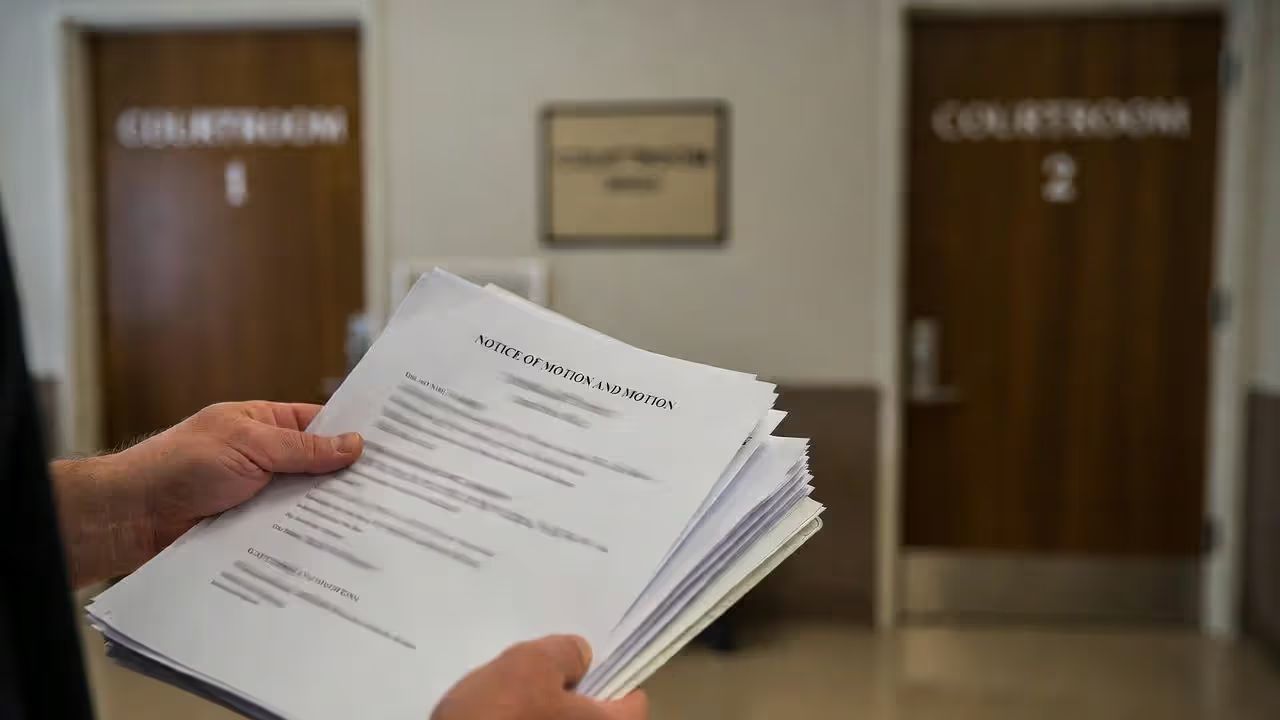
You've just landed a great job offer. Excited, you're skimming through the paperwork when you notice something about "binding arbitration" buried on page seven. Should you care? Absolutely.
That innocuous paragraph changes everything about how you'd handle a future dispute with your employer. No courthouse. No jury. Instead, you'd sit across from your boss in a conference room while a private arbitrator decides your fate.
These clauses show up everywhere now—employment agreements, credit card applications, cell phone plans, even your gym membership. Companies love them. But what do they actually mean for you? Let's break down how arbitration provisions work, when courts enforce them, and whether signing away your right to sue is ever a good idea.
What Is an Arbitration Clause in a Contract?
Think of these provisions as contracts within contracts. You're essentially agreeing upfront that if something goes wrong, you'll skip the traditional court system and hand your dispute to a private decision-maker instead.
Here's what that means in practice: Instead of filing in your local courthouse with a judge assigned from the bench, you'd enter a private process where both sides select (and pay) an arbitrator. This person—often a retired judge or attorney—conducts hearings in conference rooms, reviews whatever evidence gets submitted, and issues a final decision that's just as enforceable as any court judgment.
The process looks nothing like what you see on legal dramas. No courtroom gallery. No court reporter unless you pay extra. No jury, period. Most importantly, no automatic right to appeal if the arbitrator gets the law completely wrong.
Take this example pulled from an actual tech company's offer letter: "Employee agrees all employment-related claims shall be decided by a neutral arbitrator selected through JAMS Employment Arbitration procedures, with costs split 50/50 between parties."
That single sentence eliminates your access to: - Civil court litigation - Trial by jury - Standard court discovery rules - Meaningful appellate review
Consumer agreements package this even more cleverly. Your credit card terms might include: "We both give up our right to go to court, including the right to a jury. Any claims get decided by an arbitrator whose ruling is final." Streaming services, ride-sharing apps, and online marketplaces bury similar language in their terms—which you "agree to" simply by using the service.
What makes arbitration so different from regular litigation? Control and transparency. Public courts operate under rules established by legislatures and appellate decisions. Anyone can watch proceedings. Court records remain public. Judges must follow precedent and explain their rulings.
Arbitration flips this script. The arbitrator decides what evidence to consider, how much discovery to allow, and which legal standards to apply. Hearings happen behind closed doors. Awards rarely include detailed reasoning. The entire process—including the outcome—typically stays confidential.
How Mandatory Arbitration Clauses Work
The word "mandatory" does heavy lifting here. You might think it means you're required to arbitrate but could still sue if you really wanted to. Wrong. These provisions don't just encourage arbitration—they eliminate your ability to choose litigation.
Once you've signed (or clicked "I accept"), that choice is made. File a lawsuit anyway? The defendant will immediately ask the court to dismiss your case and force you into arbitration. Courts grant these motions roughly 80% of the time.
"Binding" packs another punch. The arbitrator's decision isn't a recommendation you can reject if you dislike it. It carries the same legal weight as a trial verdict. Win or lose, you're done. The victor can march straight to court, get the award confirmed as a judgment, and start collection proceedings—garnishing wages, freezing accounts, putting liens on property.
What triggers these clauses? Usually "any dispute arising from or related to" the contract. That sweeping language captures far more than simple contract breaches.
Employment arbitration typically covers: - Discrimination and harassment claims - Wage and hour violations - Wrongful termination - Whistleblower retaliation - Benefits disputes - Non-compete enforcement
Consumer agreements cast an equally wide net: - Billing errors and overcharges - Service quality complaints - Data breach claims - Product defects and injuries - Deceptive marketing allegations
You signed up for Netflix, and suddenly your ability to sue over a privacy violation gets routed through private arbitration. That's how broadly these provisions operate.
Class Action Waiver Provisions
Author: Michelle Granton;
Source: skeletonkeyorganizing.com
Now we get to the part that really tips the scales. Many arbitration clauses don't just require individual arbitration—they explicitly ban class actions, collective claims, or any kind of group proceeding.
Translation: Even when thousands of people get harmed identically, each person must pursue their claim alone.
Here's typical language: "Claims must be brought individually. You waive any right to participate as a plaintiff or class member in any class, collective, or representative proceeding."
Why does this matter? Economics. Say your bank charges an illegal $5 fee to 500,000 customers. In a class action, one lawsuit recovers $2.5 million for everyone. Under an arbitration clause with a class waiver, each customer would need to individually arbitrate their $5 claim—paying filing fees that exceed the claim value.
Result: The bank keeps the money. Nobody bothers arbitrating over five bucks.
Companies figured this out years ago. After the Supreme Court blessed class action waivers in the 2011 AT&T Mobility v. Concepcion decision, these provisions exploded. The 2018 Epic Systems ruling extended this protection to employment contexts, even for wage claims involving hundreds of workers.
Consumer advocates call it a "Get Out of Jail Free" card for corporate wrongdoing. Business groups defend it as protecting companies from blackmail settlements where trial lawyers pocket millions regardless of claim merit. Whatever your view, class waivers dramatically shift power toward whoever drafted the contract.
Opt-Out Windows and Exceptions
Author: Michelle Granton;
Source: skeletonkeyorganizing.com
Occasionally—very occasionally—companies offer an escape hatch. You get 30 to 60 days after signing to reject arbitration by following specific procedures.
An opt-out provision might read: "To reject this agreement, send a signed letter to Legal Department, P.O. Box 12345, Charlotte, NC 28241 within 60 days. State your name, address, account number, and 'I opt out of arbitration.' This choice doesn't impact other contract terms."
Sounds simple, right? Yet fewer than 0.1% of consumers exercise these rights. Why?
The clauses get buried in 50-page terms of service. Nobody reads that far. Even when people notice, the requirement to physically mail a letter (not email!) to some random P.O. box creates friction. Miss the deadline by one day? You're locked in.
For employees, using the opt-out can feel risky. What new hire wants to telegraph "I'm planning to sue you" before their first day? Many people correctly or incorrectly worry it'll poison the relationship or cost them the job.
Smart move if you can stomach it? Exercise opt-out rights immediately. You can always agree to arbitrate a specific dispute later if it makes sense. But once the window closes, you've given up litigation rights permanently.
Certain disputes sometimes escape arbitration requirements altogether. Common exceptions include:
Workers' compensation and unemployment insurance (handled through state administrative systems)
Requests for immediate injunctive relief (restraining orders stopping imminent harm)
Small claims court actions below the dollar threshold ($5,000-$10,000 depending on state)
Some intellectual property disputes
Administrative complaints with agencies like the EEOC or Department of Labor
Check your specific contract carefully. Just because it says "all disputes" doesn't necessarily mean all disputes. Courts sometimes read exceptions into overly broad language.
Common Types of ADR Contract Provisions
Author: Michelle Granton;
Source: skeletonkeyorganizing.com
Not all dispute resolution clauses work identically. Contracts might require arbitration, mediation, or stepped combinations depending on what the parties negotiated (or what the company's lawyers decided to impose).
Arbitration provisions mandate binding resolution by a private neutral whose decision you cannot appeal. These sections specify which organization administers the process—American Arbitration Association, JAMS, or specialized groups like the Financial Industry Regulatory Authority for securities disputes. The clause also dictates applicable rules, hearing location, and how costs get divided.
Mediation requirements take a softer approach. You must attempt settlement through a facilitator who helps negotiate but cannot impose outcomes. Unlike arbitration, mediation stays non-binding until both sides sign a settlement agreement. If talks fail, you're free to litigate or arbitrate afterward.
Example: "Before initiating litigation, parties shall participate in one full-day mediation session with a mutually agreed mediator. Each party bears its own mediation costs and splits the mediator's fee equally."
Multi-tiered dispute resolution combines methods sequentially. A typical structure: 1. Direct negotiation between executives within 30 days of written dispute notice 2. Mediation within 60 days if negotiation fails 3. Binding arbitration if mediation doesn't produce settlement
You must exhaust each step before advancing. Skip straight to arbitration? The arbitrator can dismiss your case for failure to comply with contractual procedures.
These escalating approaches aim to resolve conflicts at the cheapest, fastest level. Most disputes supposedly settle during negotiation or mediation, saving the expense of formal arbitration. Whether that actually happens depends heavily on the parties' good faith.
Carve-outs preserve court access for specific claim types. An employment contract might send discrimination and wage claims to arbitration while allowing lawsuits over trade secret theft or non-solicitation violations. Service agreements frequently arbitrate billing disputes but permit litigation for intellectual property infringement.
Why carve out certain claims? Sometimes companies want public enforcement mechanisms for issues where they're typically plaintiffs (IP theft, non-competes). Other times, state or federal law makes arbitration problematic for particular claims.
Process Type
Binding?
Cost Range
Timeline
Discovery Available
Appeal Rights
Privacy
Arbitration
Yes—decision becomes enforceable judgment
$5,000–$50,000+ depending on complexity and fee allocation
6–18 months from filing to award
Limited—typically document requests and one or two depositions
Essentially none except fraud or arbitrator misconduct
The comparison explains why businesses push arbitration aggressively. Costs run one-tenth of litigation expenses. Resolution happens years faster. Everything stays private, preventing bad publicity and precedent-setting decisions. For individuals, though, those same features often work as disadvantages—especially limited discovery and vanishing appeal rights.
Arbitration Enforcement: When Courts Uphold or Strike Down Clauses
Author: Michelle Granton;
Source: skeletonkeyorganizing.com
The 1925 Federal Arbitration Act created a strong legal presumption favoring these agreements. Congress wanted to reverse judicial hostility toward arbitration by putting such clauses on "equal footing" with other contracts. Courts have interpreted that mandate expansively—some would say aggressively—for decades.
When you file a lawsuit despite an arbitration provision, the defendant files a motion to compel arbitration. The judge applies a two-question framework: First, is there a valid, enforceable agreement to arbitrate? Second, does your particular claim fall within the scope of what the parties agreed to arbitrate?
Answer both "yes," and your lawsuit gets dismissed or stayed while you proceed to arbitration. The burden on the party resisting arbitration is substantial. Courts resolve doubts in favor of enforcement.
Federal law trumps state attempts to limit arbitration. California passed AB 51 in 2019, prohibiting employers from requiring arbitration agreements as a condition of employment. Federal courts immediately enjoined enforcement, finding the law conflicted with the FAA. Montana's restrictions on employment arbitration face similar preemption challenges.
States cannot single out arbitration for disfavorable treatment. That's the key phrase from Supreme Court precedent. But general contract defenses—fraud, duress, unconscionability—remain available because they apply equally to all agreements.
The unconscionability doctrine provides the main avenue for challenging enforcement. Courts examine two dimensions:
Procedural unconscionability focuses on the formation process. Red flags include: - Contracts of adhesion (take-it-or-leave-it with no negotiation opportunity) - Fine print burying crucial terms - High-pressure signing environments - Adding arbitration clauses after the relationship begins - Inadequate consideration (employer modifies existing employees' terms without anything in return)
Substantive unconscionability looks at one-sided or oppressive terms: - Requiring employees/consumers to pay excessive arbitration costs - Prohibiting remedies available under applicable law - Severely limiting discovery in ways that prevent proving claims - Selecting biased arbitration forums or procedures - Shortening statutes of limitations below statutory periods - Imposing confidentiality that shields repeat violations
Most jurisdictions require both procedural and substantive problems, though extreme unfairness in either dimension might suffice. Courts remain reluctant to invalidate arbitration clauses, so you need genuinely shocking facts to prevail.
Recent Supreme Court decisions have consistently favored enforcement. Epic Systems (2018) held that class action waivers don't violate workers' rights to collective action under the National Labor Relations Act. Lamps Plus (2019) ruled that ambiguous language should be interpreted against class arbitration unless explicitly authorized. The trend strongly favors companies.
When do courts still refuse enforcement?
Cost-prohibitive provisions: Clauses requiring employees or consumers to pay filing fees exceeding what they'd face in court
Statutory rights violations: Attempts to waive substantive protections under employment discrimination or consumer protection statutes
Fraud in inducement: Misrepresenting what arbitration entails or hiding the clause's existence
Lack of mutuality: Binding only one party to arbitrate (though some courts accept legitimate business justifications for asymmetric terms)
Extreme limitation of remedies: Capping damages so low that statutory rights become meaningless
How to Analyze a Dispute Clause Before Signing
Author: Michelle Granton;
Source: skeletonkeyorganizing.com
Don't just skim past the arbitration section assuming all clauses look alike. They don't. Some maintain reasonable balance while others stack every advantage toward the drafting party. Here's what to scrutinize:
1. Which organization administers arbitration? The clause should identify AAA, JAMS, CPR Institute, or an industry-specific body. Pull up their rules and fee schedules online. Check arbitrator qualifications. Some organizations lean toward repeat institutional clients (employers, corporations) who provide steady business. Others maintain stricter neutrality.
2. How are costs allocated? This might be the most important financial term. Does the company pay all fees? Do you split everything 50/50? Arbitration expenses include filing fees ($200–$5,000), arbitrator compensation ($300–$700 per hour), hearing room rental, and administrative charges. If you're facing $10,000 in upfront costs to pursue a $20,000 claim, the clause effectively eliminates your remedy.
3. What discovery is allowed? Standard arbitration rules permit limited document requests and maybe one or two depositions. If proving your case requires reviewing thousands of company records, deposing multiple witnesses, or retaining experts, restricted discovery could doom your claim. Conversely, if you already possess the key evidence, limited discovery works fine.
4. Can you appeal the decision? Nearly all arbitration awards are final. A few clauses incorporate optional appellate procedures through the arbitration organization—adding expense but allowing review of legal errors. Understand that an arbitrator's complete misapplication of the law usually cannot be challenged in court.
5. Which state's law applies? The governing law provision matters enormously. California offers stronger employee and consumer protections than many states. If you work in California but the contract designates Texas law, you lose those protections. Sometimes forum selection and choice-of-law clauses appear separately; review both.
6. Where must arbitration occur? If you're in Miami but must arbitrate in the company's Seattle headquarters, travel costs and logistics may force you to abandon meritorious claims. Reasonable clauses require arbitration in the employee's or consumer's home area.
7. What claims are excluded? Look for carve-outs. Can you still use small claims court for disputes below the jurisdictional threshold? Are injunctive relief requests exempted? May you file administrative charges with agencies? These exceptions preserve important remedies.
8. Is there a class action waiver? This matters most for small-dollar claims where individual arbitration makes no economic sense. Evaluate whether your potential disputes would likely be individual (wrongful termination, discrimination) or systemic (wage violations affecting all employees, deceptive practices harming all customers).
9. Do you have an opt-out window? Some clauses allow rejecting arbitration within 30–60 days using specific procedures. Calendar this deadline immediately. Send the required written notice to preserve litigation rights. Don't assume you'll remember later.
10. Can terms be changed unilaterally? Watch for provisions letting the company modify arbitration procedures with minimal notice. Some contracts allow amendments that take effect if you continue using the service—potentially worsening terms after you've already agreed.
A balanced clause would share costs fairly (company pays most or all), allow reasonable discovery, occur in a convenient location, and not eliminate substantive rights through procedural hurdles. Clauses that systematically favor one party deserve pushback if you have any negotiating leverage.
Pros and Cons: Should You Agree to Arbitration?
No universal answer exists. The calculation depends on your bargaining power, likely dispute types, claim values, and risk tolerance.
Factor
Benefit to Company/Employer
Impact on Employee/Consumer
Speed of resolution
Disputes resolve in 6–18 months rather than 2–5 years; legal fees stay manageable
May rush your preparation; condensed timeline can benefit the party with documents and resources already organized
Cost structure
Total expenses typically one-tenth of litigation; predictable fee schedules
If costs are split, you might pay $5,000–$25,000 that would cost under $500 in filing fees for court litigation
Confidential process
No public record of settlements, awards, or damaging facts; protects reputation
Enables concealing systemic problems; can't research company's arbitration history when evaluating claims
Limited discovery
Protects proprietary information; drastically reduces document production burden
Much harder to obtain evidence in the company's possession; may get one deposition when you need five
Lose jury sympathy in discrimination, harassment, or consumer fraud cases where emotional appeal matters
Virtually no appeals
Finality—case ends when arbitrator decides; no years of appellate litigation
Stuck with legal errors; if arbitrator misunderstands statute or ignores precedent, no meaningful correction available
Class action prohibition
Eliminates exposure to massive class damages; handles claims individually at manageable scale
Small claims become economically irrational to pursue; can't pool resources with similarly affected people
Repeat player effect
Arbitrators may unconsciously favor companies providing recurring business
One-time users potentially disadvantaged against institutional parties who participate frequently
Situations where arbitration might work in your favor:
You have a high-value individual claim—say, $100,000+ in provable damages—making arbitration costs worthwhile. You value privacy, perhaps because public litigation would expose embarrassing personal or business details. Your case involves technical issues (complex contracts, industry practices, accounting disputes) where specialized arbitrators offer advantages over lay juries. You need resolution within a year rather than waiting through multi-year litigation. Your evidence needs are modest because you already possess key documents and testimony.
Arbitration is a matter of contract.
— Justice Antonin Scalia
Situations where arbitration likely harms you:
Your claim involves damages under $10,000 where arbitration costs exceed potential recovery. You need extensive discovery—reviewing thousands of company documents, deposing numerous witnesses, obtaining expert analysis. Your case relies on jury sympathy (discrimination based on race/gender/disability, sexual harassment, deceptive consumer practices). You want to join others in a class action to make small claims economically viable. The arbitration clause imposes one-sided costs, restricts remedies below statutory minimums, or occurs in an inconvenient location. You face a repeat institutional player with established relationships in the arbitration community.
For employees and consumers, negotiating better arbitration terms usually proves impossible. Employers and companies present take-it-or-leave-it terms. Your only leverage is using the opt-out window or declining the job offer / service entirely.
Business-to-business contracts with comparable bargaining power present different dynamics. Two sophisticated parties can negotiate mutual, balanced arbitration provisions that benefit both through efficient dispute resolution while maintaining fairness.
Frequently Asked Questions About Arbitration Clauses
Can I refuse to sign a contract with an arbitration clause?
Sure—and the other side can refuse to do business with you. That's your negotiating position.
Employers regularly withdraw job offers from candidates who won't accept arbitration provisions. Service providers deny accounts to consumers who object. In business-to-business contexts where both parties have leverage, you can negotiate removal or modification of offensive terms.
For employees and consumers? Your options narrow to accepting the arbitration clause, exercising any available opt-out provision within the specified timeframe, or walking away from the deal entirely. You cannot force the other party to contract on your preferred terms.
Does an arbitration clause prevent me from filing a lawsuit entirely?
Mostly yes, with specific exceptions. You can technically file your lawsuit—no law stops you from walking into the courthouse and paying filing fees. But the defendant will immediately move to compel arbitration. The judge will almost certainly grant that motion, dismiss or stay your case, and order you to arbitrate instead.
However, these types of claims may escape arbitration requirements: - Workers' compensation (state administrative system) - Unemployment benefits (state agency jurisdiction) - Small claims court actions if the contract carves them out - Requests for emergency injunctive relief to stop immediate harm - Administrative complaints with agencies like the EEOC, DOL, or NLRB (these agencies aren't bound by private contracts)
Also check whether your specific contract contains exceptions for particular claim types. Some agreements arbitrate most disputes but allow litigation over non-competes, trade secrets, or intellectual property.
Who pays for arbitration costs?
Depends entirely on contract language. Some clauses split all costs equally between parties. Others require the company to pay everything. Many fall somewhere in between—company pays administrative fees while parties split arbitrator compensation.
Typical arbitration expenses: - Filing fees: $200–$5,000 depending on claim amount - Arbitrator compensation: $300–$700 per hour (hearings often take 8–40 hours) - Hearing room rental: $200–$500 per day - Administrative charges: $500–$2,000
Courts will invalidate clauses requiring employees or consumers to pay costs exceeding what they'd face in court (typically under $500 in filing fees). California and some other states generally require employers to pay all arbitration costs beyond what the employee would incur in litigation. But enforcement varies, and you might need to fight over cost allocation before arbitration even begins.
Can arbitration decisions be appealed?
Almost never. The Federal Arbitration Act permits vacating awards only for fraud, corruption, evident partiality, arbitrator misconduct, or exceeding authority.
Notice what's missing? Legal errors. The arbitrator can completely misinterpret the statute governing your claim, ignore binding precedent, or apply the wrong legal standard—and you're stuck with the result.
A handful of arbitration clauses include opt-in appellate procedures through organizations like AAA or JAMS. These allow limited review of legal errors but add substantial cost and time. Such provisions remain uncommon.
Practically speaking, treat arbitration awards as final. That's a huge difference from court judgments, which you can appeal if the judge makes legal mistakes.
Are arbitration clauses enforceable in all states?
Federal law—specifically the Federal Arbitration Act—makes these agreements enforceable nationwide, overriding state laws that discriminate against arbitration.
California tried prohibiting mandatory employment arbitration through AB 51. Federal courts blocked it. Montana attempted restricting arbitration in employment contracts. Similar preemption challenges followed. States cannot categorically ban or disfavor arbitration compared to other dispute resolution methods.
However, general contract defenses work everywhere. You can challenge arbitration clauses for fraud, duress, lack of consideration, or unconscionability—just like any other contract term. Some states (particularly California) scrutinize arbitration agreements more carefully for unconscionability, examining cost allocation, remedy limitations, and procedural fairness more strictly than other jurisdictions.
The baseline enforceability framework comes from federal law, but state contract principles still matter in analyzing whether a specific clause is valid.
What happens if I ignore an arbitration clause and file in court?
You waste time, money, and credibility. Here's the sequence:
You file your complaint and pay filing fees. The defendant files a motion to compel arbitration within weeks. The court schedules a hearing. At the hearing, the defendant demonstrates you signed an arbitration agreement covering this dispute. Unless you can prove the clause is invalid (unconscionable, fraudulent, etc.), the judge grants the motion. Your lawsuit gets dismissed or stayed. You're ordered to pursue arbitration instead.
Now you're behind schedule, having burned weeks or months on aborted litigation. You've spent money on court filing fees that won't be refunded. If you hired an attorney, you've paid for drafting a complaint that goes nowhere.
Worse, if you continue refusing to participate in arbitration after the court orders it, the defendant may pursue arbitration without you and obtain a default award. That award gets confirmed as a court judgment enforceable through wage garnishment, bank account levies, and property liens.
Bottom line: If a valid arbitration clause exists, you must arbitrate. Fighting that reality just delays resolution while costs accumulate.
Arbitration clauses have become ubiquitous across employment, consumer, and commercial contracts. Understanding what these provisions actually mean—not just the sanitized description companies provide—helps you make informed choices about whether to accept them, negotiate different terms, or exercise opt-out rights where available.
The binding nature of arbitration, combined with class action prohibitions and vanishing appeal rights, fundamentally changes how disputes get resolved. These clauses typically favor the drafting party through repeat-player advantages, confidentiality that conceals patterns of wrongdoing, and elimination of collective actions for systemic problems.
Before accepting arbitration terms, scrutinize the specifics: cost sharing, discovery allowances, arbitrator selection procedures, location requirements, and opt-out windows. Recognize that most consumer and employment contracts offer no negotiation opportunity—you're choosing between accepting the terms or walking away.
If you're evaluating a contract with arbitration provisions, consider consulting an attorney familiar with your jurisdiction's enforcement standards. When you do have negotiating power—particularly in business-to-business contexts—push for mutual, balanced terms that don't systematically advantage one party.
Make that choice consciously, understanding both what you gain (speed, privacy, informality) and what you surrender (jury trials, full discovery, meaningful appeals, class actions). Once you sign, those litigation rights disappear. At least make sure you know what you're trading away.
A clear guide to U.S. contract law: definition and purpose, the elements of enforceable agreements, how formation works (including online terms and the Statute of Frauds), key contract types, why contracts become unenforceable, and what remedies apply after breach—plus common pitfalls and FAQs.
A practical guide to contract remedies when someone backs out: how courts award expectation and reliance damages, when restitution applies, and when judges order specific performance. Includes mitigation duties, foreseeability and certainty limits, liquidated damages, and common mistakes that reduce recovery.
A clear guide to public vs private law in the U.S.: how government power differs from person-to-person disputes, what areas fall under each (criminal, constitutional, administrative vs contracts, torts, family/property), and how procedures, proof standards, remedies, and case control change your strategy.
A clear guide to negligence vs recklessness in U.S. injury cases: the mental state line, how courts classify conduct, and what proof you need. See where gross negligence fits, when punitive damages apply, and how insurance exclusions and settlement strategy shift when conduct moves from careless to consciously dangerous.
The content on Legal Insights is provided for general informational purposes only. It is intended to offer insights, commentary, and analysis on legal topics and developments, and should not be considered legal advice or a substitute for professional consultation with a qualified attorney.
All information, articles, and materials presented on this website are for general informational purposes only. Laws and regulations may vary by jurisdiction and may change over time. The application of legal principles depends on specific facts and circumstances.
Legal Insights is not responsible for any errors or omissions in the content, or for any actions taken based on the information provided on this website. Users are encouraged to seek independent legal advice tailored to their individual situation before making any legal decisions.