Сonsumer protection enforcement hit unprecedented levels—both in dollar amounts and in the types of business practices regulators targeted. Federal regulators alone secured over $2.3 billion through settlements and judgments since January. State-level actions added hundreds of millions more.
What's different this year? Enforcers aren't just chasing outright fraud anymore. They're scrutinizing interface designs, algorithmic pricing, and subscription cancellation flows. Even practices that companies considered "industry standard" now face regulatory challenges.
For consumers, this enforcement wave translates into expanded rights and, in many cases, refund checks. But you need to know where to look and what these actions mean for your specific situation.
Recent FTC Enforcement Actions Against Major Corporations
Amazon paid $30.8 million settlement covering two distinct privacy violations. Ring, Amazon's doorbell camera subsidiary, gave employees and third-party contractors unrestricted access to customers' private video feeds. Meanwhile, Amazon's Alexa division kept children's voice recordings stored permanently—even when parents explicitly asked the company to delete them.
The settlement goes beyond just writing a check. Amazon can't use any deleted voice data or location information to train its algorithms. The company must purge inactive child accounts according to strict timelines. Most significantly, the order sets a precedent that privacy policies aren't just aspirational marketing copy—they're enforceable commitments.
In September, Intuit paid $141 million to settle charges related to TurboTax's "free" filing advertisements. The problem? Roughly 70% of tax filers couldn't actually use the free version. Intuit spent millions on Super Bowl commercials shouting "free, free, free" while hiding eligibility requirements in microscopic footnotes. Many consumers paid $60-$120 for services they could have accessed free through the IRS Free File program. Settlement funds went directly to affected consumers as refunds.
Credit Karma's March settlement ($3 million) addressed a particularly sneaky practice. The company labeled certain credit card offers as "pre-approved" with "90% chance of acceptance." Internal emails showed Credit Karma knew approval rates for some user segments dropped below 10%. Consumers submitted applications thinking approval was virtually guaranteed, resulting in hard credit inquiries that dinged their credit scores—often for cards they were never going to get. New disclosure requirements force Credit Karma to show realistic approval odds before consumers apply.
Epic Games, creator of Fortnite, paid the largest administrative penalty in FTC history—$275 million—in December 2023. The violations centered on "dark pattern" interface designs. Purchase buttons sat directly next to menu navigation controls. The game lacked confirmation screens before charging credit cards. Kids racked up hundreds of dollars in charges while their parents thought they were just playing. A separate $245 million penalty addressed children's privacy violations where voice chat features exposed minors to harassment and predatory behavior.
These cases share a pattern: growth teams overruled compliance concerns, companies prioritized revenue over transparency, and internal documents showed executives knew about the problems years before enforcement arrived.
Author: Michelle Granton;
Source: skeletonkeyorganizing.com
State-Level Consumer Rights Litigation: Key Cases to Watch
California and New York Lead Multi-State Actions
California's attorney general sued Amazon in September, with twenty-three other states joining the action. The allegation? Amazon's contracts with third-party sellers include "fair pricing policies" that effectively ban sellers from offering lower prices anywhere else online. According to the complaint, this keeps prices artificially high across the entire e-commerce ecosystem. Unlike typical antitrust cases seeking only monetary damages, this lawsuit demands structural changes to Amazon's marketplace contracts.
New York's AG secured a $15 million settlement from Zoetis, a pet medication manufacturer, in August. Zoetis required veterinarians to sign contracts prohibiting them from discussing medication prices or telling pet owners about cheaper pharmacy options. Vets couldn't even mention that the same medication might cost 40% less at a competing pharmacy. The settlement bans these gag clauses permanently and requires Zoetis to notify every veterinary practice that they're now free to discuss pricing openly with clients.
Seventeen state attorneys general launched coordinated investigations into rental housing platforms. The focus: algorithmic rent-setting tools like RealPage. These platforms collect competing landlords' pricing data, then generate rent recommendations. State enforcers are investigating whether this crosses the line from price optimization into illegal price-fixing—particularly given that rental costs have spiked 30-40% in some markets where these tools dominate.
Emerging Patterns in Class Action Settlements
"Subscription trap" class actions generated over $180 million in settlements. Defendants included fitness apps, meal delivery services, and software companies. The common thread? Making cancellation absurdly difficult compared to signup. Sign up with two clicks online, but cancel only by calling during business hours and enduring a 20-minute retention pitch.
Courts now routinely approve settlements requiring "same-medium cancellation." Signed up via the website? You can cancel via the website. No phone calls required. No "account specialists" to convince. Just a cancel button that actually works.
Illinois' biometric privacy law (BIPA) continues generating massive settlements. Snapchat paid $35 million in February for collecting facial geometry data through its filters without proper consent. White Castle paid $9.4 million after requiring employees to clock in using fingerprint scanners—without the legally required disclosures and consent forms. These cases demonstrate that even routine collection of fingerprints or facial data carries substantial liability under state biometric privacy laws.
Author: Michelle Granton;
Source: skeletonkeyorganizing.com
Data breach litigation has evolved beyond arguing whether breaches happened. Courts now scrutinize whether companies maintained reasonable security before breaches occurred. Recent settlements require specific security implementations: mandatory multi-factor authentication, encryption protocols meeting defined standards, and regular third-party security audits. Companies can't just offer credit monitoring anymore—they must fix the underlying security deficiencies.
Deceptive Advertising Crackdowns: Industries Under Scrutiny
Health and wellness companies received over forty warning letters from the FTC. Products claiming to treat diabetes, reverse Alzheimer's disease, or cure opioid addiction drew particular attention. Warning letters represent the first step—companies that ignored them faced enforcement actions. One supplement manufacturer paid $4.2 million after claiming its product could replace insulin for Type 2 diabetes management. The company had zero clinical trials, just customer testimonials and a study on a completely different supplement.
Tech companies selling VPNs encountered enforcement for overpromising security. Several providers advertised "military-grade encryption" and "complete anonymity" while maintaining connection logs that undermined these promises. One VPN claimed it had been "audited and verified" by an independent security firm. Investigation revealed the firm had reviewed only marketing materials—not the actual VPN infrastructure. Settlements required honest disclosures about what data gets logged and real-world limitations of VPN technology.
Buy-now-pay-later companies faced scrutiny for understating true costs. Apps showing "$25 every two weeks" made the total cost and effective interest rates less obvious than traditional lending disclosures require. Some providers claimed their services "build credit" without explaining that they don't report payments to credit bureaus—rendering the credit-building claim meaningless. New disclosure requirements force these providers to show total payment amounts and all fees upfront, before consumers commit to installment plans.
Author: Michelle Granton;
Source: skeletonkeyorganizing.com
Subscription services across every industry—streaming video, software, meal kits—received enforcement attention for obstacles to cancellation. The FTC proposed a "click-to-cancel" rule requiring cancellation to be as simple as signup. Industry groups fought the rule, and it remained unfinalized by year-end. But enforcement proceeded anyway against companies requiring phone calls, multiple verification steps, or mandatory retention conversations to cancel subscriptions that started with two clicks.
Recent Deceptive Advertising Enforcement by Industry
Company/Sector
What They Did Wrong
Financial Penalty
When Resolved
Who Enforced It
Amazon Ring & Alexa
Privacy rule violations, kept deleted recordings
$30.8 million
June
FTC
Intuit's TurboTax
Advertised "free" filing most users didn't qualify for
$141 million
September
FTC
Epic Games Fortnite
Interface tricks causing unwanted purchases
$275 million
December 2023
FTC
Credit Karma
Fake "pre-approved" credit card offers
$3 million
March
FTC
Supplement seller
Claimed product replaces insulin
$4.2 million
August
FTC
Zoetis pet meds
Silenced veterinarians from discussing prices
$15 million
August
NY AG
How Unfair Practice Enforcement Trends Are Shifting
"Dark patterns" now encompasses far more than obvious trickery. Enforcement targets subtle interface manipulations: countdown timers manufacturing urgency ("Only 3 hours left at this price!"), pre-checked boxes for add-on purchases, confusing double-negative phrasing in consent screens, and comparison charts visually designed to push expensive options.
The FTC's updated endorsement guidance addresses AI-generated content directly. Companies must disclose when customer reviews come from AI rather than real purchasers. Influencer personas that are partially or fully synthetic require clear labeling. Incentivized testimonials need disclosure explaining the incentive. Several enforcement actions hit companies that generated thousands of fake reviews using language models. Penalties exceeded $1 million per company—and that's just administrative penalties before any civil litigation.
"Shrinkflation"—reducing product sizes while maintaining prices—entered regulatory crosshairs after consumer complaints spiked. Shrinkflation isn't automatically illegal. Enforcement focuses on deceptive presentation: packaging redesigned to hide size reductions, maintaining "family size" labels after cutting contents by 25%, or advertising products as "new and improved" when the main change is less product per package.
Data privacy enforcement has merged with consumer protection mandates. The FTC increasingly frames inadequate data security as an unfair practice harming consumers, not merely a privacy lapse. This approach matters because it allows broader remedies and higher penalties. Companies experiencing breaches after ignoring known vulnerabilities now face enforcement framed around unfair practices—expanding potential liability beyond traditional privacy violations.
Consumer protection law evolves where business innovation outpaces transparency.
— Lina M. Khan, Chair, Federal Trade Commission
Junk fees became a coordinated priority across federal agencies. The FTC, Consumer Financial Protection Bureau, and Transportation Department launched parallel actions targeting mandatory fees disclosed late in purchase processes. Hotels, concert ticket sellers, car rental companies, and airlines faced enforcement for "drip pricing"—advertising attractive base prices then adding mandatory fees at checkout. Proposed rules requiring all-in pricing upfront faced industry litigation delaying implementation, but enforcement proceeded case-by-case.
Environmental marketing claims face substantially stricter scrutiny. The FTC's updated Green Guides establish tougher substantiation standards for recyclability, compostability, carbon offsets, and general "eco-friendly" claims. Technically true but misleading claims no longer pass muster. Products aren't "recyclable" if fewer than 60% of consumers can actually recycle them through available municipal programs. "Carbon neutral" claims require specific, verifiable offset purchases—not vague commitments to future reductions.
What These Consumer Protection Updates Mean for Your Rights
Author: Michelle Granton;
Source: skeletonkeyorganizing.com
If you paid for TurboTax, made unwanted Fortnite purchases, or struggled to cancel subscription services, check your eligibility for refunds. The FTC maintains a searchable refund database at ftc.gov/refunds. Search by company name and claim period. Some settlements automatically refund affected consumers using purchase records. Others require filing claims within specific deadlines—typically 60-120 days after settlement announcements.
State protections often exceed federal baselines significantly. California's automatic renewal law requires clear affirmative consent before charging renewal payments and bans cancellation processes that force you to speak with retention specialists. New York's consumer protection statute allows private lawsuits for actual damages plus $50 per violation—creating strong incentives for companies to resolve problems quickly. Check your state attorney general's website for local protections potentially stronger than federal law.
Statutes of limitations for consumer violations vary dramatically. Federal FTC enforcement typically reaches back three years. State laws range from one year (Tennessee) to six years (Maine). Some states pause limitation periods during ongoing violations—the clock doesn't start until companies stop the deceptive practice. This timing matters when deciding whether to file complaints or join class actions for older purchases.
Documentation dramatically strengthens consumer protection claims. Screenshot advertised terms. Save email confirmations. Keep chat transcripts with customer service. Retain credit card statements showing unauthorized charges. When companies change terms or pricing, capture before-and-after comparisons. Many successful enforcement actions started with consumers who systematically documented experiences rather than relying on memory months later.
Filing complaints triggers investigations even without immediate individual resolution. The FTC's complaint database identifies patterns informing enforcement priorities. One complaint rarely produces action. When hundreds report similar experiences, investigations launch. State attorneys general coordinate with federal agencies, so filing with both increases visibility. Effective complaints include specifics: exact dates, precise amounts, word-for-word advertisement language, and steps you took trying to resolve issues directly.
Tracking Federal vs. State Consumer Protection Priorities
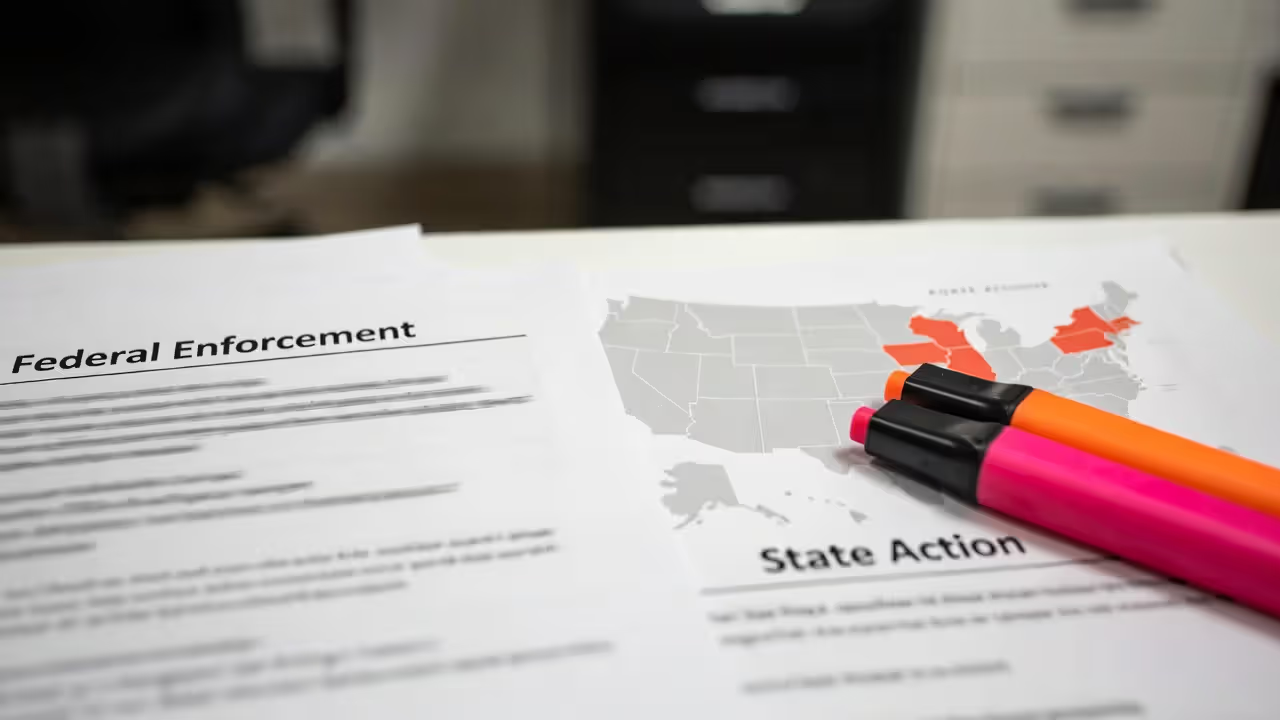
The FTC pursues nationwide patterns affecting millions, while state attorneys general can tackle regional issues or test novel legal theories. This creates complementary enforcement: federal agencies handle massive platforms and cross-border commerce; states address local businesses and emerging issues federal agencies haven't prioritized yet.
Federal vs. State Consumer Protection Focus Comparison
What's Being Enforced
FTC Priority
State AG Priority
Recent Action Examples
Impact on Consumers
Subscription traps, dark patterns
Very High
High
Amazon Prime cancellation, Adobe subscription suit
Simpler cancellation, refunds for unwanted charges
Substantiated environmental claims, less greenwashing
Biometric data collection
Low
Very High (IL, TX, WA)
Facial recognition apps, fingerprint time clocks
Mandatory consent, substantial damages per violation
Federal-state coordination has increased through information-sharing agreements and joint task forces. The National Association of Attorneys General runs working groups on data privacy, antitrust, and consumer fraud that coordinate multi-state investigations and share resources. This collaboration means companies can't escape accountability by arguing state enforcers lack jurisdiction over interstate commerce or that federal law should preempt state regulations.
Author: Michelle Granton;
Source: skeletonkeyorganizing.com
Preemption battles continuously shape consumer protection boundaries. Industries routinely argue federal regulations should block stricter state laws—particularly regarding labeling, advertising, and product safety. Courts generally reject broad preemption arguments for consumer protection, allowing states to maintain higher standards. California's Proposition 65 warnings survived repeated preemption challenges and influenced national product formulations despite industry opposition.
Private rights of action vary dramatically by state. California, New York, and Massachusetts allow consumers to sue directly for violations, with attorney fee provisions incentivizing representation. Texas and Florida restrict most consumer protection enforcement to government agencies. This determines whether class actions can proceed and whether individual consumers can find lawyers for smaller-value claims.
Frequently Asked Questions About Consumer Protection Enforcement
How do I report a company for deceptive advertising?
Start with the FTC's complaint form at ReportFraud.ftc.gov. The process takes roughly five minutes and doesn't require legal knowledge. Include the company's name, specific ad language (screenshots help enormously), dates you encountered the ads, what you bought, and how the actual product or service differed from advertised claims. Also file a complaint with your state attorney general's consumer protection division—most states offer online forms. Save the confirmation numbers from both filings. Individual complaints rarely trigger immediate action, but they create records. When patterns emerge across hundreds of consumers, investigations start. Your complaint might be the one that pushes a pattern over the threshold.
What compensation can I receive from FTC enforcement actions?
Compensation varies based on settlement structure. Some FTC actions provide automatic full refunds to all affected consumers, pulling purchase records directly from the company. Other settlements establish claims processes where you submit proof of purchase within deadlines—usually 60-120 days after the settlement announcement. Check ftc.gov/refunds for active refund programs, eligibility requirements, and claim instructions. Refund amounts range from partial reimbursement (when settlement funds can't cover all victims) to full refunds with interest (in well-funded settlements). The FTC can't award punitive damages or pain-and-suffering compensation—only actual financial losses you can document.
How long does a typical consumer protection investigation take?
FTC investigations average eighteen months to three years from initial complaint analysis through settlement or litigation. Complex cases involving multiple companies, technical products, or untested legal theories stretch beyond four years. State attorney general investigations often move faster—six months to two years—especially for straightforward deceptive advertising cases. Consumers don't typically receive updates during investigations because of confidentiality requirements protecting the investigation's integrity. The first public signal usually arrives when the FTC or state AG announces a settlement or files a lawsuit. Realistically, complaints you file today might not produce visible enforcement until 2026 or later. Patterns affecting many consumers often accelerate these timelines, though.
Can states enforce stricter consumer protection laws than federal agencies?
Absolutely. States routinely maintain standards exceeding federal minimums. State consumer protection statutes typically ban "unfair or deceptive acts or practices" using broader definitions than federal law applies. California requires businesses to honor advertised prices even when marked incorrectly, while federal law provides more exceptions. Illinois' biometric privacy law creates specific consent requirements and private lawsuit rights that federal law doesn't touch. Massachusetts prohibits certain lending practices federal law permits. Federal agencies can't preempt state consumer protection laws unless Congress explicitly authorizes preemption in specific statutes—which happens rarely. When federal and state requirements conflict, companies must comply with whichever is stricter—usually state law.
What should I do if I'm a victim of an unfair business practice?
Document everything immediately. Screenshot advertisements and website terms. Save email confirmations and receipts. Photograph products showing discrepancies from descriptions. Record dates and details of customer service calls or chats. Dispute charges with your credit card company within 60 days if products differ materially from descriptions—federal law provides chargeback rights for billing errors and undelivered goods. File complaints with both the FTC and your state attorney general using the methods described above. Search classaction.org by company name for existing class action lawsuits—you might qualify to join without hiring your own attorney. Consider small claims court for losses under your state's limit (typically $5,000-$10,000) when companies refuse refunds for clear violations. For losses exceeding small claims thresholds, consult a consumer protection attorney. Many offer free initial consultations and work on contingency for strong cases.
Are online purchases from international sellers covered by US consumer protection laws?
Coverage depends on whether sellers target US consumers and maintain sufficient US connections. Foreign companies that advertise in the US, accept US dollars, ship to US addresses, or operate US subsidiaries generally must comply with US consumer protection laws. The FTC has secured settlements from foreign companies operating primarily overseas when they marketed to American consumers. However, enforcement gets complicated—foreign companies might ignore US judgments, and recovering assets internationally faces jurisdictional obstacles. Your payment method significantly affects recovery options. Credit card purchases offer chargeback protections regardless of seller location. Wire transfers and cryptocurrency payments provide minimal recourse. Check whether sellers participate in international consumer protection networks like econsumer.gov, which coordinates cross-border complaint resolution among 40+ countries. Purchases through marketplaces like Amazon or eBay receive platform purchase protection even when individual sellers operate internationally.
Enforcement shows regulators have expanded focus well beyond traditional false advertising. Interface design, algorithmic decision-making, and subtle psychological manipulation all face scrutiny now. Companies can't hide behind technically accurate disclosures buried in terms of service or presented through confusing interfaces anymore.
These enforcement actions create stronger protections and clearer remedies for consumers—but you need to engage actively. Check refund program eligibility. Document problems systematically. File complaints with appropriate agencies. Individual frustrations transform into enforcement priorities when enough consumers report them.
The convergence of federal enforcement, state actions, and increased international cooperation means companies face accountability from multiple directions simultaneously. Businesses prioritizing compliance and transparent communication avoid the substantial penalties and reputation damage enforcement creates. Companies treating consumer protection as an afterthought? Expect continued regulatory attention and costly settlements throughout 2025.
Trademark strategy changed. The USPTO now demands transactional specimens and precise service descriptions, while examination waits lengthened and AI-copied language gets flagged. Courts raised the bar for trade dress proof, shifted confusion analysis (channels and sophistication), and expanded remedies for willful infringement. Expungement petitions surged, making use audits essential.
U.S. privacy litigation accelerated as BIPA biometric claims, CCPA/CPRA statutory damages, tracking-pixel and session replay suits, and dark-pattern enforcement expanded. Learn the most common causes of action, why class certification drives mega-settlements, which industries face the highest risk, and how companies adapt privacy programs to avoid lawsuits.
Federal environmental compliance shifted sharply in 2024: stricter PM2.5 standards, mandatory closed-cycle cooling for major intakes, expanded RCRA pharma waste coverage, tougher oil & gas methane monitoring, and broader TRI chemical reporting. Add stricter state rules and faster enforcement, and missed deadlines can trigger major penalties and shutdown risk.
U.S. cybersecurity regulation shifted fast: SEC 8-K incident disclosure within 4 business days, CISA’s 72-hour reporting proposals, tighter HIPAA timelines, and rapid state-law changes redefining “personal data.” Learn what triggers reporting, how deadlines differ by industry, and where enforcement penalties are rising.
The content on Legal Insights is provided for general informational purposes only. It is intended to offer insights, commentary, and analysis on legal topics and developments, and should not be considered legal advice or a substitute for professional consultation with a qualified attorney.
All information, articles, and materials presented on this website are for general informational purposes only. Laws and regulations may vary by jurisdiction and may change over time. The application of legal principles depends on specific facts and circumstances.
Legal Insights is not responsible for any errors or omissions in the content, or for any actions taken based on the information provided on this website. Users are encouraged to seek independent legal advice tailored to their individual situation before making any legal decisions.